

AI tools changed content creation fast, but tools alone didn’t fix the real problem most teams face: coordination and execution across the workflow.
By 2026, almost every agency, SaaS brand, and content team is “using AI.” Yet output quality is inconsistent, workflows feel fragile, and scaling still hurts. Why? Because most teams stopped at tools instead of building systems.
According to the State of Content Teams 2025 report, 75% of content teams say maintaining quality with AI is their biggest challenge. Whereas, research, planning, and production remain the biggest time sinks.
Agent-based content workflows are the next evolution. They don’t replace human creativity; they remove friction: hand-offs, rework, scattered decisions, and endless revision loops. Instead of prompting tools one by one, teams use specialized AI agents that plan, execute, review, and adapt across the entire content lifecycle.
This blog breaks down what agent-based workflows really are, how they differ from automation, where they save time (and where they don’t), and why most teams misuse them.
Quick Summary
TL;DR: Relying on AI tools alone doesn’t scale content effectively because it can’t handle coordination, context, or workflow dependencies. Teams succeed when agent-based workflows automate repetitive tasks, research, drafting, editing, visuals, and publishing. While humans retain control over strategy, creativity, brand voice, and final approvals. Hybrid workflows reduce bottlenecks, cut revisions, and make scaling content faster and more predictable. #tldr
- Core Components: Topic Assignment → Research Agent → Writer Agent → Editor / Critic Agent → Visual & Publisher Agents → Human QA & Approval → Multi-format Publishing → Performance Feedback & Iteration
- Outcome: Scalable, high-quality content production with fewer bottlenecks, faster turnaround, and human-led strategy, achieved through a structured agent + human workflow.
Build your scalable AI content system today!
What’s the Real Difference Between AI Tools, Automation, and True Agents?
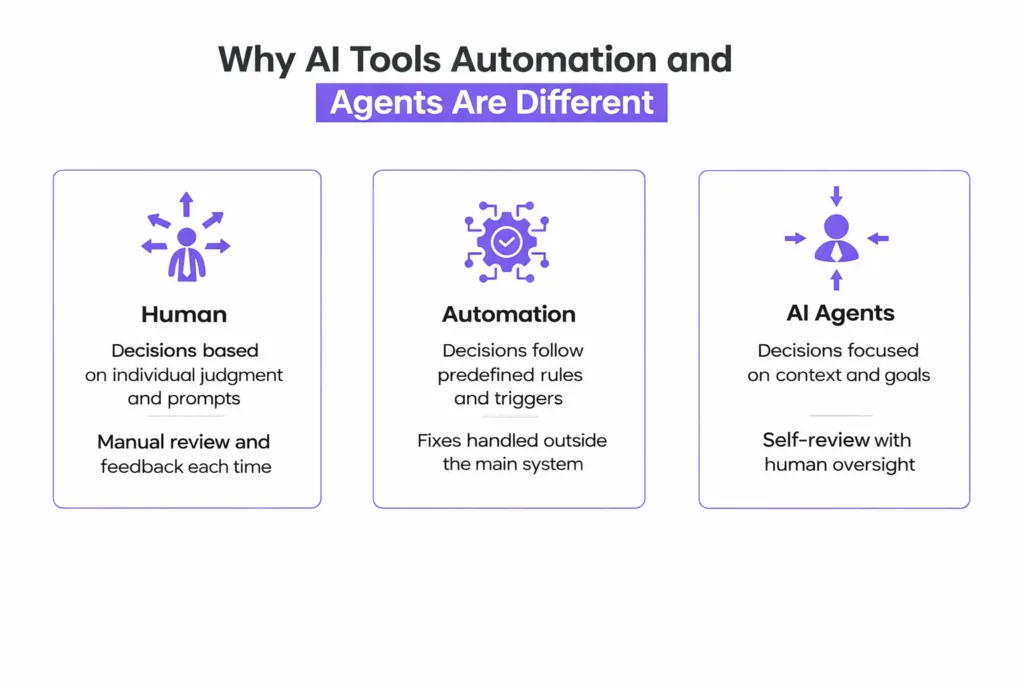
Most teams casually use the terms AI tools, automation, and agents as if they mean the same thing. They don’t. Confusing them leads to broken workflows, unrealistic expectations, and disappointment with AI results.
To build scalable content systems, you need to understand what each layer actually does and where it stops being useful.
AI Tools
AI tools work on demand. You give them an instruction, they return an output, and the responsibility immediately shifts back to you. Tools like ChatGPT, Midjourney, or Claude are excellent at producing drafts, visuals, or rewrites, but they don’t understand the broader workflow.
They don’t remember past decisions, can’t plan, and don’t improve unless you guide them. Think of AI tools as skilled freelancers waiting for exact instructions every time. Useful, but entirely reactive.
Automation
Automation links tasks together. When one action happens, another follows. Tools like Zapier, n8n, or CMS schedulers help move content faster across systems without human involvement. However, automation doesn’t understand why something is happening.
It executes predefined rules without context, judgment, or adaptability. Automation saves time on repetition, but it cannot handle ambiguity or evolving goals.
True AI Agents
AI agents operate at the outcome level. Instead of executing a single task, they work toward a defined goal. Agents observe context, plan multi-step actions, select tools when needed, review their own output, and revise without being prompted.
Unlike tools or AI automation, agents don’t wait for every instruction. They behave like junior operators who understand what success looks like.
Quick Comparison Table
This table shows how AI tools, automation, and true agents differ in capability, decision-making, and ownership across content workflows.
| Capability | AI Tools | Automation | AI Agents |
|---|---|---|---|
| Respond to prompts | Yes | No | Yes |
| Multi-step planning | No | No | Yes |
| Self-review & iteration | No | No | Yes |
| Context awareness | No | Limited | Yes |
| Outcome ownership | No | No | Yes |
From prompts to systems: scale content the right way!
Why Do Teams Still Struggle Despite Using AI Tools?
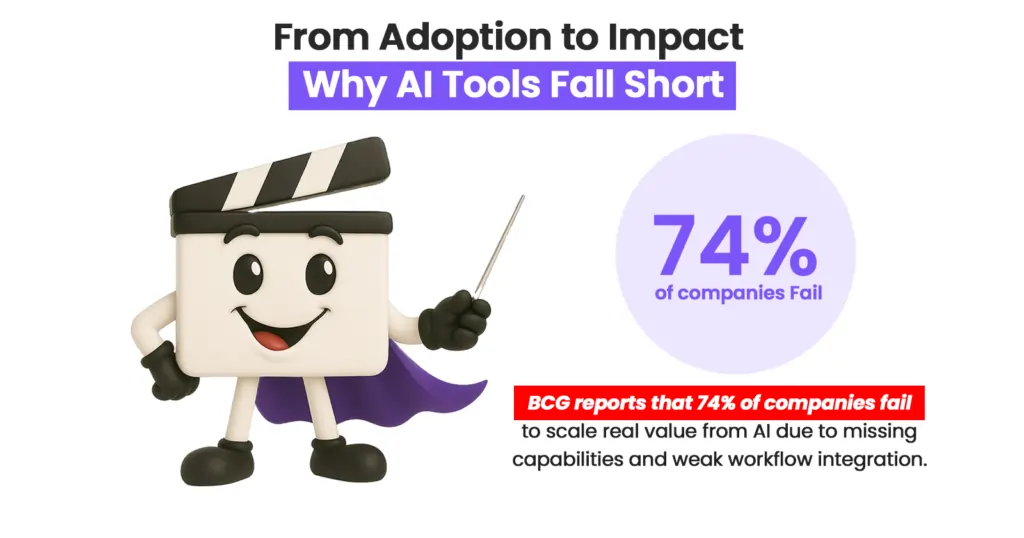
Here’s the uncomfortable truth: AI didn’t remove work but moved it. Teams happily adopted AI tools, but most didn’t rethink how work actually gets done. What looked like a magical productivity booster quickly became another set of tasks to manage.
Instead of reducing workload, AI tools have often added a layer of coordination overhead that teams weren’t prepared for.
According to McKinsey research, 88% of companies now use AI in some function, but only about one-third have scaled it beyond pilots. This means most organizations still struggle to turn AI outputs into real business impact because workflows and hand-offs remain manual and fragmented. (Source: Medium)
In practice, teams still spend significant time on tasks like:
- Rewriting and improving AI drafts
- Fixing tone, brand voice, and accuracy
- Rechecking facts and compliance
- Reformatting for different channels
- Coordinating with teammates and tools
The bottleneck isn’t creativity; it’s hand-offs, context switching, and system mismatches. AI tools generate content, but they don’t own the workflow, don’t understand dependencies, and don’t reduce the manual effort needed to turn outputs into publishable work. This is exactly the gap agent-based workflows are designed to close.
How Agent-Based Workflows Reduce Coordination Cost?
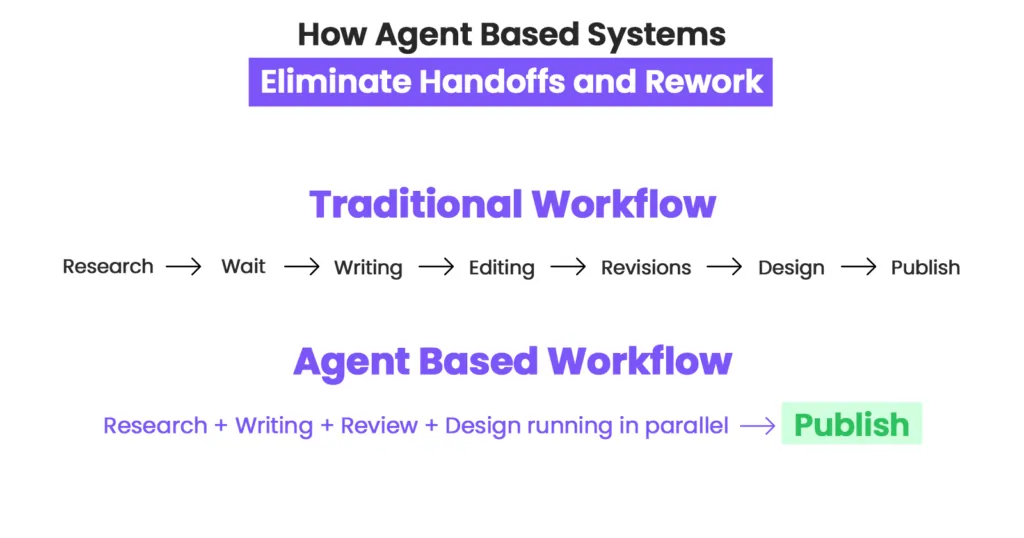
Agents don’t “work harder.” They work around friction, the invisible coordination drag that eats teams’ time. Most content teams still follow a serial workflow where one step waits on another: research, then writing, then editing, then design. Each hand-off creates delay, confusion, and misalignment.
Traditional workflows often break at predictable points:
- Research happens separately from writing
- Editors fix things writers never saw
- Designers guess context after drafts arrive
- Strategists step in too late
Agent-based workflows collapse these silos by running key stages in parallel and reducing dependency on manual coordination. Instead of:
Research → wait → write → wait → edit → fix → redesign
You get:
Research + writing + review running in parallel
Agent architectures can dramatically cut coordination load. For example, organizations that implemented agentic AI orchestration reported a 52% reduction in time spent on routine data labeling and workflow tasks. It makes teams to focus on higher-value work rather than hand-offs and rework.
A simplified view of this effect can be seen in the table below:
| Workflow Stage | Traditional | Agent-Based |
|---|---|---|
| Research | Separate & Serial | Parallel & adaptive |
| Drafting | Waits on research | Begins immediately |
| Editing | Manual hand-off | Integrated review |
| Design | Context gap | Context-aware execution |
| Publishing | Multi step-waits | Streamlined end to end |
What agents actually remove are the hidden costs: endless clarifications, redundant revisions, “Can you tweak this again?”, and manual QA cycles. Creative thinking stays human. Execution becomes systematic and much faster.
What Roles Do AI Agents Play in Modern Content Pipelines?
AI agents aren’t magic; they’re specialized operators designed to handle specific steps of the content workflow. Unlike general-purpose AI tools, each agent focuses on a domain, collaborates with others, and ensures output aligns with strategy, brand voice, and audience needs.
When orchestrated correctly, these agents dramatically reduce friction and speed up content production without compromising quality.
Orchestrator Agent
The orchestrator agent acts like a project manager for AI systems. It defines goals, breaks down projects into smaller tasks, and assigns responsibilities to specialized agents.
For instance, when a team wants a blog on “AI trends for 2026,” the orchestrator decides what research is needed, what sections to write, what visuals to generate, and the sequence of publishing. By maintaining oversight, it ensures no stage is blocked or duplicated.
Research Agent
Research agents collect and validate information. They pull data from credible sources, analyze trends, and flag outdated or low-quality content.
Original research and data‑backed content, especially long‑form, insightful posts earn significantly more backlinks because other sites cite unique insights when linking. Research shows long content with original insights earns up to 77.2% more backlinks than shorter posts. (Backlinko)
Writer Agent
Writer agents focus on drafting content in the brand’s voice. They adhere to structure, SEO rules, and formatting guidelines. While they aren’t creative geniuses, they ensure consistency and speed, producing drafts that can be refined rather than rewritten from scratch.
Editor / Critic Agent
Human editors review content for clarity, conciseness, and brand alignment. They check for:
- Video and audio generated together, saves huge editing time
- Strong realism and adherence to prompts
- Flexible formats for social and widescreen content
This self-reflection loop can cut revision cycles by 30–50%.
Visual & Publisher Agents
Visual agents generate supporting media like blog images, thumbnails, and short clips. Publisher agents handle formatting, CMS uploads, metadata, and social snippets. Both ensure outputs are aligned with content intent, not random prompt creation.
| Agent | Primary Function | Key Benefit |
|---|---|---|
| Orchestrator | Plans and assigns tasks | Reduces bottlenecks |
| Research | Gathers & validates data | Ensures accuracy & freshness |
| Writer | Drafts content | Consistency & speed |
| Editor | Reviews & refines | Cuts revisions & errors |
| Visual | Generates media | Saves design time |
| Publisher | Distributes content | Streamlined deployment |
Example Workflow
Check this workflow example for a better idea:
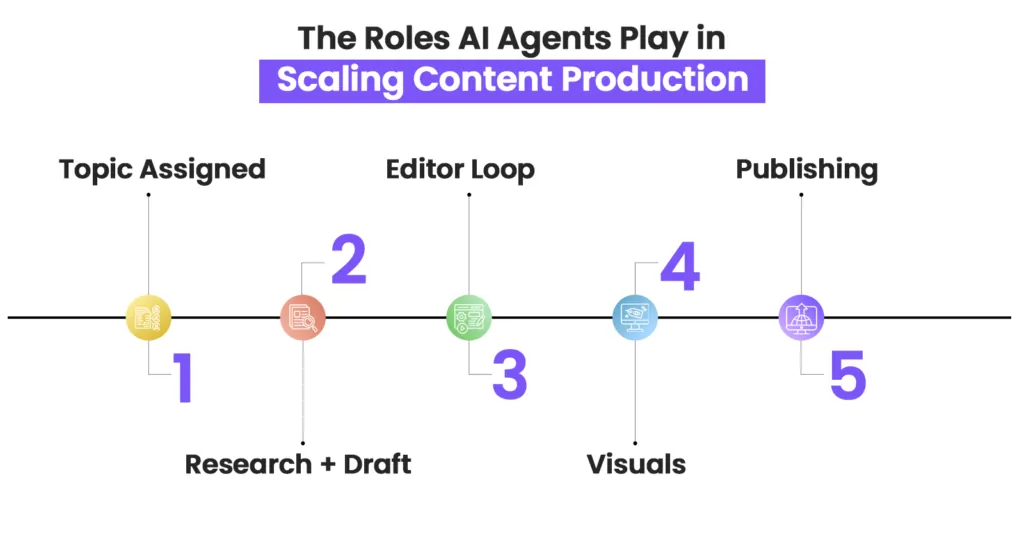
- Topic assigned
- Research + draft happen simultaneously
- Editor agent refines while writing continues
- Visuals generated post-section completion
- Publisher deploys content across platforms
Human intervention is only needed for final approval, letting teams focus on strategy and creativity while agents handle execution.
Where Do Agent-Based Workflows Save Time and Where Don’t They?
Agent-based workflows are often oversold as a magic solution, but the reality is nuanced. They excel at reducing repetitive, coordination-heavy tasks, freeing humans to focus on strategy and creativity. The biggest gains come from parallelizing processes that normally create bottlenecks.
Agents save time on tasks like:
- Research aggregation
- Drafting initial content
- Structural editing
- Repurposing existing material
- Formatting and publishing across channels
Organizations implementing agentic workflows report faster execution for these tasks. Where they don’t save time is strategic decision-making, creative ideation, or sensitive messaging. Agents handle execution, not judgment. Teams still need human oversight for brand positioning, narrative tone, and content that drives high-impact decisions.
How Teams Misuse Agents (Then Blame the Tech)?
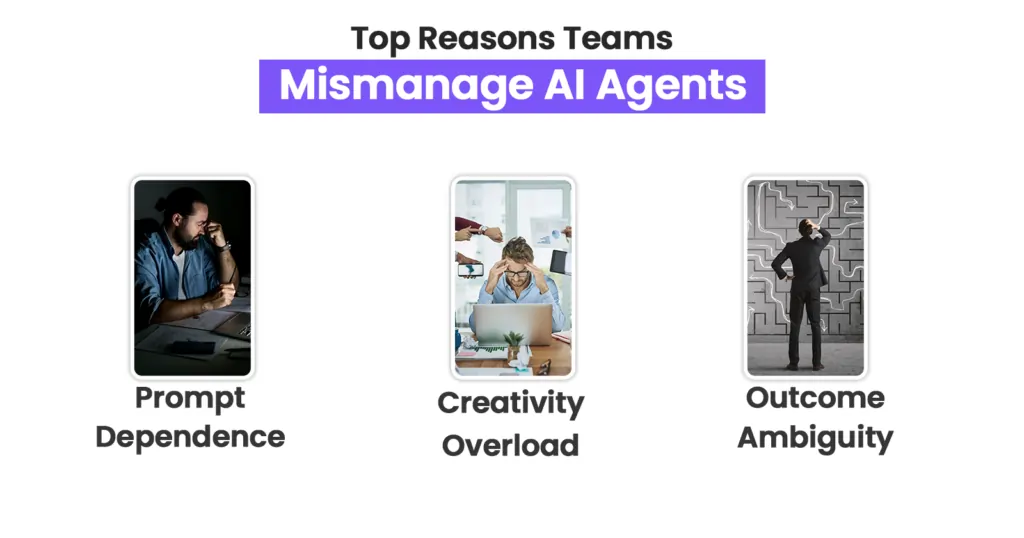
Many teams adopt AI agents and expect instant magic, but the problem is usually workflow design, not technology. Misuse happens in predictable ways:
1. Treating Agents Like Fancy Prompts: If every step still requires manual guidance, you don’t have agents, you have scripts. Agents are meant to own outcomes, not just follow commands. Treating them like advanced prompts wastes their potential and creates frustration.
2. Over-Automating Creativity: Teams often assume agents can replace creative thinking. They can’t. Creativity isn’t the bottleneck, coordination is. Agents shine when they remove repetitive friction, freeing humans to focus on ideas, storytelling, and strategy.
3. No Clear Ownership: Agents need clear outcomes, not vague instructions. For example: “Publish a ranking article that converts” works. “Write 2,000 words” does not. Without outcome-focused directives, agents can produce content, but it won’t align with business goals.
Teams that fail at these points often say, “AI content doesn’t work.” The truth? Their system doesn’t exist yet. The tech can perform only if the workflow and expectations are properly defined.
How Platforms Like ShortVids Fit Into Agent-Based Content Systems
Platforms like ShortVids act as an execution layer within agent-based content systems. By solving common content bottlenecks and smoothing out production workflows that slow teams down.
Most teams face video execution challenges that add coordination overhead, such as inconsistent formats, long turnaround times, and revision chaos that disrupt broader content schedules.
ShortVids‑style systems standardize output, reduce the need for constant human coordination, and help teams scale without sacrificing quality. Instead of piecing together freelancers, internal editors, or siloed tools, ShortVids becomes a dependable production partner inside end‑to‑end workflows that include content planning, creation, and publishing.
Case Study Example: Our client, Reenita Malhotra Hora, used ShortVids to convert raw podcast footage into polished, audience‑ready videos that preserved narrative tone and boosted engagement. It gives her more time to concentrate on producing content while ShortVids handles complex editing, thumbnails, captions, and pacing.
In short, by embedding platforms like ShortVids into agent‑based pipelines, teams keep strategy and creative decisions human‑led.
While execution, AI editing, formatting, and delivery become consistent, rapid, and scalable, reducing friction without replacing creativity.
Your Takeaway!
Agent-based content workflows aren’t about producing more content. They’re about removing friction that slows down good teams. If your workflow still depends on manual prompting and endless coordination, you’re scaling effort, not output. Start with one agent, one system, and one goal. The teams that win won’t use more AI; they just use it better. Take control of your content pipeline & contact ShortVids to handle execution, so your team can focus on strategy and creativity.
Frequently Asked Questions
No. Small teams benefit more because they lack coordination bandwidth.
No. They reduce execution load so humans focus on judgment and strategy.
No. Automation follows rules. Agents reason and adapt.
Yes, it’s possible when humans define constraints and review the final output.
Start by one pipeline, one outcome, and one agent role at a time.
Book a Call Today
- Fixed monthly plans starting at $999
- 24-hour turnaround time (or less) on all short-form edits
- 3-layer quality check system on every video
- No more chasing freelancers or managing editors
- Scale up to 50+ videos/month without hiring in-house
- Content team trained on platform trends, scroll-stopping hooks & storytelling
- Fully managed by professionals – you just upload & approve
- Response time: Under 1 hour (US & GCC time zones)
Cut your production costs, not your standards.