

You hire a freelancer. Things start great. Videos are delivered on time, revisions are smooth, and your content calendar finally feels under control. Then one day… silence. No replies. No updates. Deadlines pass, and your pipeline stalls.
If you’ve ever relied on a Fiverr or Upwork editor, this probably sounds familiar. Freelancers don’t usually quit loudly; they fade out. Holidays, burnout, personal issues, or better-paying gigs quietly pull them away, and suddenly your entire content operation is at risk. This isn’t a talent problem. It’s a reliability problem.
In this article, we break down why freelancers disappear, the real damage it causes, and how structured editing teams like ShortVids eliminate downtime. If consistency, speed, and reliability matter to your content strategy, this guide shows why freelancer-based editing is no longer sustainable.
Quick Summary
TL;DR: Freelancers on Fiverr and Upwork are prone to disappearing due to burnout, multiple clients, or personal issues, creating stalled pipelines, missed deadlines, and inconsistent quality. ShortVids eliminates these risks with backup editors, global team coverage, and dedicated account managers, ensuring consistent output. #tldr
- Core Components: Backup Editors → Global Coverage → Documented Workflows → Account Management → Predictable Turnarounds → Scalable Content
- Outcome: A reliable, scalable video production system that maintains consistent quality, protects posting schedules, and reduces stress for agencies and brands.
Why Do Fiverr and Upwork Editors Disappear Without Warning?
At first glance, hiring a Fiverr or Upwork editor appears to be a smart and affordable choice. But there’s a pattern most agency owners only notice once it’s too late: editors vanish without warning, without notice, and without backup.
This doesn’t usually happen because the editor is bad. It happens because freelancing itself is structurally unstable, especially for recurring, deadline-driven workflows.
When you hire a freelancer from Fiverr, Upwork, or similar gig platforms, you aren’t hiring a system but just one person. That person has:
- One schedule
- One time zone
- One personal life
- One threshold for burnout
- One set of priorities
And when life, workload, or better-paying gigs shift, there’s nothing in place to ensure continuity.
What Actually Happens With Freelancers
Here are the most common reasons an editor suddenly disappears:
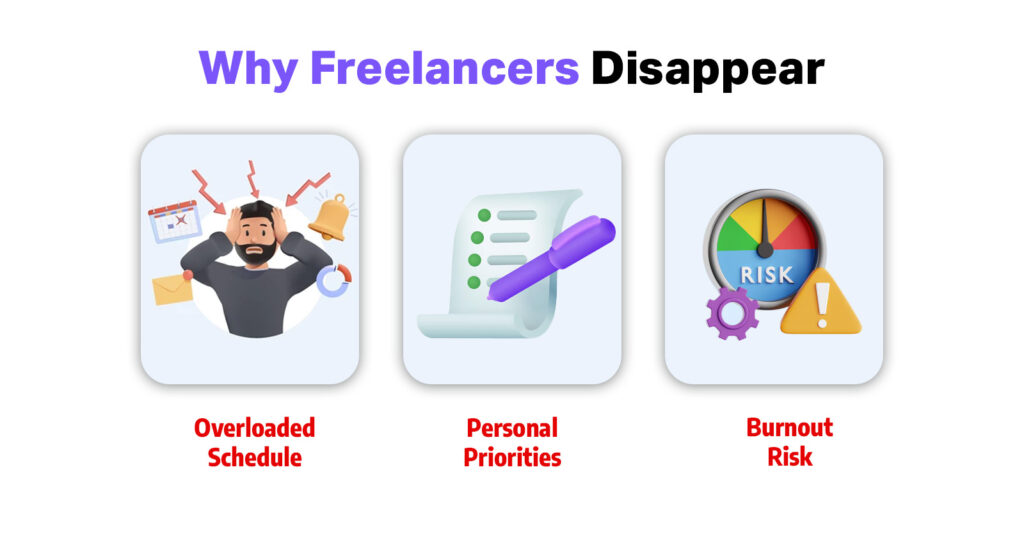
- They take on too many clients and can’t manage all the deadlines
- They burn out from nonstop revisions
- They go on holiday with no coverage
- They fall ill or have a personal emergency
- They find a higher-paying project and quietly shift focus
- They simply stop responding to messages
This isn’t rare, it’s normal. According to Upwork’s Freelance Forward research, full-time freelancers often work with an average of 10 clients over six months, and freelancers overall work with about six clients in that same period. That kind of workload naturally spreads attention thin and increases the likelihood of dropped commitments.
When you’re relying on single-person freelancers to hit your weekly or daily content deadlines, that means your entire content operation hinges on one person always.
Freelancing Reality: Objective Numbers
Below are real, data-backed statistics that explain why freelancer reliability breaks down at scale. These numbers highlight how workload pressure and multi-client juggling lead to missed deadlines and sudden drop-offs.
| Statistic | What It Means |
|---|---|
| 10 clients (average per full-time freelancer in 6 months) | Freelancers divide their time, not focused on one client alone. Upwork |
| 6 clients (average overall) | Even part-time freelancers rarely work with only one client at a time. |
| Up to 15% of marketing gigs face cancellation or disputes | A real share of gigs don’t complete smoothly, highlighting the risk in project-based hiring. |
| 74% of first-time client-freelancer gigs face delays | Frequent delays aren’t unusual especially without structured workflows. Amra and Elma LLC |
These figures paint a more complete picture: freelancers do deliver quality work, but their schedules and commitments are volatile. The more people they serve, the more fragile your deadlines become. And there’s no backup editor, no continuity plan, no coverage team.
In contrast, structured editing partners (like ShortVids) design workflows with reliability built in. Multiple editors, clear documentation, and overlapping team coverage, so one person’s absence never stops your output.
This is the core difference between freelancing hope and professional reliability.
What Is the Real Cost of an Unreliable Video Editor?

Most businesses underestimate the hidden cost when a freelancer quietly disappears. At first glance, a missed delivery might feel like a minor inconvenience, like a delayed post or two. But in practice, an unreliable editor triggers a chain reaction that affects everything from content calendars to audience growth.
Planned campaigns miss their launch windows, which means promotional efforts (and related ad spend) lose momentum. Social algorithms, particularly on platforms like Instagram, TikTok, and YouTube, reward consistency and regular activity.
The consistent posting behavior has been shown to dramatically affect engagement performance: a Buffer analysis of more than 100,000 users found that highly consistent posters (posting weekly for at least 20 out of 26 weeks) received up to 5x more engagement per post than inconsistent accounts.
The impact of an unreliable editor goes far beyond a single missed deadline. Below is a breakdown of how one drop-off can ripple across your entire content operation.
| Area Affected | What Actually Happens |
|---|---|
| Content Calendar | Scheduled posts pause or disappear entirely |
| Campaign Launches | Promotions miss optimal timing |
| Social Reach | Algorithms deprioritize inconsistent accounts |
| Team Productivity | Hours lost to rehiring and re-onboarding |
| Brand Trust | Clients notice delays and inconsistencies |
Why Can’t Freelancers Offer Long-Term Reliability at Scale?
Freelancers are great for one-off projects, but long-term content pipelines demand consistency and coverage. At scale, relying on individuals instead of systems becomes a serious operational risk.
Freelancers Are Built for Projects, Not Ongoing Pipelines
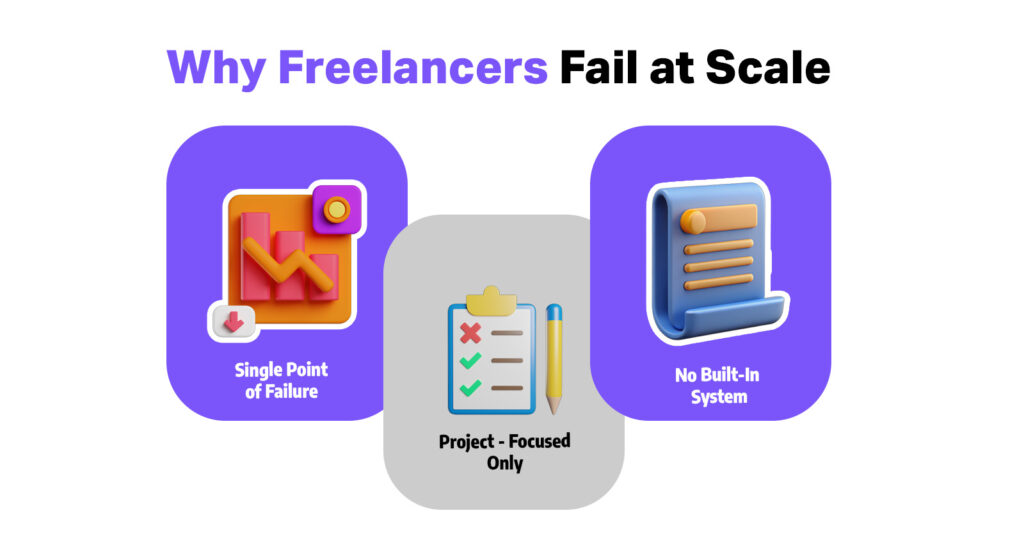
Freelancers work best when the scope is limited and the timeline is short. A single video, a one-off campaign, or a fixed batch of edits fits their operating model. But recurring content pipelines demand something different: continuity, predictability, and the ability to absorb fluctuations in volume. Freelancers aren’t designed for that. When output increases or timelines tighten, there’s no system behind them to catch the overflow.
One Person Means One Point of Failure
When you rely on a freelancer, all responsibility lies with one individual. There are no backup editors, no documented workflows, and no quality control layers to step in if something breaks. If that editor is unavailable for any reason, your entire production flow stops instantly. There’s no handoff, no redundancy, and no safety net.
Why In-House Teams Don’t Solve the Problem Either
Hiring in-house feels like a more stable option, but it introduces a different set of limitations. Recruiting takes weeks, salaries and benefits lock you into high fixed costs, and you’re still dependent on individual availability. If output needs to double, you can’t scale overnight; you have to hire again. The bottleneck simply moves from freelancers to internal capacity.
This is why growing agencies eventually hit a wall. Scaling content isn’t about adding more editors; it’s about editor coverage, continuity, and systems that keep production moving no matter what.
How Does Freelancer Ghosting Kill Content Pipelines?
Freelancer ghosting doesn’t happen all at once; it builds quietly and breaks systems fast. What starts as delayed replies quickly turns into missed deadlines and stalled content pipelines.
It Starts Small, Then Breaks Everything
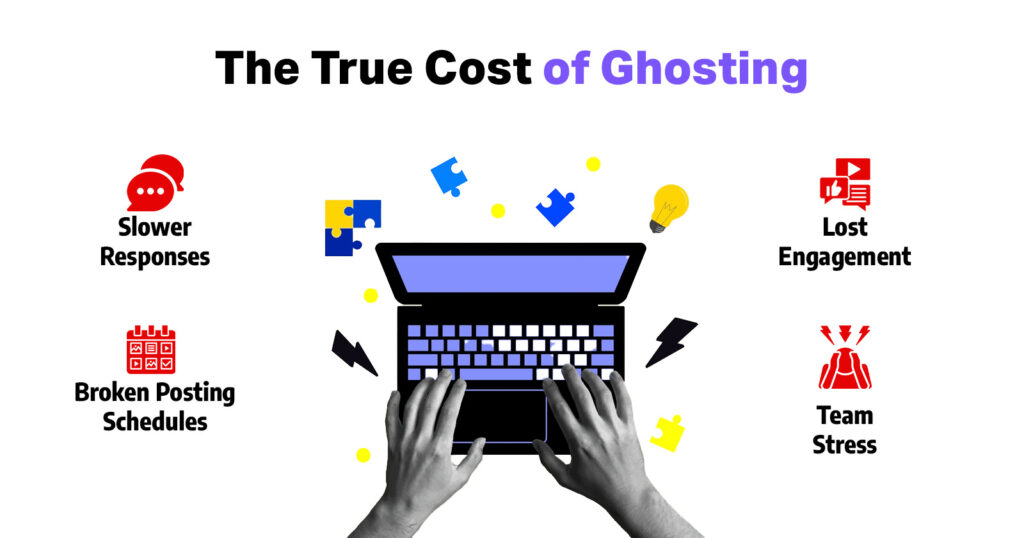
Freelancer ghosting rarely happens overnight. In most cases, the editor starts strong and delivers consistently for the first few weeks. As output increases and revision requests grow, response times slowly stretch.
Messages that once took minutes now take hours, then days. Eventually, replies stop altogether. By the time you realize what’s happening, deadlines have already been missed and your content calendar is in trouble.
Ghosting Forces Teams Into Damage-Control Mode
When an editor disappears, the burden doesn’t vanish with them, it shifts entirely onto your team. Someone has to explain delays to clients, justify missed posting schedules, and manage expectations. Someone has to scramble to find a replacement, onboard them, and hope they can match the existing style fast enough.
That “someone” is always you or your internal team, absorbing the reputational and operational damage every single time.
Inconsistency Breaks Algorithmic Momentum
Content platforms reward consistency, not intent. When uploads pause or become irregular, reach and engagement suffer almost immediately. A stalled pipeline means broken momentum, resulting in videos losing traction, audiences disengaging, and growth slowing down.
Restarting that momentum takes significantly more effort than maintaining it, especially in short-form content environments where frequency matters.
Freelancer Ghosting Is Structural
Freelance relationships often end abruptly because there’s no structural obligation or backup plan built into the model. Editors juggle multiple clients, deal with burnout, or reprioritize work without notice. This is why a significant portion of long-term freelance arrangements fail without formal closure.
When your entire content operation depends on one individual, ghosting exposes a broken system. This is exactly why relying on individuals for recurring content is fundamentally unstable. Pipelines need coverage, continuity, and accountability, not hope.
The Ripple Effect of Freelancer Ghosting on Content Operations
The given breakdown shows how a single editor’s disappearance can quietly disrupt every layer of your content operation.
| Stage of Ghosting | What Happens Behind the Scenes | Business Impact |
|---|---|---|
| Slower Responses | Messages take longer to get replies | Early warning signs are missed |
| Missed Deadlines | Content isn’t delivered on time | Posting schedule breaks |
| Content Gaps | Planned videos aren’t published | Algorithmic reach drops |
| Internal Scramble | Teams rush to find replacements | Productivity loss and stress |
| Client Fallout | Delays need to be explained | Trust and credibility decline |
| Pipeline Restart | New editor onboarding begins | Time and momentum lost |
How Does ShortVids Eliminate Downtime Completely?
ShortVids wasn’t built just to edit videos. It was built to remove reliability risk from content production so agencies and brands never have to worry about stalled pipelines or disappearing editors. When comparing ShortVids vs Freelancers, ShortVids takes the lead in the following aspects:
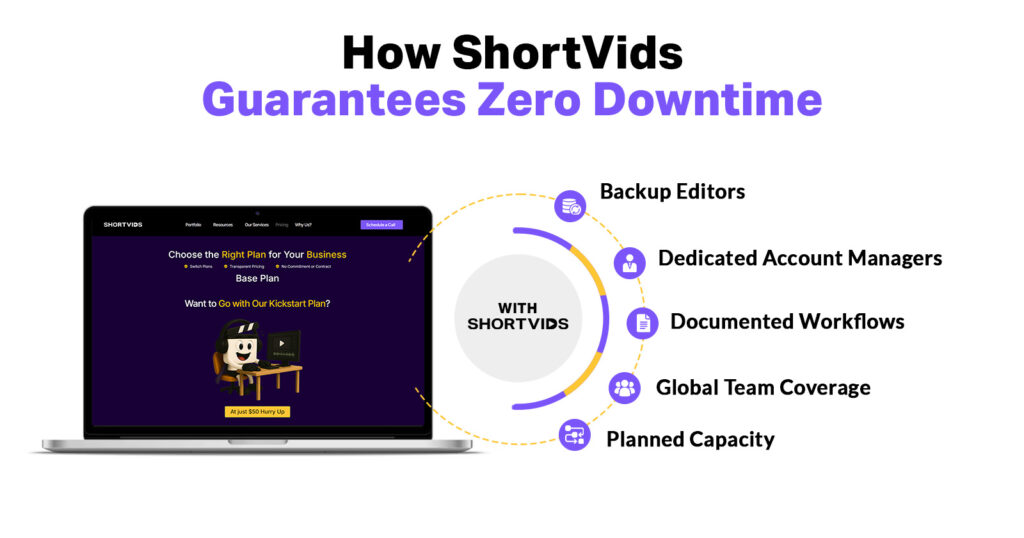
Backup Editors Are Built Into the System
ShortVids never relies on a single editor to keep production moving. Every project has built-in redundancy, so if one editor becomes unavailable, another steps in smoothly. There’s no pause, no reset, and no quality drop. Output continues without you needing to intervene or even notice the switch.
Case Study: Gene Slade’s Success
Gene Slade scaled from 50 to 150+ videos per month with ShortVids. Backup editors, global coverage, and documented workflows kept his pipeline running smoothly, even during holidays or high-volume periods. Posting schedules stayed on track, quality remained consistent, and audience engagement grew. This proves how structured teams eliminate downtime risks freelancers can’t.
Dedicated Account Managers Keep Everything Moving
Instead of managing freelancers, chasing updates, or clarifying timelines, you work with a dedicated account manager. This person oversees delivery, revisions, and priorities, ensuring communication stays clear and deadlines stay intact. You’re no longer the project manager… ShortVids is.
Documented Editing Systems Remove Single-Person Risk
With ShortVids, your brand style, pacing, formats, and preferences are documented and standardized. Nothing lives only in an editor’s head. This means consistency is maintained regardless of who’s working on your content, and onboarding new editors doesn’t disrupt output.
Global Team Coverage Prevents Production Gaps
ShortVids operates with editors across multiple regions, which eliminates downtime caused by holidays, sick days, or time zone gaps. Production continues year-round because availability is distributed, not concentrated in one person or location. Freelancers go on vacation. ShortVids’ content creation team doesn’t stop.
Planned Capacity Ensures Predictable Turnaround
Turnaround times at ShortVids are predictable because capacity is planned. Output isn’t based on how busy one person is; it’s based on a system designed to absorb volume changes without delays.
Why Agencies Switch to ShortVids for Reliable Scaling
Agencies don’t leave freelancers because freelancers are bad. They hire ShortVids because growth exposes reliability gaps that individuals simply can’t cover.
- No More Rehiring Cycles
Freelancers disappear, and the rehiring loop starts again. With ShortVids, editor coverage is built in, so production never resets or stalls. - Posting Schedules Stay Intact
Missed uploads hurt reach and engagement. ShortVids maintains consistent output even as volume increases, protecting momentum across platforms. - Quality Doesn’t Drop During Scale
As freelancers juggle more clients, edits get rushed. ShortVids uses documented systems to keep branding, pacing, and polish consistent at higher volumes. - No Last-Minute Scrambling
Teams stop firefighting, miss deadlines, and start focusing on strategy, client growth, and performance optimization. - Global Coverage Prevents Downtime
With editors across time zones, production continues through holidays, sick days, and peak seasons, something individual freelancers can’t replicate. - Built for Agencies of All Sizes
ShortVids supports agencies managing multiple clients, brands posting daily or weekly, and teams tired of restarting every time an editor disappears.
The result is simple: smoother delivery, lower stress, and scalable output that doesn’t depend on one person showing up.
Your Takeaway!
Freelancers don’t fail because they’re bad; they fail because they’re alone. If your content pipeline stalls when one editor disappears, the problem isn’t talent, it’s the system. ShortVids replaces uncertainty with structured workflows, backup editors, global coverage, and dedicated account management, ensuring zero downtime. Stop risking your content schedule. Build a system that works year-round. Schedule a ShortVids consultation today and secure your content pipeline for good.
Frequently Asked Questions
Most freelancers juggle multiple clients, face burnout, or prioritize higher-paying work. There’s no obligation or backup system when they disappear.
Higher pay reduces risk but doesn’t eliminate single-person dependency. Availability is still fragile.
In-house teams still rely on individuals. ShortVids provides system-level redundancy and coverage.
ShortVids can fully replace or supplement your current setup, ensuring continuity without disruption.
Most teams are onboarded within days, not weeks, without pausing existing output.
Book a Call Today
- Fixed monthly plans starting at $999
- 24-hour turnaround time (or less) on all short-form edits
- 3-layer quality check system on every video
- No more chasing freelancers or managing editors
- Scale up to 50+ videos/month without hiring in-house
- Content team trained on platform trends, scroll-stopping hooks & storytelling
- Fully managed by professionals – you just upload & approve
- Response time: Under 1 hour (US & GCC time zones)
Cut your production costs, not your standards.