

Content creation in 2026 feels wildly different from what we knew just two years ago. Instead of staring at blank documents for hours or paying premium rates for every script and social post, creators and brands now focus on making their content work seamlessly with AI models like ChatGPT and Perplexity.
73% of Brand-Related Queries diverge between traditional SERPs and LLMs, meaning that LLMs “don’t think like Google” and brands optimizing for LLM visibility saw 2.3× higher visibility. LLM Content Creation has basically changed how businesses structure and format their content to maximize AI compatibility. The shift is not about dumbing down your content but rather structuring it strategically so large language models can understand, process, and repurpose it effectively.
Quick Summary
TL;DR: Create LLM-friendly content using clear hierarchies, question-answer formats, concise paragraphs, lists, and schema markup so AI systems can easily understand and cite your material in 2026. ShortVids helps brands structure video scripts and marketing content for maximum AI compatibility without losing authenticity. #tldr
- How to create LLM-friendly content: Clear hierarchies → Question-answer structure → Concise paragraphs → Lists and bullets → Schema markup.
- Process: Plan topics and calendars with LLM content planning, let LLMs draft and repurpose content, keep humans on review and strategy, adapt assets per channel using a clear large language model strategy, and connect everything to business KPIs (time saved, quality, revenue impact).
The Reality Behind LLM-Friendly Content
The reality is that creating LLM-friendly content requires more than just writing clearly. At ShortVids, we have witnessed this transformation firsthand while helping clients optimize their video scripts and marketing materials for AI workflows. You need specific formatting techniques, structural patterns, metadata strategies, and a clear understanding of how large language models interpret information. This roadmap walks you through every step from initial content structuring to final optimization so you can create material that works beautifully for both AI systems and human audiences without sacrificing quality or authenticity.
What Does an LLM-Integrated Content Strategy Actually Look Like?
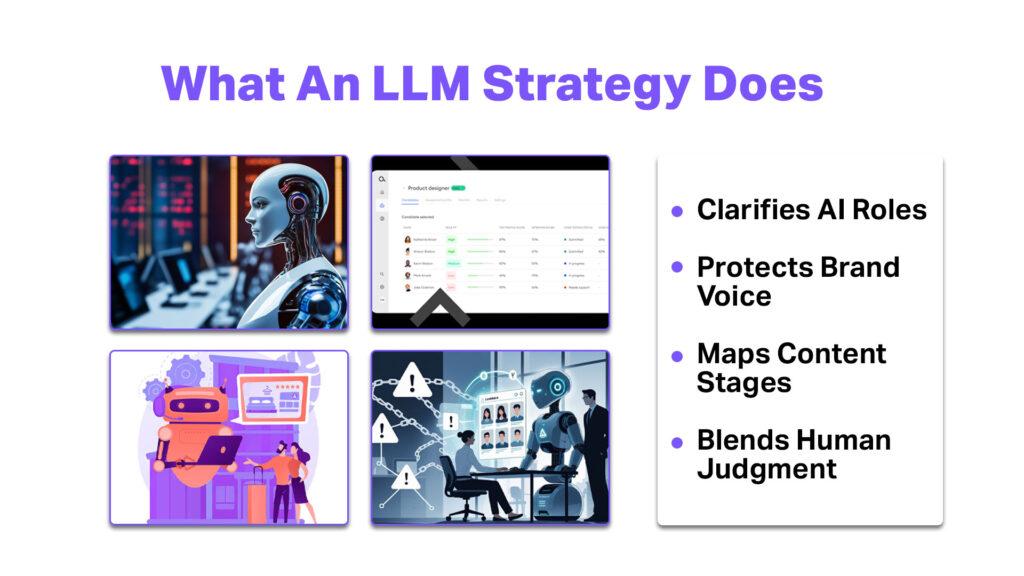
An LLM content strategy identifies specific stages where AI models provide genuine value while preserving the strategic vision and Brand Voice that only humans can deliver through thoughtful content planning and execution.
Strategy Foundations
Your foundation starts with understanding which content formats benefit most from large language model strategy integration. Blog posts, social media captions, video scripts, email sequences, and product descriptions all respond well to LLM content creation assistance. However, highly technical documentation or deeply personal Storytelling pieces usually require more human input from the beginning to maintain authenticity and strategic alignment.
Adore Me (Fashion Brand) uses AI to generate product descriptions, blog concepts, and campaign copy, saving hundreds of hours of manual writing work.
Workflow Integration
Companies report that integrating AI into workflows trims 25–74% off production time by removing research + formatting bottlenecks. Maybe research takes forever, or reformatting content for different platforms drains your team’s energy. Integration happens when you map your existing LLM content planning Workflow and identify bottlenecks that slow production.
These pain points become your priority areas for AI content strategy 2026 implementation because that is where you will see immediate efficiency gains without compromising quality standards. It helps :
- Cut 25–74% production time
- Removing research & formatting bottlenecks
- Speeding up multi-platform content
- Boosting efficiency without losing quality
- Focusing AI on high-impact areas
Quality Guardrails
Quality guardrails are probably the most overlooked aspect of any AI Marketing playbook implementation. Without these checkpoints, you risk publishing generic or inaccurate material that damages audience trust and undermines your content strategy.
39% of marketers feel they don’t know how to safely use AI, which is why Human QA is Required. You need human editors who understand your brand voice, fact-checkers who verify AI-generated claims, and strategists who guarantee that your LLM content creation aligns with business goals.
How Businesses Must Set Goals for Workflows?
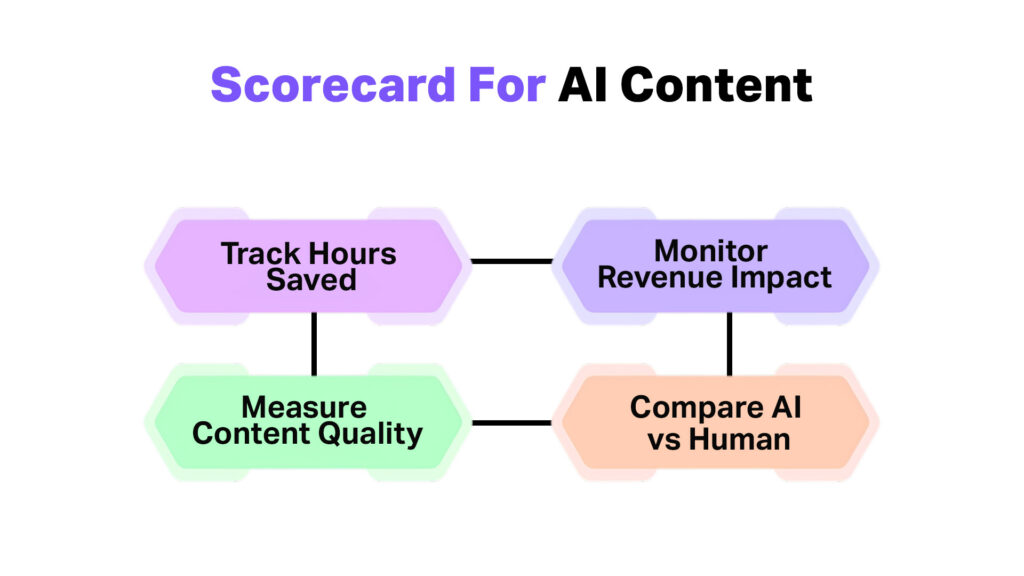
Setting goals for LLM content creation workflows requires evaluating efficiency gains, Quality Consistency, and how well AI-enhanced content performs against your business objectives, rather than just measuring output quantity alone.
Time Efficiency
If your scriptwriter previously spent four hours researching and outlining a single Video Script but now completes the same task in ninety minutes with ChatGPT assistance, that is a meaningful improvement worth documenting for your AI content strategy 2026 optimization efforts.
A case study from Hashmeta AI: an enterprise implemented their LLM-Operations solution and reduced content production costs by 80%. Time efficiency metrics should track hours saved across each LLM content creation stage throughout your production cycle.
Quality Scores
Quality scores need human evaluation combined with Performance Data to assess LLM content creation output effectively. Create rubrics that rate content on brand voice adherence, factual accuracy, engagement potential, and strategic alignment. Then compare these scores between purely human-created content and AI-assisted pieces to identify patterns and areas needing refinement in your large language model strategy prompting processes.
In an academic ad-persuasion test, LLM-generated ads outperformed humans on persuasion: AI ads had a 59.1% preference rate vs 40.9% for human-created ads.
Business Impact
Business impact KPIs connect LLM content planning performance to revenue or growth objectives that matter most. The goal is to prove that your LLM content strategy delivers tangible business value rather than just operational efficiency without meaningful results. Track Metrics like conversion rates, lead generation, audience retention, and customer acquisition costs for content produced with AI marketing playbook assistance.
A B2B company used LLMs for SEO content, generating $5.9 million in revenue over 17 months. They report an average ROI of 6,864× (i.e., for every $1 invested, they get $68 back).
How To Make LLM-Friendly Content?
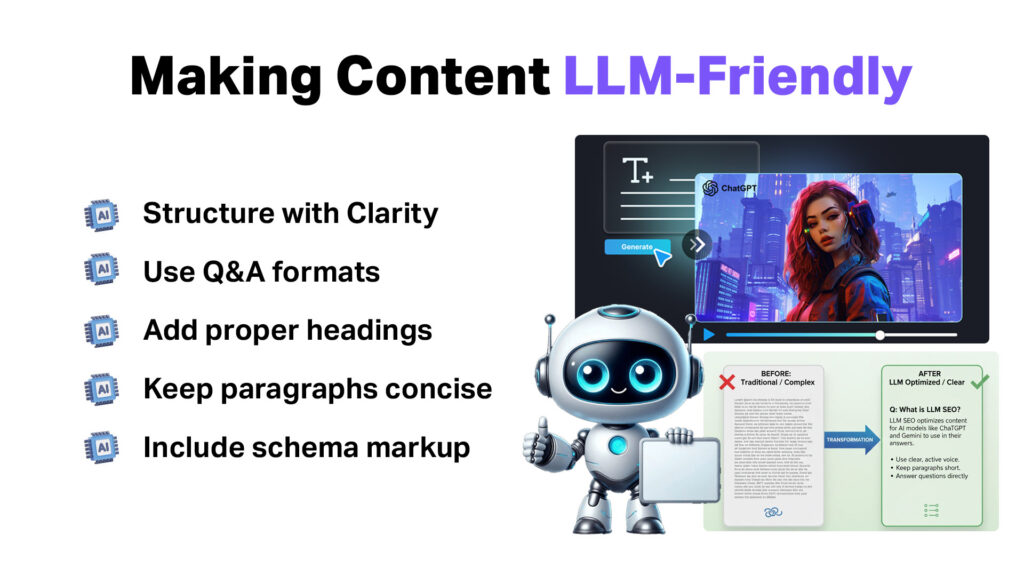
Creating LLM-friendly content means structuring your material so AI models can easily understand, extract, and cite your information when answering user queries through platforms like ChatGPT and Perplexity. LLM content creation requires specific formatting that makes information easily extractable by AI systems. Research shows content with clear questions and direct answers is 40% more likely to be rephrased by AI tools.
Clear Hierarchies
Your heading levels should flow naturally, where each section answers one specific question or explains one concept clearly. Use proper heading structures with H1 for titles, H2 for main topics, and H3 for subtopics to help LLMs extract relevant answers logically. Headings serve as cues for both readers and AI models to understand content structure. Frame your H2 headings as questions like “What are the benefits of Video Editing?” because this mirrors how people actually ask AI assistants for help and improves your LLM content strategy effectiveness.
Question-Answer Structure
Question-answer formatting allows AI to identify specific sections as direct responses to user queries. Start with a direct 40-60-word answer before elaborating because LLM Content Planning models prioritize extractable information over lengthy explanations. Structure each section around clear user-focused questions with concise answers immediately following, then expand with context and examples afterward. This format ensures AI content strategy 2026 systems can quickly parse your content and lift discrete answers for summaries when users ask similar questions.
Concise Paragraphs
Keep paragraphs to three to five sentences, where each makes one clear point without unnecessary complexity or filler words. Following the rule of one block equals one idea, because AI systems cannot extract entities when information is diluted with fluff. Short paragraphs with focused ideas make your large language model strategy more effective because embedding Algorithms require each chunk to have a clear and consistent meaning throughout your content structure.
Lists and Bullets
Lists help break down complex information into digestible chunks that both humans and LLM content creation systems can process efficiently. Use bulleted or numbered lists because LLMs love well-structured lists that can be directly extracted for AI-generated answers. When explaining processes or features, numbered steps work particularly well because they create a logical flow that AI can easily follow and reproduce when answering user questions about your topic area.
Schema Markup
Add Article schema for blog posts and How To schema for instructional content because this metadata signals to AI crawlers what type of information your page contains and how it should be categorized. Apply the FAQ Page schema markup to make content easily extractable by LLMs, with studies showing pages using the FAQ Schema achieve citation rates roughly 2.7 times higher than pages without schema. Schema markup provides structured data that helps AI marketing playbook systems understand relationships between concepts, people, and organizations on your page.
How Can LLMs Help Build and Maintain Content Calendars?
Building Content Calendars with LLM content planning support transforms tedious scheduling into strategic conversations that balance variety with consistency while accounting for seasonal relevance and production capacity limitations.

Calendar Structure
Use your LLM to create monthly themes that tie individual content pieces together, making it easier for audiences to follow your narrative arc. Calendar structure needs to balance consistency with flexibility through smart LLM content strategy planning techniques. For example, a “customer success” theme in March might include case study videos using LLM Content Creation for initial scripting. This is how LLM helps you build your calendar structure:
- Plan monthly themes
- Connect content to a narrative
- Keep consistency with flexibility
- Use LLMs to draft scripts
- Align with seasonal/strategic goals
Resource Allocation
Describe your team’s skills and available time, then get suggestions for which projects need external support, which can be handled internally, and how to sequence production to avoid bottlenecks during high-volume periods with your LLM content planning approach.
Resource allocation becomes clearer when you ask your AI content strategy 2026 tools to estimate Video Production requirements for each piece.
Adaptation Planning
Adaptation planning involves building flexibility into your calendar for responding to unexpected opportunities through your large language model strategy framework. Ask your LLM content creation system, like ChatGPT or Perplexity, to suggest content slots specifically reserved for timely topics, plus backup content you can publish if those opportunities do not materialize through your AI marketing playbook execution.
What Does an Effective Production Workflow Look Like with LLM Assistance?
An effective production workflow with LLM content creation support has clearly defined handoff points between AI drafting and human refinement, where both contribute their unique strengths to the final output.
| Stage | What LLMS Do (AI) | What Humans Do |
|---|---|---|
| Brief & prompt setup | Structure briefs, suggest angles, turn goals into detailed prompts | Define objectives, audience, and positioning |
| First‑draft creation | Generate outlines, scripts, posts, emails, and product copy | Choose the best draft, add brand story and insights |
| Review & refinement | Offer alternative phrasings, tighten structure, propose hooks, and CTAs | Fact‑check, edit for tone, compliance, and strategic fit |
| Repurposing for channels | Convert long‑form into platform‑specific snippets and variations | Approve final versions, select channels, and posting order |
| Publish & optimize | Suggest test variants and updates based on generic best practices | Analyze results, iterate prompts, and workflow for higher ROI |
Drafting Process
63% of marketers say they use generative AI for first-draft creation. The drafting process starts with Detailed Prompts that give your LLM content creation system context about audience, goals, format, and tone. Instead of asking for “a video script about productivity,” you describe your target viewer, their pain points, the specific transformation your content delivers, and examples of your brand voice through your AI content strategy 2026 framework.
Human Review
Your editor verifies every claim, adjusts language to match your authentic voice, and makes sure that the AI Content Creation output actually serves your business objectives rather than just producing generic content that misses strategic targets. 30% of marketers said that the accuracy and factual correctness of AI output is one of their biggest concerns. Human review focuses on three critical areas within your LLM content planning workflow: factual accuracy, brand alignment, and strategic effectiveness.
Repurposing Workflows
Some businesses report that repurposing content with AI saves 50%+ of the time compared to manually rewriting each version. Repurposing workflows leverage large language model strategy capabilities to reformat content for different platforms quickly without starting from scratch.
Take your long-form video script and ask your AI marketing playbook system to create social media teasers, email newsletter segments, and blog post adaptations that maintain consistency while respecting each platform’s unique requirements and audience expectations.
How Should Content Be Adapted Across Channels?
Distribution planning with LLM content creation support means thinking about Platform-Specific Optimization from the content creation stage rather than treating it as an afterthought that slows down publishing schedules.

Platform Requirements
Ask your LLM content creation system to analyze each platform’s best practices, then generate adapted versions of your content that fit those specifications while maintaining brand consistency across channels. This will also help you Autopilot Your Content Creation. Platform requirements go beyond character limits to include ideal content length, visual formatting, captioning needs, and hashtag strategies through your AI content strategy 2026 approach.
Audience Context
Audience context matters because the same person consumes content differently on LinkedIn versus Instagram through their LLM content planning journey. Use large language model strategy tools to help tailor messaging and emphasis for each platform while keeping the underlying story coherent. Your professional audience might want data-driven insights on LinkedIn but behind-the-scenes glimpses on Instagram.
Engagement Optimization
Engagement optimization involves testing different content formats and analyzing what resonates on each platform using your AI marketing playbook framework. While LLM content creation systems cannot run these tests, they can help you rapidly create variations for testing and suggest optimization strategies based on general platform best practices that improve performance over time.
Setting Up Automation for Research-to-Publish Workflows
Automation Setup for LLM content strategy workflows does not require complex technical infrastructure or expensive tools that overwhelm small teams with unnecessary features and complicated interfaces.
Research Pipelines
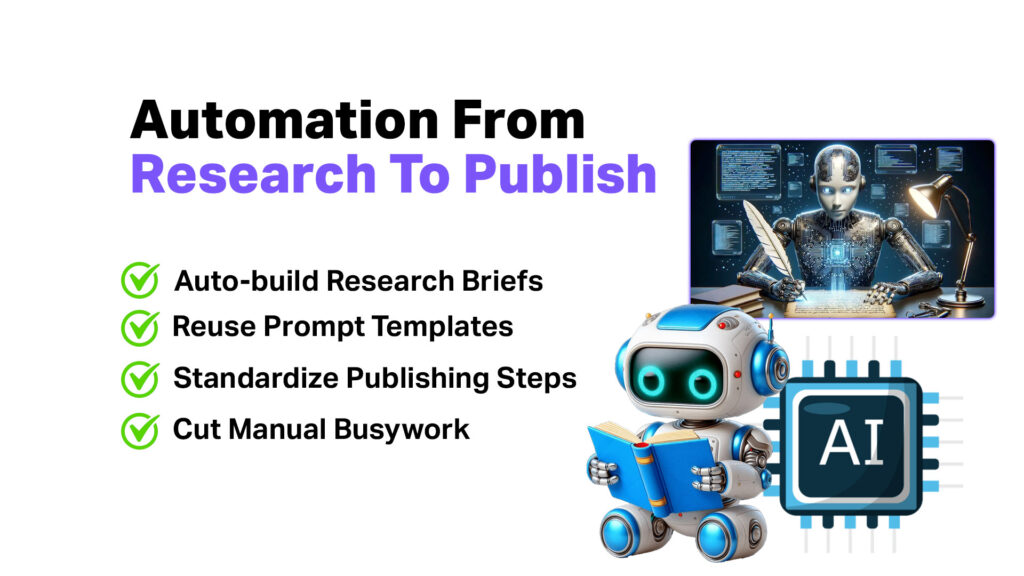
Research pipelines collect information from multiple sources and compile it into organized briefs using AI content strategy 2026 tools. Set up a process where you feed article links, video transcripts, and industry reports to your LLM content planning system with instructions to extract key insights, identify patterns, and highlight actionable takeaways that inform your content direction. There are many ways this can benefit you, like:
- It gathers info from multiple sources quickly
- It organizes insights into clear briefs
- It identifies patterns and trends efficiently
- It highlights actionable takeaways
- It guides smarter content planning
Template Systems
Create prompts that define your structure for video scripts, social captions, or blog outlines using large language model strategy principles, then use these templates consistently to speed up production and simplify quality control processes. Template systems standardize repetitive Content Formats while allowing customization for specific topics through your LLM content creation approach.
Publishing Coordination
Publishing coordination involves creating checklists and schedules that ensure content moves smoothly from final approval to live publication through your AI marketing playbook system. While you might not fully automate posting, having standardized procedures for asset preparation, metadata completion, and scheduling reduces errors. Think of it like a Collaboration Tool that ensures nothing falls through the cracks during high-volume production periods.
Your Takeaway!
Building an LLM content strategy for 2026 means embracing AI as a collaborative tool rather than viewing it as either a complete solution or a threat to creativity. From ideation through distribution, AI handles speed and scale while humans provide strategic direction and authentic voice. The businesses and creators who thrive are those who thoughtfully integrate LLM content creation systems into structured workflows with clear quality checkpoints. At ShortVids, we have seen how this balanced approach transforms content production from a resource drain into a sustainable competitive advantage that delivers consistent value.
Frequently Asked Questions
LLM-friendly content uses clear heading hierarchies, question-answer formats, concise paragraphs, and schema markup so AI systems can easily extract information.
LLM Content Creation cuts research and formatting time, turning briefs into first drafts in minutes and enabling faster multi‑channel publishing with the same or smaller team.
Schema markup provides structured data that helps AI understand your content’s context. The FAQ schema achieves 2.7 times higher citation rates than unmarked pages.
ShortVids uses LLM Content Creation to draft hooks, scripts, and variations, then layers human editors on top, giving brands a fast, on‑brand AI marketing playbook for short‑form video.
Book a Call Today
- Fixed monthly plans starting at $999
- 24-hour turnaround time (or less) on all short-form edits
- 3-layer quality check system on every video
- No more chasing freelancers or managing editors
- Scale up to 50+ videos/month without hiring in-house
- Content team trained on platform trends, scroll-stopping hooks & storytelling
- Fully managed by professionals – you just upload & approve
- Response time: Under 1 hour (US & GCC time zones)
Cut your production costs, not your standards.