

Running Facebook and Instagram ads with a $25 daily budget sounds simple, yet it’s one of the most misunderstood spending levels in digital marketing. Some advertisers dismiss it as too small to matter, while others quietly generate steady leads and sales with it every day. The reality sits somewhere in between.
According to recent advertising benchmarks published by XtendedView, average Facebook ad CPMs typically range from $5 to $18. While the cost per click often falls between $0.60 and $1.40, depending on industry and targeting.
Meanwhile, Meta’s own performance data indicates that well-optimized advertisers often see 2x to 5x return on ad spend, even without large daily budgets. A $25/day budget isn’t a shortcut to fast growth, nor is it wasted money by default. Its effectiveness depends on how Meta’s auction system works, how the learning phase behaves at low spend, and how efficiently your funnel converts clicks into revenue.
This Ads Budget ROI Breakdown educates readers with real benchmarks, ROI math, and practical examples, showing exactly what $25/day can achieve.
Quick Summary
TL;DR: In 2026, a $25/day Instagram or Facebook ads budget can deliver real ROI when used strategically. Success depends on creative quality, funnel efficiency, proper campaign structure, and patient testing. Even modest daily spends can generate actionable data, leads, and conversions when campaigns are optimized for the right objectives and audiences. #tldr
- Core Components: Low-Budget Testing → High-Converting Creatives → Funnel Optimization → Warm Audience Targeting → Data-Driven Decisions
- Outcome: Clear insights into profitable campaigns, measurable conversions on small budgets, optimized ad spend, and a foundation to scale effectively once results prove viable.
Want better ROI from $25/day ads?
$25/Day Ads ROI Calculator (Break-Even CPA & ROAS)
Before running ads, you need to know one thing: what success actually looks like.
This simple $25/day ROI calculator shows whether your campaign can be able to crush ROI before you spend a dollar.
Break-Even Performance Metrics (E-Com + Lead Gen)
| Model | Metric | Formula | Example Inputs | Break-Even | Interpretation |
|---|---|---|---|---|---|
| E-Commerce | Break-Even CPA | Profit per Conversion (AOV × Margin) | AOV: $100 Margin: 40% | $40 | CPA > $40 = Loss CPA < $40 = Profit |
| E-Commerce | Break-Even ROAS | 1 ÷ Gross Margin | Margin: 40% | 2.5x | ROAS > 2.5x = Profit ROAS < 2.5x = Loss |
| Lead Generation | Break-Even CPL | Client Value × Close Rate | Client Value: $500 Close Rate: 20% | $100 | CPL > $100 = Loss CPL < $100 = Profit |
What Does a $25/Day Meta Ads Budget Really Mean in 2026?

A $25/day Meta ads budget equals $750 per month, and that figure is far more meaningful than most advertisers realize. It places you firmly in the testing and validation stage, not in aggressive growth or scaling mode. At this level, the goal isn’t domination, it’s learning what works without risking significant capital.
Meta Platforms does not enforce high minimum spends. Campaigns can technically run on as little as $1/day. However, practical performance tells a different story. When budgets are too fragmented across ad sets or frequently changed, delivery becomes unstable and optimization slows down. That’s why most experienced advertisers treat $25/day as the lowest practical floor for reliable testing.
What Meta’s algorithm actually needs
Meta’s delivery system optimizes based on conversion signals. For most objectives, the platform performs best when it receives:
- Around 50 conversions per week
- Stable budgets for at least 7–14 days
- Minimal structural changes during learning
Hitting 50 weekly conversions with $25/day is realistic only if your cost per conversion is low, your offer converts efficiently, and targeting isn’t overly narrow. This explains why this budget works well for lead generation, local services, and low-ticket offers, but struggles in competitive ecommerce niches.
Exact $25/Day Meta Ads Setup (2026-Proof)
At a $25/day budget, campaign stability matters more than complexity. The highest-performing structure uses a single campaign with one ad set and no more than three to five creatives. This keeps all conversion signals flowing into one learning stream, allowing Meta’s system to optimize faster and avoid diluted delivery.
Daily spend should remain fixed at $25 with no edits for at least seven to fourteen days. Frequent changes reset learning and increase CPMs, especially at low spend. Advantage+ placements should be left on by default, allowing the algorithm to allocate budget dynamically across feeds.
For optimization, lead-based businesses should optimize for leads, while purchase optimization should only be used if sales are already occurring consistently. One signal stream drives faster learning, lower costs, and more reliable ROI.
Rule:
One signal stream → faster learning → lower CPM → better ROI
Budget capability breakdown
The table below shows how different daily budgets perform on Meta, highlighting which spends are best for testing, learning, and scaling campaigns.
| Budget Level | What It’s Best For | Expected Outcome |
|---|---|---|
| $5–$10/day | Basic visibility | Unstable delivery |
| $25/day | Testing offers and creatives | Actionable data |
| $50–$100/day | Faster learning | Scalable signals |
According to the VaizleFacebook Ads Benchmarks report, the average CPC on Meta ads in 2025 was $0.82 globally, with a CTR near 2.46%. While the average ROAS is 2.33x across industries. It shows that even modest budgets can produce actionable performance data when structured correctly.
With careful targeting, creative testing, and steady optimization, a $25/day budget becomes a strategic tool to collect insights, validate offers, and prepare campaigns for scaling in 2026.
Curious how $25/day can perform?
How Does the Ads Budget ROI Breakdown Work?
When evaluating any ad budget, it’s critical to focus on return, not just activity. Impressions and clicks don’t pay bills; conversions and revenue do. For a $25 per day Meta ads budget, understanding what that spend actually delivers helps you set realistic expectations and avoid costly assumptions.
First, let’s look at typical 2025–2026 performance ranges you can expect across major cost metrics. These averages help us break down how far $25/day can stretch in real campaigns.
Core ROI formula
ROI = (Revenue − Ad Spend) ÷ Ad Spend
To understand ROI at $25/day, we need to break down typical Meta costs.
Average Meta benchmarks 2026
The table below shows common cost benchmarks across CPM, CPC, CPL, and CPA, providing baseline expectations for your ads.
| Metric | Typical Range |
|---|---|
| CPM | $8–$15 |
| CPC | $0.50–$1.50 |
| CPL | $5–$25 |
| CPA | $20–$80 |
These numbers vary by industry, region, season, and competition but serve as useful planning benchmarks.
Next, let’s translate those cost ranges into what $25/day actually buys you in terms of measurable outcomes.
What $25/day actually buys you
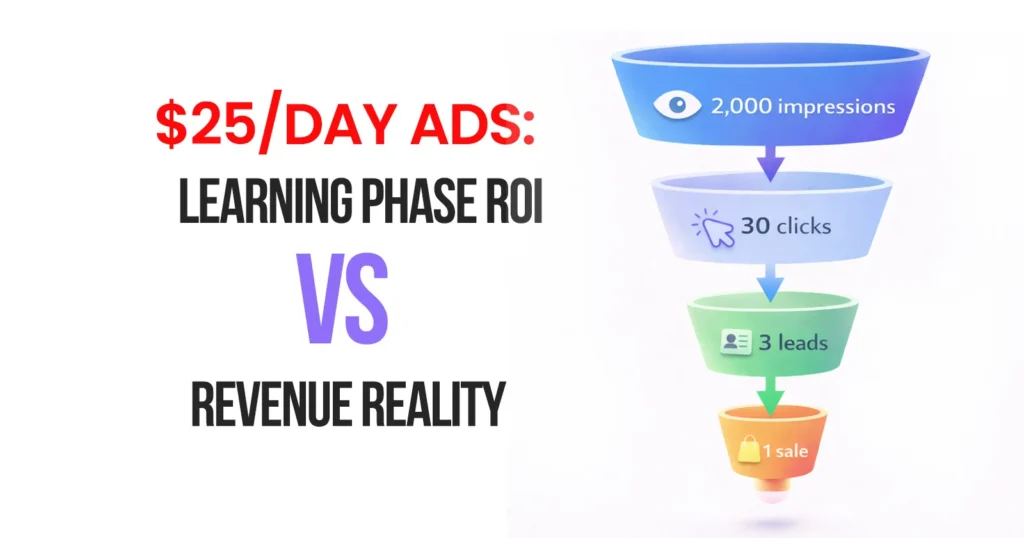
Here’s a realistic projection of outcomes for a $25/day budget, based on the cost ranges above.
| Outcome | Daily Estimate |
|---|---|
| Impressions | 1,500–3,000 |
| Clicks | 15–40 |
| Leads | 1–5 |
| Purchases | 0–1 |
This illustrates why many beginners misinterpret data, $25/day produces meaningful learning data, but limited volume for rapid scaling.
| Every click counts when budgets are tight.
Real‑World Case Study
In a documented Meta ads example, Seltzer Goods achieved a 9.68x return on ad spend and a 785% increase in revenue by refining campaign structure, targeting, and creative optimization. This proves that strong ROI is possible even without massive daily budgets. (Source: goinflow)
Kill, Fix, or Scale? $25/Day Decision Rules
A $25/day campaign should be judged by signals, not hope. After seven to ten days of stable delivery, performance will usually reveal whether the issue lies in creative, funnel, or budget readiness. Acting decisively at this stage prevents wasted spend and speeds up learning.
Kill the campaign if:
- CTR < 0.7%
- CPC > 2× benchmark
- Zero conversions after 500–1,000 impressions
Fix the funnel if:
- CTR > 1.2%
- Clicks present
- No leads or sales
Scale only if:
- CPA below break-even for 7 consecutive days
- Stable delivery
Scaling rule:
Increase budget by 20–30% max, then wait 3–4 days.
Can $25/Day Generate Positive ROI in Real Scenarios?
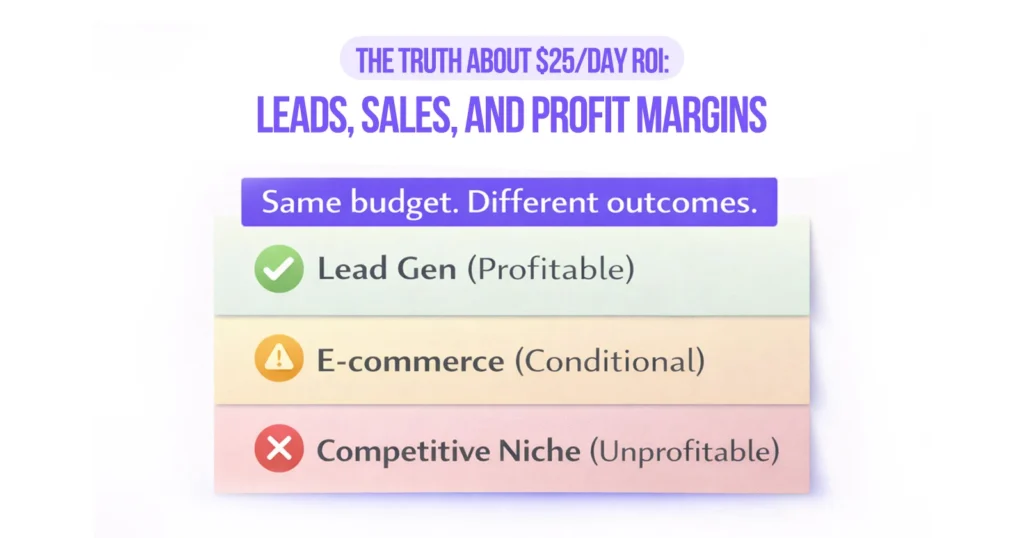
A $25/day Meta ads budget can deliver positive ROI, but it’s highly dependent on campaign structure, industry, and profit margins. It’s not about the raw budget alone; it’s about how efficiently each dollar converts into leads or sales. Small budgets shine in well-targeted, low-competition campaigns, but can struggle when CPAs exceed product margins or conversion rates are low.
Example 1: Lead generation business
- Daily spend: $25
- CPL: $10
- Leads per day: 2–3
- Close rate: 20%
- Client value: $300
Monthly breakdown:
- Spend: $750
- Leads: ~75
- Sales: 15
- Revenue: $4,500
This demonstrates a highly profitable scenario, with ROI driven by strong offer-to-lead alignment. Low CPL campaigns are perfect for service-based businesses like coaching, consulting, or local services.
Example 2: E-commerce Store
- Average order value (AOV): $100
- Gross margin: 40% ($40 profit)
- Required CPA: ≤ $25
If the campaign delivers 1 sale/day at $25 CPA:
- Monthly revenue: $3,000
- Ad spend: $750
- ROAS ≈ 4x
Here, a $25/day budget generates steady profit, proving that small budgets can work in e-commerce if margins and CPA targets are managed carefully.
| Net profit remains healthy after product costs.
Example 3: Competitive Niche Failure
- CPA: $60
- Sales/day: 0.3
- Monthly revenue: ~$900
Even though the budget is modest, high CPAs in competitive industries like finance or high-ticket products make $25/day insufficient. ROI fails not because of the small budget, but because conversion costs exceed profits, emphasizing the importance of targeting, funnel optimization, and market selection.
A $25/day budget can be extremely effective for low-to-mid-ticket products, local services, or lead generation. Its success depends on maintaining a CPA below profit margins, strong targeting, and a compelling offer, rather than the budget alone.
Why Do Most Small Budget Ad Campaigns Fail?
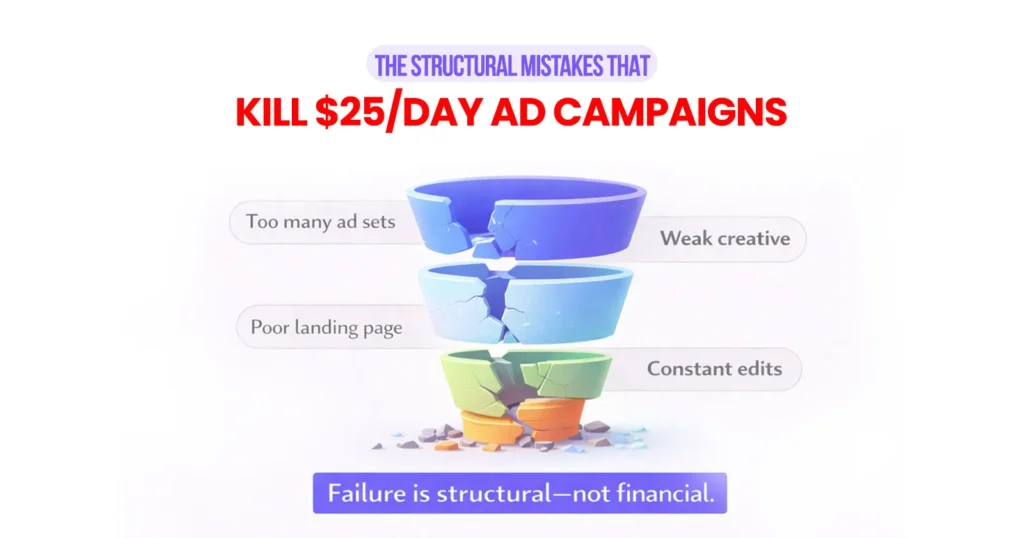
Many advertisers assume a $25/day Meta ad budget is too small to succeed, but in reality, most failures are structural, not financial. Even modest budgets can generate positive ROI if campaigns are set up correctly.
Low-budget campaigns demand clarity, focus, and patience rather than complicated setups or constant tinkering. Understanding where things go wrong helps you avoid costly mistakes and maximize every dollar spent.
Common Reasons Campaigns Lose Money
Before diving into specifics, it’s important to recognize that small daily budgets require streamlined campaigns. Complexity often hurts performance more than a limited spend. At $25/day, the platform’s algorithm struggles to optimize when data is scattered, and small audiences amplify mistakes.
Some frequent missteps include:
- Expecting fast scaling instead of testing: Small budgets need time to gather conversion signals. Trying to scale prematurely leads to wasted spend.
- Running cold traffic only: Without retargeting or warm audiences, conversions remain low, and ROAS suffers.
- Poor landing page conversion: Even strong ads can fail if your landing page does not convert visitors effectively.
- Weak creatives with no hook: Ads must capture attention in the first 3 seconds; static or unengaging content drastically reduces CTR.
- Fragmenting budget across multiple ad sets: Splitting $25/day over 4–5 ad sets dilutes learning and slows optimization.
The Learning Phase Problem
Meta’s learning phase is critical for stable delivery. It resets whenever you make frequent changes, which is especially harmful for small budgets.
- Changing budgets too often
- Editing creatives daily
- Splitting $25 across multiple ad sets
All of these actions prevent the algorithm from gathering sufficient data, resulting in unstable delivery, rising costs, and missed opportunities.
Simplicity and patience are your best friends with $25/day campaigns. Focus on a single well-structured ad set, high-converting creatives, and stable budgets to maximize ROI before scaling.
What Campaign Types Perform Best With a Small Ad Budget?
A $25/day Meta ads budget requires strategic allocation to maximize ROI. Not all campaign objectives perform equally at low spend; some deliver meaningful results, while others struggle to generate traction.
Understanding which campaigns perform best helps small advertisers focus on objectives that produce leads, conversions, and actionable performance data, rather than just chasing impressions or clicks.
Best-Performing Objectives
Even with modest budgets, some campaign objectives consistently outperform others because they use warm intent or lower-funnel conversion paths. These campaigns need less data to optimize and generate measurable results quickly.
- Lead forms: Perfect for local services, coaching, and consultations, where capturing information directly drives revenue.
- Messages: Messenger or WhatsApp campaigns foster quick, one-on-one engagement with prospects.
- Calls: High-value service businesses can turn inquiries into appointments immediately.
- Website traffic for retargeting: Send users to landing pages to build audiences for warm retargeting.
- Warm audience conversions: Targeting past visitors or engaged users maximizes ROAS with minimal spend.
Weak Performers at This Budget
Not every campaign thrives on $25/day. High-competition or broad-targeting campaigns often require more data and budget to succeed.
- Cold ecommerce sales: Small budgets rarely generate sufficient volume without retargeting.
- Broad international targeting: Competes with high-spend advertisers, driving up CPC and lowering ROI.
- High-ticket funnels without nurturing: Expensive offers require multiple touchpoints; low spend can’t sustain the funnel.
Smart Budget Allocation
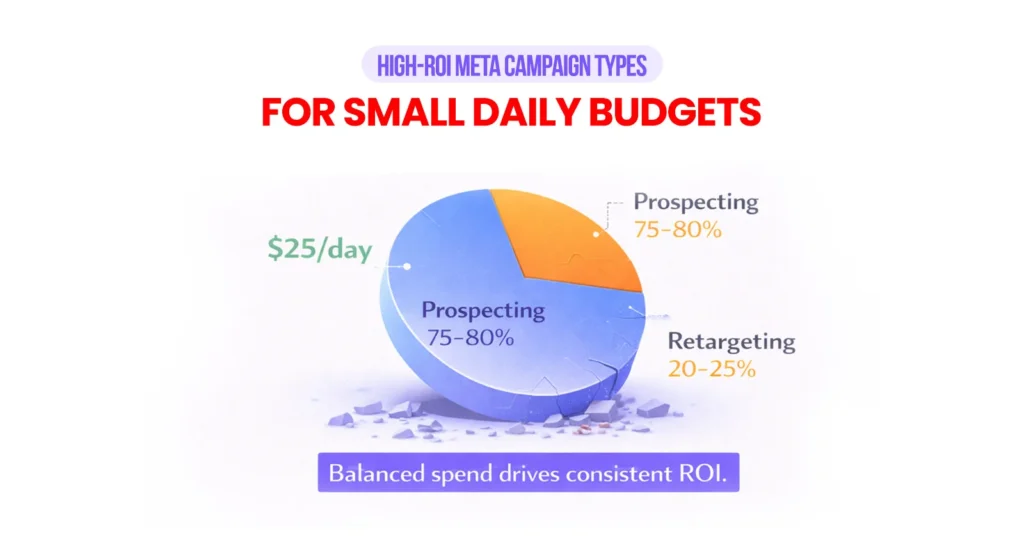
For best results, keep campaigns simple and focused. A modest split between prospecting and retargeting balances acquisition with conversions.
| Campaign Type | Daily Budget |
|---|---|
| Prospecting | $18–$20 |
| Retargeting | $5–$7 |
This structure ensures new users are acquired while warm audiences are captured for higher conversions.
According to the Forbes Technology Council, campaigns optimized for lower-funnel conversion events like lead forms, messages, or calls perform significantly better than broad cold traffic campaigns. So, this highlights that objectives and optimization matter more than budget size.
How Can You Maximize ROI on a Small Meta Ad Budget?
A $25/day budget may seem modest, but it can yield meaningful results if approached strategically. Small budgets require precision and focus, with each decision from creative design to campaign setup directly impacting how efficiently Meta’s algorithm can optimize.
Maximizing ROI isn’t about spending more; it’s about making every dollar work harder through strong creative messaging, proper campaign structure, and careful tracking.
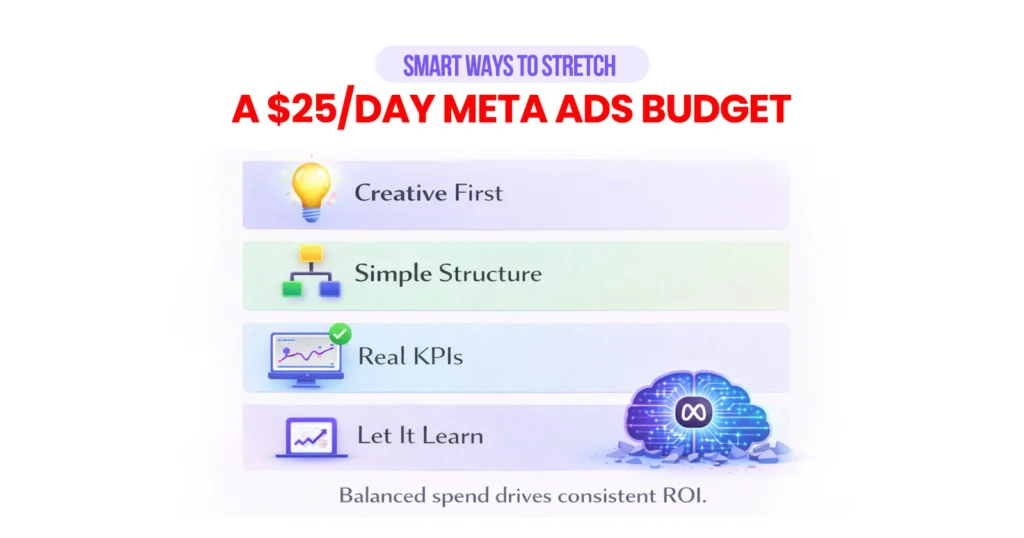
1. Creative Quality Matters More Than Targeting
At low budgets, creatives carry the weight of your campaign’s performance. Even with precise targeting, ads that fail to grab attention or communicate value quickly will underperform. Video creatives consistently outperform static images because they engage users more deeply and keep them watching.
Capturing attention in the first three seconds is essential, whether that’s by highlighting a pain point or showing the desired outcome immediately. Strong creative storytelling converts faster, while weak or generic visuals waste budget without generating actionable performance data.
2. Consolidate Campaigns
Simplicity is key when managing small budgets. Spreading $25 across multiple campaigns or ad sets fragments data, slows algorithmic learning, and increases CPMs. Keeping a single campaign with one ad set and a few creative variations allows Meta to gather consolidated conversion signals, improving ad delivery and optimizing results faster.
Avoid frequent changes or edits, as these reset the learning phase and reduce the efficiency of every dollar spent.
3. Track Real KPIs
Focusing on metrics that actually impact ROI is essential. Instead of chasing likes, comments, or impressions, monitor cost per conversion, ROAS, and lead quality. Understanding the real business outcomes ensures that you optimize campaigns based on meaningful performance rather than vanity statistics.
Tracking the right KPIs allows iterative improvements to creatives, offers, and audience targeting.
4. Let Campaigns Run
Patience is critical for low-budget campaigns. Allowing ads to run steadily for two to four weeks without major interruptions gives Meta’s algorithm time to optimize delivery to the right users. Frequent tweaks or pauses reset learning, reducing efficiency and increasing costs.
By letting campaigns run and collect performance data, small budgets can consistently achieve measurable conversions over time.
| Optimized creatives turn $25/day into actionable data.
Low-Budget Creative Testing Plan ($25/Day)
With limited spend, creative testing must be intentional. A $25/day budget doesn’t allow for broad experimentation, so the focus should be on testing messaging angles that immediately capture attention and signal relevance. At this level, you’re not testing formats or audiences, you’re testing hooks.
Hooks to test:
- Pain-first
- Outcome-first
- Myth-busting
- Before/after
- Direct call-out
14-day approach:
- Week 1: Launch 3–5 creatives, no edits
- Week 2: Kill bottom 1–2, replace with new hooks
Never rotate everything at once.
Is $25/Day Enough for Scaling or Only Testing?
A $25/day budget should primarily be viewed as a testing and validation tool rather than a scaling lever. At this level, advertisers can experiment with different offers, test multiple creative approaches, and gauge how audiences respond to their messaging. It allows you to measure funnel performance, track conversions, and identify which campaigns or ad sets show the most promise.
Essentially, it proves whether your concept is viable before committing larger sums. While $25/day provides valuable data, it is rarely sufficient for aggressive scaling. Once you identify winning creatives, targeting, and messaging, budgets typically need to increase to $50–$100 per day for more stable learning and consistent conversions.
For rapid growth or high-volume campaigns, $150/day or more is often required. Importantly, if the $25/day test is unprofitable, simply increasing spend won’t resolve underlying issues; the offer, funnel, or creative must first be optimized.
Ads Budget ROI Breakdown Table for Quick Decisions
To help advertisers make quick decisions at a glance, this table summarizes how viable a $25/day budget is across different business types. It highlights where small daily spends can deliver meaningful results and where higher budgets are necessary for scaling.
| Business Type | $25/Day Viability |
|---|---|
| Local services | Very strong |
| Coaching | Strong |
| Digital products | Strong |
| E-commerce low ticket | Moderate |
| E-commerce high competition | Weak |
| High-ticket cold traffic | Poor |
How Does Geography Affect $25/Day Ad Performance?
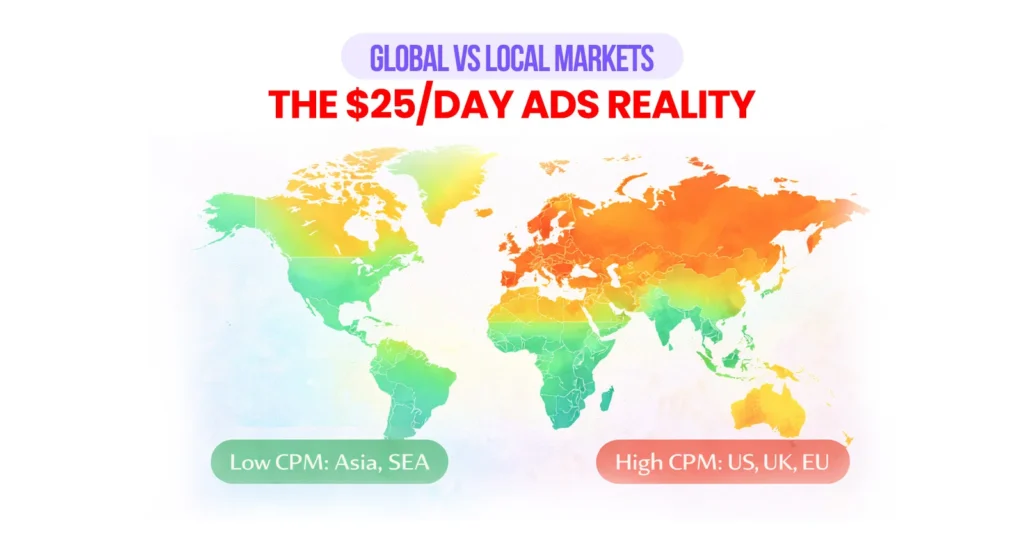
Geography plays a crucial role in determining the effectiveness of a $25/day Meta ads budget. Advertising costs vary significantly by country and city, impacting how far a small daily spend can stretch. For example, targeting markets in Pakistan, India, or Southeast Asia generally results in lower CPMs and cheaper clicks compared to the US, UK, or EU.
This allows advertisers in these regions to generate more impressions and conversion data per dollar. In result, $25/day is sufficient for testing and even small-scale lead generation campaigns.
Smaller local cities also benefit from lower competition, enabling campaigns to reach a larger portion of the audience without overspending. In contrast, campaigns targeting highly competitive Western markets face higher CPMs and CPCs, meaning the same $25/day buys fewer clicks and slower learning. This explains why local businesses and service providers often see better ROI with modest budgets than global brands attempting broad reach at low spend.
Tracking Reality in 2026 (Why Numbers Don’t Always Match)
When running Meta ads, it’s important to remember that Ads Manager provides directional data rather than absolute performance. Metrics often differ from reality due to delayed conversions, cross-device behavior, attribution windows, and privacy limitations. To get an accurate picture, use UTMs on every ad and verify results through GA4 conversion tracking.
By comparing multiple sources, you can identify true performance trends instead of relying on single-day ROAS, which can be misleading. Focus on patterns over time to make informed decisions and optimize campaigns effectively.
What Role Does Funnel Optimization Play in ROI?
Running ads is only part of the equation; real revenue comes from how well your funnel converts traffic into paying customers.
At $25/day:
- Every click must matter
- Every page must load fast
- Every CTA must be clear
Even small improvements can have a dramatic impact, effectively doubling the ROI from 1% to 2% by boosting a conversion rate.
Funnel optimization is often where the majority of ROI gains occur, far outweighing minor tweaks in targeting or ad creative. For small daily budgets, a strong, well-optimized funnel transforms $25/day campaigns from mere tests into actionable growth engines.
How ShortVids Can Maximize Your $25/Day Ads ROI
Running a $25/day Meta ads campaign effectively requires expertise in creative strategy, funnel optimization, and performance analysis, all areas where ShortVids excels. Our team helps businesses’ structure campaigns for maximum learning, design high-performing video creatives that capture attention in the first three seconds and set up retargeting sequences to boost conversions.
By consolidating campaigns, tracking meaningful KPIs, and optimizing ad delivery, ShortVids turns small daily budgets into actionable insights and measurable results. Whether you’re testing lead generation offers, local services, or low-ticket e-commerce products, we ensure every dollar works harder. We’re here to help you identify winning strategies faster and scale confidently once performance data proves the concept.
Case Study Example: One ShortVids client, Gene Slade of Lead Ninja, used strategic video content and targeted Meta ads to scale lead generation. Through consistent creative production and funnel refinement, his campaign began generating 20–30 leads per day. Thus, slowly converting into $10,000–$12,000 in monthly revenue from Facebook ads alone.
Your Takeaway!
A $25/day Meta ads budget won’t make you rich overnight, but it can absolutely build profitable campaigns when used correctly. This Ads Budget ROI Breakdown shows that success depends on margins, funnel efficiency, and realistic expectations. Treat $25/day as a testing engine, not a scaling lever. If you want to turn small budgets into steady growth without guessing, call ShortVids today and get expert guidance on optimizing every dollar of your Meta ad spend.
Frequently Asked Questions
Only if your conversion cost is low, lead gen campaigns exit faster than e-commerce.
Minimum 14 days. Ideally, 30 days for stable data.
Yes. Advantage placements usually outperform manual splits.
Yes. It limits risk while producing usable performance data.
Only after hitting consistent CPA or ROAS targets for 7–10 days.
Book a Call Today
- Fixed monthly plans starting at $999
- 24-hour turnaround time (or less) on all short-form edits
- 3-layer quality check system on every video
- No more chasing freelancers or managing editors
- Scale up to 50+ videos/month without hiring in-house
- Content team trained on platform trends, scroll-stopping hooks & storytelling
- Fully managed by professionals – you just upload & approve
- Response time: Under 1 hour (US & GCC time zones)
Cut your production costs, not your standards.