

Most agencies know the frustration too well: late deliveries, overflowing revision requests, inconsistent tone, and editors burn out from repetitive tasks. Editing at scale is challenging, and while AI is often positioned as the solution, many agencies quickly discover that automation alone doesn’t address quality issues.
It can actually amplify them when used without structure. According to Deloitte’s State of AI in the Enterprise report, nearly three-quarters of organizations see AI as critical to their future. Yet many still struggle to use it effectively, especially in creative workflows. This readiness gap explains why AI-driven editing systems often fail to deliver consistent results at scale.
This disconnect highlights a key reality: AI only works when paired with a human-centric editing pipeline.
In this article, we’ll explain where AI fits best, why editorial judgment must stay human, and how agencies avoid brand drift while scaling. You’ll also see real stats, examples, and proven operational practices throughout.
Quick Summary
TL;DR: Agencies scale content creation most effectively when AI handles repetitive tasks like transcription, rough cuts, and format resizing, while humans control storytelling, brand tone, hooks, and final approval. A structured AI-human workflow reduces bottlenecks, ensures consistency, and maintains quality. Services like ShortVids enable faster delivery, fewer revisions, and higher engagement.
#tldr
- Core Components: Raw Footage → AI Preprocessing → AI Template Resizing → Human Narrative & Hooks → Human Final Review → Multi-format Output → Performance Tracking
- Outcome: Faster, brand-consistent videos with fewer revisions, higher engagement, and preserved creative quality through AI-human collaboration.
What Is AI-Augmented Editing & Why Can’t AI Replace Human Editors?
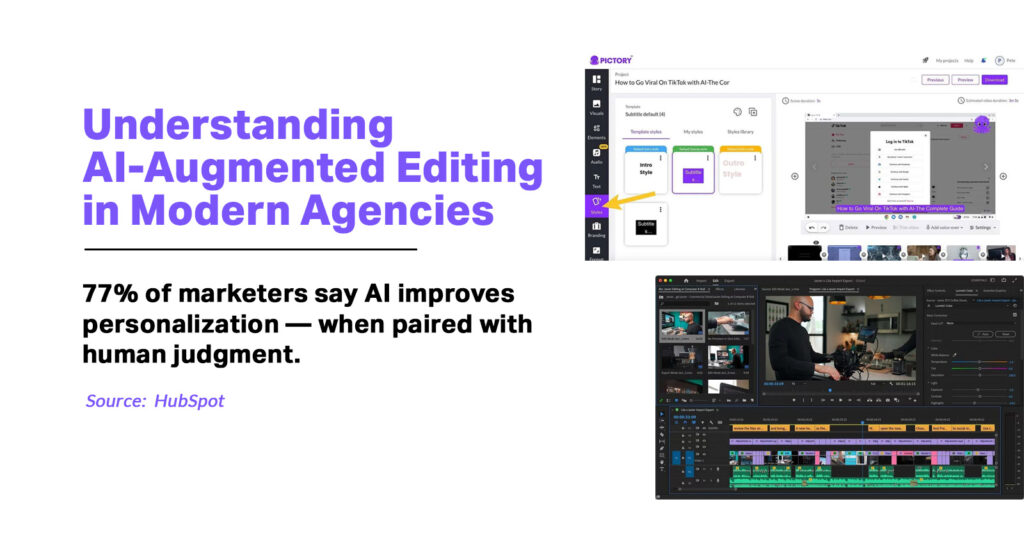
AI-augmented editing is often misunderstood as automation taking over the entire editing process. In reality, it works best as a support system, not a replacement. The goal isn’t to remove editors from the workflow; it’s to remove friction from their work.
When AI handles repetitive, mechanical tasks, human editors can focus on what actually drives results: judgment, storytelling, and brand alignment.
Problems arise when agencies let AI make decisions it’s not equipped to handle. Replacing human judgment with AI may speed up output, but it usually leads to generic pacing, inconsistent tone, and more revision requests. Instead of saving time, teams end up fixing mistakes AI can’t recognize.
The AI vs. Human Role Split
High-performing agencies clearly separate responsibilities to protect quality at scale. Here’s how high-performing agencies divide responsibilities:
| Editing Task | Primary Responsibility |
|---|---|
| Transcription and captions | AI |
| Silence removal and basic pacing | AI |
| Format resizing and versioning | AI |
| Template application | AI |
| Hook selection | Human editors |
| Emotional storytelling | Human editors |
| Brand voice and tone control | Human editors |
| Final review and approval | Human editors |
This division matters because audiences respond better to meaningfully personalized content. According to HubSpot’s 2025 State of Marketing survey, 77% of marketers who use generative AI say it helps them create more personalized content, underscoring the importance of combining AI speed with human judgment.
AI accelerates execution and reduces manual work. Humans still define quality and ensure edits align with brand strategy. Agencies that respect this balance can scale output without sacrificing results.
Where Does AI Fit Best in the Editing Workflow?
AI is powerful, but misplaced AI is one of the biggest reasons quality collapses in high‑volume editing environments. Many teams adopt AI without a clear marketing strategy, assuming it will magically streamline everything. The reality is different: AI performs best when applied to specific stages of the pipeline where routine tasks slow human editors down.
If you try to put AI everywhere, especially in judgment‑heavy stages, you actually introduce errors, context loss, and inconsistent output that the team then has to fix manually.
The smartest agencies use AI for content creation as a frontline engine to speeding up pre‑ and post‑process tasks, while humans remain the backbone of creative and strategic decisions. High‑volume editing workflows that respect this division reduce revision cycles and maintain brand voice, even across hundreds of pieces of content.
A clear division of responsibilities also prevents bottlenecks caused by context loss during handoff points, a common flaw in AI‑heavy pipelines where outputs aren’t reviewed until the final stages.
Where AI Works Best and Where Humans Lead
To clearly see where AI adds the most value and where human expertise is essential, check the table below. It outlines the ideal responsibilities at each stage of the editing workflow.
This helps agencies allocate tasks efficiently while maintaining quality and brand consistency.
| Workflow Stage | Ideal Lead |
|---|---|
| Pre‑processing (raw cleanup, transcribing, tagging) | AI |
| Initial cut assembly | AI |
| Template resizing (formats/versions) | AI |
| Pattern detection (silence, transitions, color balance) | AI |
| Narrative flow decisions | Human editors |
| Brand nuance and tone | Human editors |
| Emotional pacing and storytelling | Human editors |
| Strategic hook placement | Human editors |
| Final review & quality approval | Human editors |
This hybrid model emerges across industries where structured collaboration between machines and humans leads to higher productivity without quality loss. Research consistently shows that AI excels in routine optimization, pattern recognition, and scaling output. But humans still lead where nuance, context, and emotion matter, exactly why editors remain vital even with advanced AI tools. (Webstacks)
Real‑Life Case: Scaling with Human‑AI Workflows
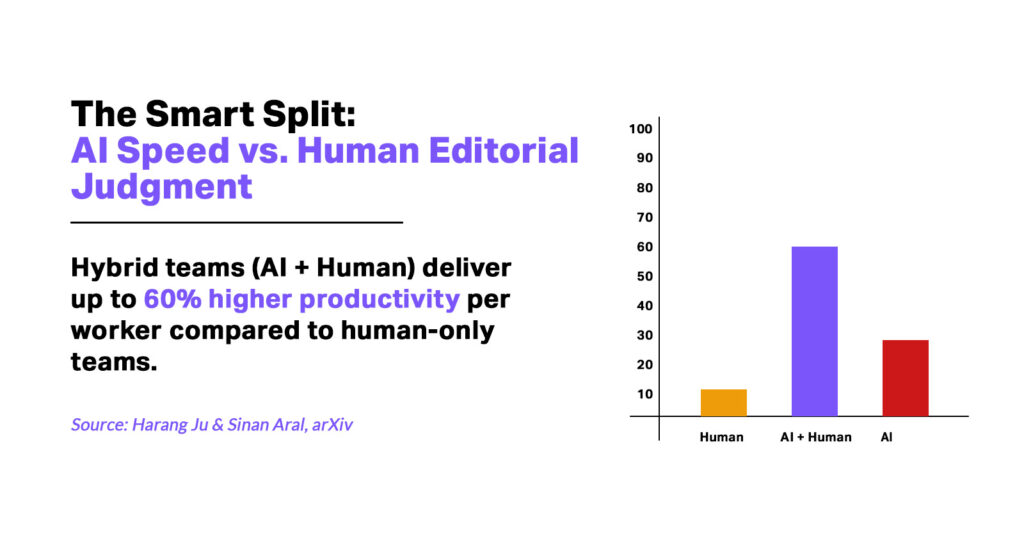
Research shows hybrid human‑AI teams can achieve up to 60% higher productivity than human-only teams, automating repetitive tasks while preserving creative quality. Thoughtful AI integration allows agencies to scale output efficiently without sacrificing brand impact or engagement.
How Do Teams Prevent Brand Drift Across Hundreds (or Thousands) of Edits?
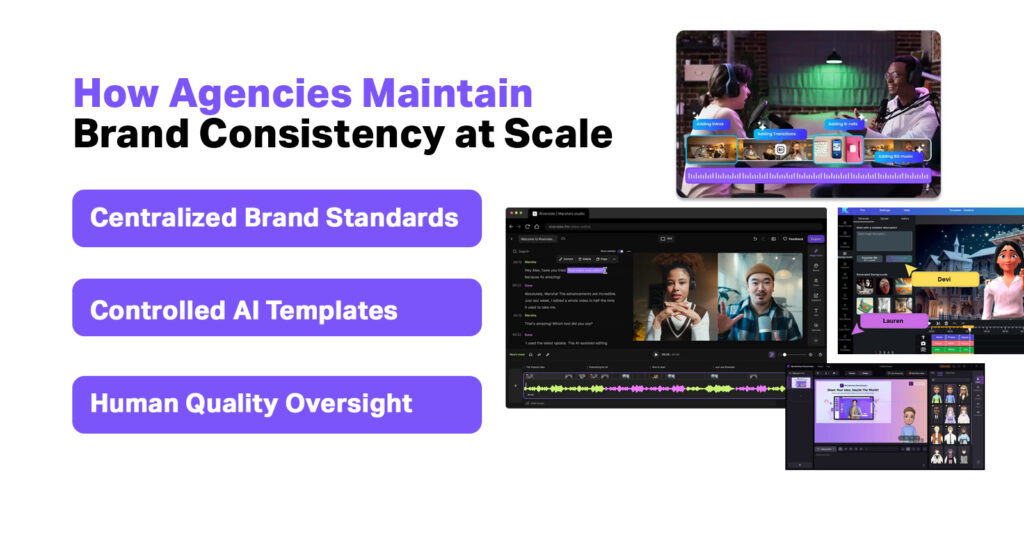
When agencies scale to producing hundreds of videos per month, maintaining a consistent brand voice becomes a major challenge. Brand drift, small inconsistencies in tone, visuals, or messaging can accumulate quickly, reducing engagement and eroding trust.
Even with AI in the workflow, teams often see mismatched captions, uneven pacing, or subtle shifts in style across multiple edits. Preventing this requires a combination of clear systems, centralized guidance, and human oversight at every stage of the editing pipeline.
Best Practices to Stop Brand Drift
Implementing structured processes helps teams maintain brand consistency across hundreds of edits. The following best practices show how agencies combine AI and human oversight to prevent drift and protect quality.
1. Centralized Brand Playbooks
Create a single source of truth that every editor, human or AI follows, covering:
- Tone and language
- Caption styles and formatting
- Cutting rhythm and pacing
- Call-to-action guidelines
2. Locked Templates with Guardrails
AI can handle repetitive formatting, but templates should enforce:
- Approved fonts and spacing
- Visual style consistency
- Fixed pacing ranges for different platforms
3. Version Control Systems
Track every change systematically to ensure no edits are lost or applied inconsistently.
4. Continuous Feedback Loops
Instead of reacting to mistakes after publishing, implement rapid check-ins at each stage to catch inconsistencies early.
When these practices are combined with AI-powered efficiency, teams can scale output without compromising quality or brand integrity.
Are There Real Bottlenecks Even With AI-Augmented Editing?
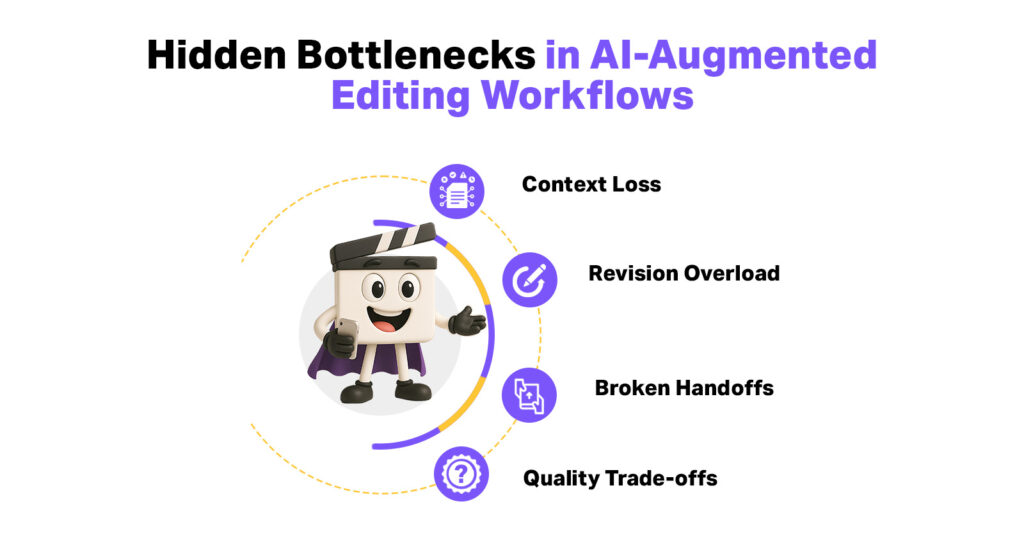
AI accelerates repetitive tasks and can handle high volumes of content, but it doesn’t eliminate all workflow challenges. Agencies often assume that automation alone will solve content scaling problems, only to find that hidden bottlenecks persist, particularly in high-volume or multi-format workflows.
Understanding these common pain points is key to designing effective AI-augmented editing pipelines that maintain both speed and quality.
Context Loss Between Stages
AI can trim silences, assemble rough cuts, and segment footage automatically. However, it often loses the context of why certain scenes or moments matter to the narrative. Without this context, downstream edits can feel disconnected. The solution is simple: add editor notes, intent tags, and brief handoff summaries at each stage so human editors know the “why,” not just the “what.”
Revision Overload
AI encourages multiple iterations, which can be productive, but unlimited revisions overwhelm teams and reduce efficiency. Agencies should implement clear revision limits and checkpoint stages to prevent unnecessary cycles while preserving creative control.
Handoff Failures and Duplicate Effort
Different AI tools or platforms often break communication, causing redundant work. Standardized naming, shared workspaces, and AI-generated variants reviewed by humans help avoid duplicated effort while ensuring brand consistency.
Brand Quality Trade-Offs
AI selects patterns, not intent. Humans must approve final edits to protect tone, pacing, and messaging. Balancing AI speed with human judgment ensures that content scales without sacrificing quality.
What High-Performance Agencies Are Doing Differently
Top agencies understand that scaling content is about amplifying human creativity with intelligent AI automation. By combining AI’s speed in handling repetitive tasks with human judgment for storytelling, brand tone, and emotional impact, these agencies produce high-quality content faster, maintain consistency, and reduce unnecessary revision cycles.
This hybrid approach ensures that quality and efficiency grow together, not at the expense of one another.
Comparing Traditional vs. AI-Augmented Editing
The table below highlights how AI-augmented workflows differ from traditional editing approaches.
It shows where automation accelerates tasks and where humans maintain control to protect quality and brand voice.
| Feature | Traditional Editing | AI-Augmented Editing |
|---|---|---|
| Turnaround Time | Slow (manual) | Rapid (AI + human) |
| Revision Cycles | Many, inconsistent | Fewer, intentional |
| Brand Consistency | Hard | Easier with templates |
| Multi-format Output | Manual | Automated + human review |
| Emotional Editing | Human only | Human-driven |
| Repetitive Tasks | Manual | Automated |
The agencies winning today don’t eliminate editors, but they empower them with AI to scale efficiently while preserving quality.
How AI Reduces Labor But Preserves Editorial Judgment
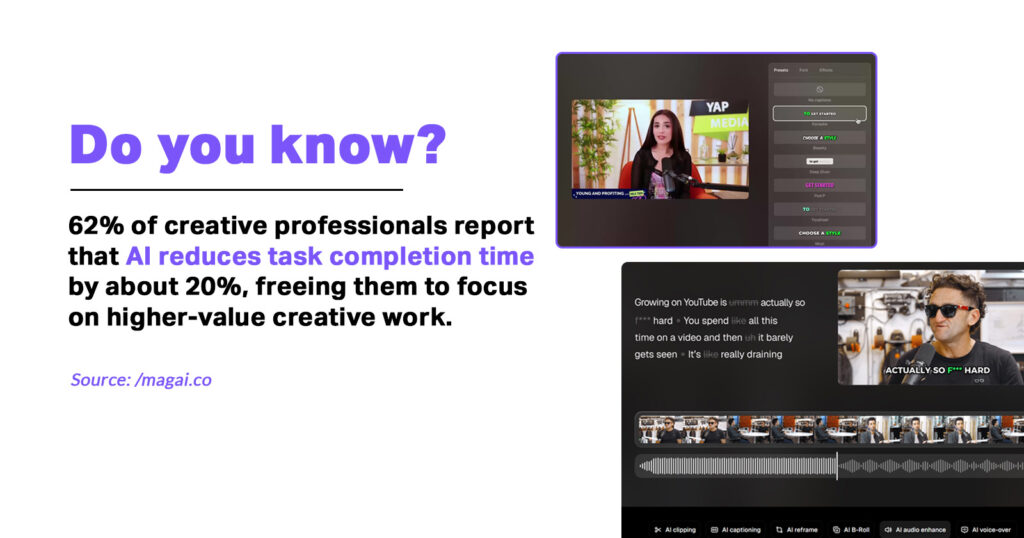
AI excels at automating repetitive, time-consuming tasks, trimming silences, generating rough cuts, resizing formats, or applying templates. But it struggles with judgment, nuance, and creative decision-making.
This distinction is critical: while AI can drastically reduce labor, it cannot replace the human touch that ensures content aligns with brand identity and resonates emotionally with audiences.
According to Gartner, at least 30% of generative AI projects are expected to be abandoned after proof of concept by the end of 2025. It often happens due to content creation challenges like poor data quality, escalating costs, and unclear business value. Thus, underscoring the importance of human governance and strategy in AI workflows.
The best agencies:
- Deploy AI at scale only under human supervision
- Treat AI as a support tool, not a decision maker
- Ensure humans’ own brand strategy, storytelling, and final approvals
In this way, AI accelerates production while humans safeguard quality, consistency, and audience impact.
How ShortVids Helps Agencies Implement Smart AI-Augmented Editing
Many agencies come to ShortVids because they need scalable editing without ballooning costs or inconsistent results. Traditional editing solutions often require hiring more staff, juggling freelancers, or investing in fragmented tools.
ShortVids flips that model by offering a hybrid system where AI accelerates repetitive tasks with AI automation tools and human editors control creative decisions, brand voice, and quality. This combination allows agencies to hit deadlines, maintain consistency, and deliver polished content without micromanaging every cut.
ShortVids’ hybrid workflow starts with AI processing raw footage, handling tasks like transcription, rough assemblies, and format versions. Skilled human editors then shape narrative flow, hooks, pacing, and brand tone.
Templates and style guides are applied to preserve uniformity, and final quality checks ensure audience‑ready delivery. This approach significantly reduces revision cycles and increases client satisfaction.
Case Study: SuperDupe is an AI content firm that struggled to convert AI‑generated videos into engaging, polished outputs. After partnering with ShortVids, they began producing 40–50 high‑quality, brand‑ready videos per month, complete with thumbnails and human‑driven edits that improved engagement and client satisfaction.
Your Takeaway!
AI-augmented editing isn’t a silver bullet, but when applied thoughtfully, it automates repetitive tasks while keeping human judgment at the core. Agencies that switch video editing with clear role splits, robust templates, and smart handoffs can scale content efficiently without sacrificing quality. For faster, consistent, and brand-aligned edits, partner with ShortVids today and transform your editing pipeline with AI-powered efficiency and human creativity combined.
Frequently Asked Questions
Yes, but only if agencies maintain human creative control. AI alone won’t protect brand quality.
No. AI lacks judgment, audience awareness, and brand memory; that is why it can’t completely replace humans.
Yes. Agencies report 20–40% cost savings by reducing manual labor hours.
We use AI to handle preprocessing and scaling tasks and human editors to control hooks, pacing, and final delivery.
It occurs only when it replaces judgment. When AI is used correctly, engagement improves.
Book a Call Today
- Fixed monthly plans starting at $999
- 24-hour turnaround time (or less) on all short-form edits
- 3-layer quality check system on every video
- No more chasing freelancers or managing editors
- Scale up to 50+ videos/month without hiring in-house
- Content team trained on platform trends, scroll-stopping hooks & storytelling
- Fully managed by professionals – you just upload & approve
- Response time: Under 1 hour (US & GCC time zones)
Cut your production costs, not your standards.