


AI content is everywhere, but creating it responsibly is where most brands fail. In 2026, ignoring ethical considerations in LLM content creation can harm your credibility, SEO, marketing, and audience trust.
This guide explores essential LLM content creation considerations, including bias prevention, transparency, fact-checking, plagiarism safeguards, and privacy protection. You’ll learn how to spot bias, fact-check like a pro, protect privacy, and steer clear of plagiarism.
All this, while still creating content that’s fast, smart, and genuinely useful. Think of it as your roadmap to AI content done the right way.
Quick Summary
TL;DR: Create ethical LLM content by combining AI efficiency with human oversight. Focus on bias mitigation, fact-checking, privacy, originality, and transparency. Use structured workflows that define purpose, refine prompts, review outputs, and validate with experts. #tldr
- Core Components:
Purpose → Prompting → Review → Fact-check → Humanize → Approval
- Process (6 steps): Research → Draft → Bias Check → Fact-Check → Humanize → Final Approval
- Outcome: Scalable, trustworthy AI-assisted content that protects brand credibility, reduces risk, and drives engagement.
What is LLM Content Creation and What Role Does Ethics Play?
LLM content creation refers to using large language models like ChatGPT, Claude, or GPT-4/5 to produce content, email copy, or even marketing strategies. These AI tools help brands, agencies, and creators scale content rapidly. But they also introduce ethical risks that can impact credibility, legal compliance, and audience trust.
Role of Ethics in AI Content
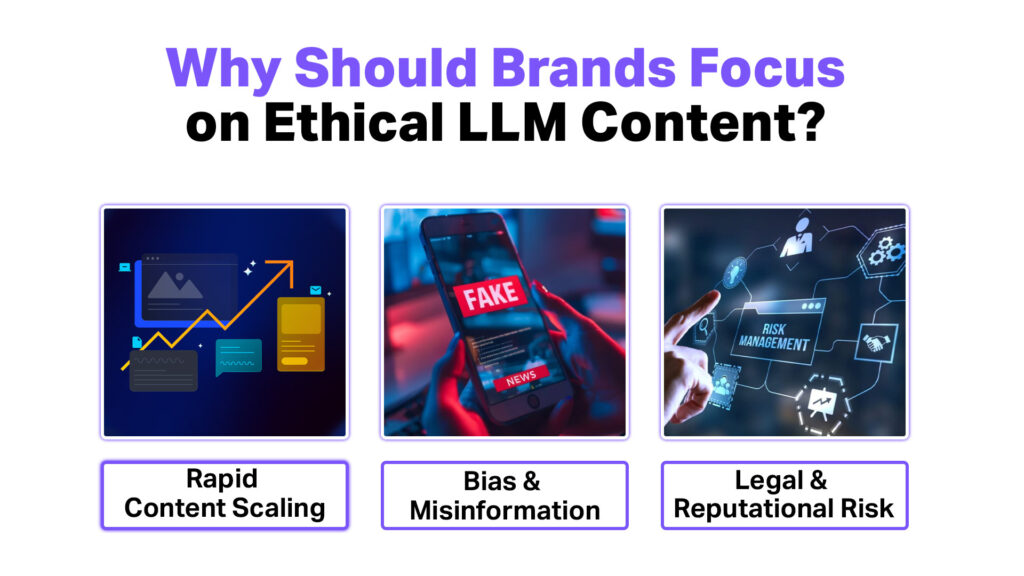
- Consumer trust: 50.1% of people would think less of a writer who uses AI (Search Engine Journal, 2025).
- Legal exposure: Improper use of AI content can result in copyright or privacy violations.
- Bias propagation: LLMs can unknowingly reinforce stereotypes or discriminatory content.
Case Studies Highlight These Concerns
1. A research study on LLMs in decision-making emphasizes that these models can amplify biases in training data, potentially leading to unfair or harmful outputs in sectors like healthcare, finance, and governance (Saxena, 2024).
2. A peer-reviewed academic survey of students, faculty, and administrators included 41 respondents. They reported concerns over plagiarism, bias, authenticity, and fairness when AI-generated content is used in academic or professional settings (Ethical Implications of ChatGPT and other LLM Models in Academia). This illustrates that ethical pitfalls are not just theoretical but real, observable, and impactful.
Example: Asking an AI to draft “best careers for women” may unintentionally reproduce outdated stereotypes if the content isn’t carefully monitored.
Key Takeaway
Ethical LLM content creation isn’t simply a compliance checkbox. It’s actually the strategic risk management. Only ensuring bias mitigation, transparency, and accuracy protects your brand, your audience, and your credibility while utilizing AI efficiently.
How Has LLM Content Creation Grown and Why?
AI-generated content has exploded due to technological advances and increasing demand for fast, scalable content.
| Sr. | Factor | Explanation |
|---|---|---|
| 1. | Market growth | Bloomberg predicts the generative AI market will grow from $40B in 2022 to $1.3 trillion by 2032. |
| 2. | Technology advancement | LLMs improve constantly in NLP and machine learning, producing human-like content with minimal input. |
| 3. | Multiple use cases | Blogs, emails, ad copy, Scripts, long-form novels, and video game content, Personalized user content. |
| 4. | Productivity & convenience | As generative AI grows, its use extends beyond research labs into marketing, code, customer support, and other knowledge work. McKinsey estimates it could add US$2.6–4.4 trillion annually, highlighting its potential to boost efficiency and expand content creation use cases. |
Example: Agencies can use LLMs to draft multiple social media campaigns in hours instead of days.
Because of this value boost, many businesses are embracing AI‑assisted content processes. As a result, LLM content creation stands as a core part of their content and productivity strategy.
Ethical Challenges in LLM Content Creation
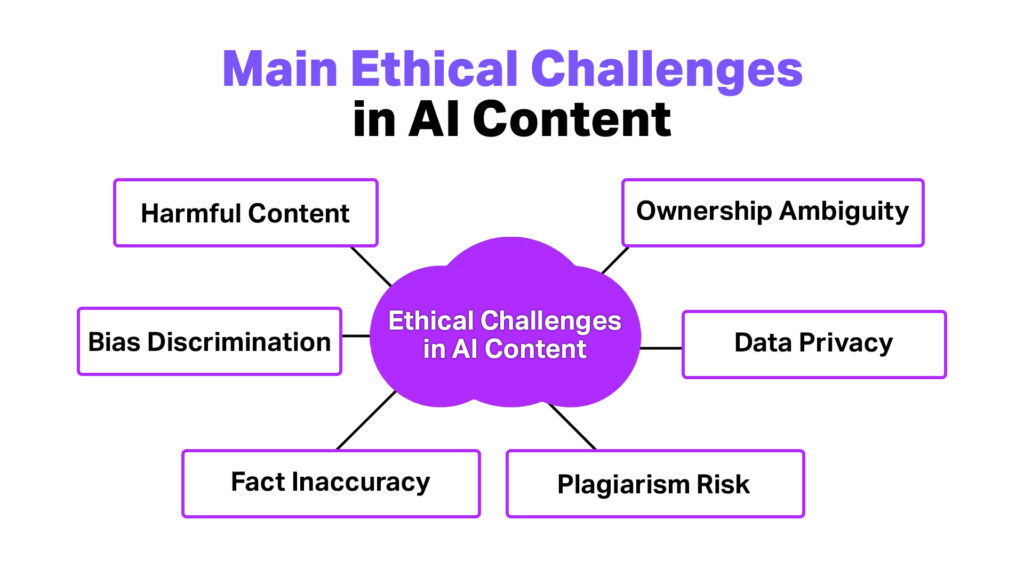
When using AI for content creation, ethical risks go beyond grammar or readability to other challenges. They affect brand reputation, legal compliance, and societal perception. Ignoring them can lead to mistrust, misinformation, or even legal consequences.
Harmful or Discriminatory Content
LLMs can inadvertently generate content that promotes misinformation, contains offensive language, or reinforces stereotypes. For example, a playful internal company email drafted by AI might accidentally offend employees if the content isn’t carefully reviewed, creating internal conflict or reputational issues.
Best practice: Always review AI outputs before sharing externally or internally and implement guardrails to prevent harmful content.
Bias & Discrimination
Bias is inherent in AI models because they learn from datasets created by humans. LLMs may reproduce gender, racial, cultural, or political biases, occupational stereotypes, or regional/linguistic slants. To mitigate these risks, it’s crucial to use neutral prompts, diverse training datasets, and human review.
Example: Asking AI to suggest “best jobs for men or women” could inadvertently reinforce outdated stereotypes if prompts aren’t carefully phrased.
Inaccuracy & Hallucinations
AI-generated content can invent facts or misinterpret information. An Example: An AI might claim that a startup received $50M in funding when no such report exists.
To prevent misinformation, always fact-check AI outputs using credible sources like government reports, Statista, or peer-reviewed studies. Relying on AI without human verification can harm brand credibility and mislead audiences.
Plagiarism Risk
While LLMs rarely copy text verbatim, they can mimic text patterns, creating potential intellectual property risks. Using plagiarism checkers (e.g., Copyscape, Grammarly), adding brand-specific examples, and rewriting generic AI outputs can ensure originality.
These steps safeguard both your brand and your audience from unintentional copyright issues. While LLMs rarely copy text verbatim, they can imitate text patterns, risking intellectual property infringement.
Privacy & Sensitive Data
Using personal or confidential information in AI prompts can inadvertently expose sensitive data. Always anonymize inputs and avoid sharing internal emails, HR files, or customer PII. Clear data-handling policies for AI use protect your company and maintain user trust.
Using personal or confidential information in AI prompts can expose sensitive data.
Ownership & Legal Ambiguity
A critical question remains: Who owns AI-generated content?
- The individual creating the content?
- Is the company deploying the AI?
- Or the AI developer itself?
Tip: Establish clear ownership policies and internal guidelines for content creation, reuse, and rights management to prevent disputes.
How to Create Ethical, High-Quality Content with LLMs?
Creating ethical AI content is about protecting your brand reputation, maintaining user trust, and following legal compliance. Below is a practical, step-by-step framework that teams can follow to make sure their AI automation workflows remains responsible, accurate, and human-centered.
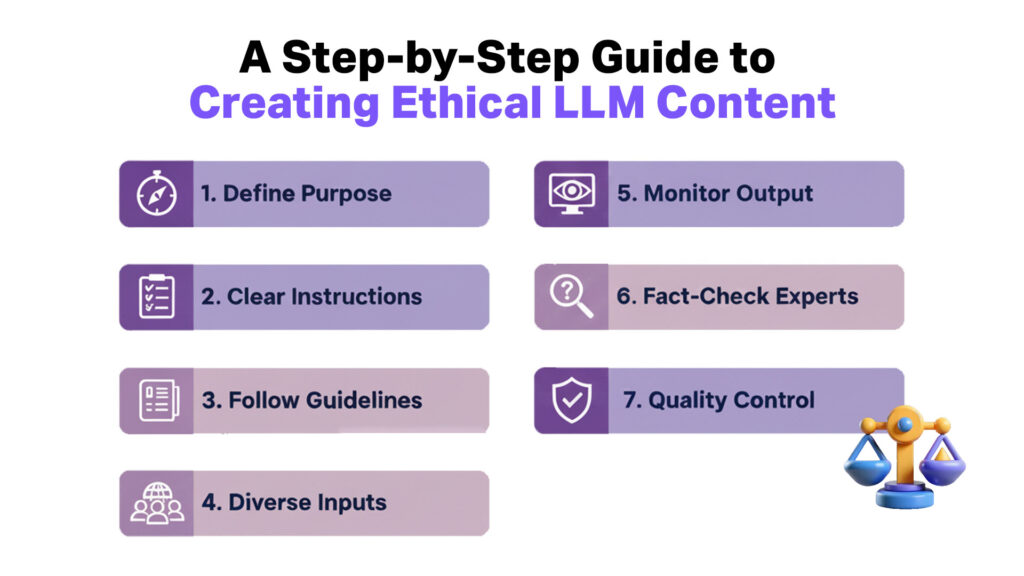
Define the Purpose
Before generating any content, be crystal clear about why the content is needed. AI performs best when it has a well-defined goal.
A strong purpose statement helps:
- Align the output with your brand voice, tone and messaging.
- Make sure the content directly supports user intent.
- Reduce irrelevant or misleading text.
When the purpose is clear, the AI can produce content that feels intentional, consistent, and valuable.
Input Clear Instructions with Guardrails
LLMs perform best when given precise, constrained instructions.
Your prompts should specify tone, depth, audience, and any boundaries that avoid bias or misinformation. Guardrails help prevent harmful phrasing, overgeneralizations, or subtle stereotypes.
Example prompt:
“Explain the benefits and challenges of remote work for employees without reinforcing stereotypes, using balanced, factual insights and a neutral tone.”
This reduces the chance of biased or overly generalized content.
Follow Guidelines & Standards
Responsible AI usage requires adherence to recognized frameworks.
This includes:
- Global regulations like the EU AI Act
- Technical standards such as IEEE AI Ethics Guidelines
- Your company’s internal policies on data use, content review, and AI governance
Having these frameworks in place helps maintain consistency and protects your organization from compliance risks.
Use Diverse Data Inputs
AI fairness improves when it’s exposed to diverse viewpoints.
Best practices include:
- Incorporating multiple perspectives into prompts
- Fine-tuning or training models using datasets that represent different genders, cultures, regions, and socioeconomic backgrounds
This creates more balanced, inclusive outputs and reduces the risk of one-sided or biased narratives.
Monitor and Evaluate AI Output
Even advanced LLMs can hallucinate facts, exaggerate claims, or produce subtle biases. Continuous human oversight is essential. Review the content for accuracy, tone, sensitive data exposure, and unintended harm. Treat AI output as a draft, not a final decision.
Fact-Check with Subject Matter Experts
AI is not a replacement for domain expertise.
For technical, high-stakes, or regulated content (health, finance, legal, cybersecurity, engineering), SMEs should always verify:
- Claims
- Stats
- References
- Terminology
- Compliance Requirements
This step protects your brand from misinformation or liability.
Implement Quality Control
Before publishing, run AI-generated content through a structured quality-control process. This often includes originality checks, compliance screens, tone consistency reviews, and accuracy validation. A multi-stage workflow ensures the final content is polished, ethical, and professional.
What Workflow Should You Follow to Keep AI Content Safe and Fair?
To keep AI-generated content safe, fair, and trustworthy, teams need a clear workflow that blends automation with human oversight.
| Step | Action | Responsible Party |
|---|---|---|
| Research | Gather credible sources | Human editor |
| Draft | AI generates outline/content | LLM |
| Bias Check | Review for bias or stereotypes | Human editor |
| Fact-Check | Verify all claims/statistics | SME or Editor |
| Humanize | Rewrite AI outputs for tone & context | Editor |
| Plagiarism Scan | Check originality | Editor |
| Final Approval | Approve for publication | Content Lead |
How Does Ethical LLM Content Benefit Brands in Practice?
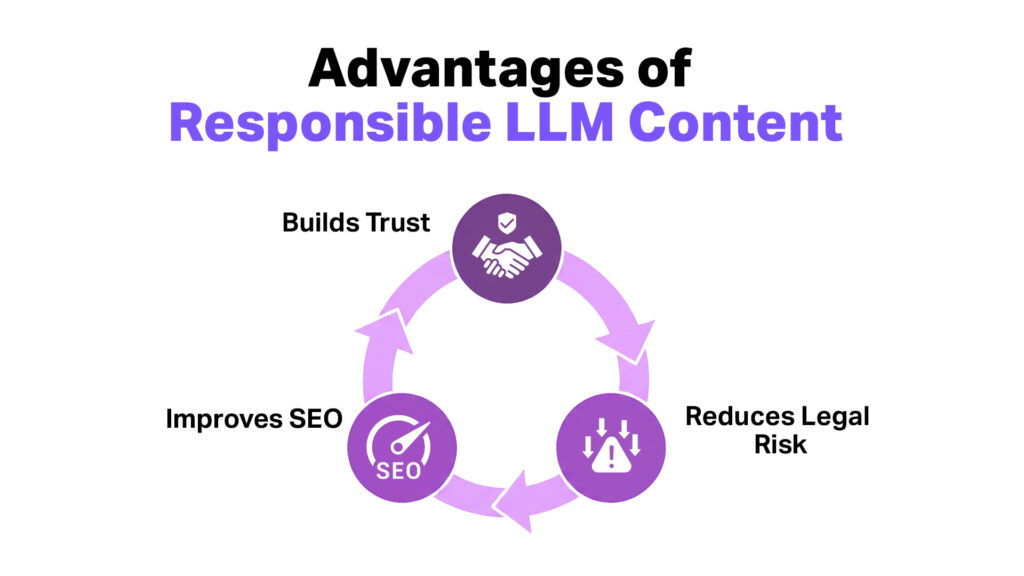
LLM Content that follows ethical practices helps brands in multiple ways:
- Improved trust & loyalty: Transparency shows audiences you care about accuracy and fairness.
- Better SEO & ranking: Google favors verified, high-quality, trustworthy content.
- Reduced risk: Mitigates legal, copyright, and data privacy concerns.
- Scalable content production: Ethics + workflow allow large volumes without sacrificing quality.
Example: A U.S.-based SaaS agency increased content output 3x while maintaining zero plagiarism flags and improved engagement using ethical AI content processes.
How ShortVids Helps Brands Create Ethical, High-Quality AI-Assisted Content
Ethical AI content is about producing trustworthy, human-centered content at scale. ShortVids helps brands achieve exactly that by blending AI efficiency with expert human oversight in their content workflows. Their team ensures every script, short video, repurposed clip, or social content piece goes through a structured review process for accuracy, originality, and brand safety.
ShortVids supports ethical content creation through:
- Human-led scripting & editing to prevent bias, hallucinations, or misleading claims
- AI-assisted research workflows with manual fact-checks
- Brand voice refinement so content feels genuinely human
- Content repurposing (long → short) without losing context or accuracy
- Motion graphics & thumbnails produced with compliant, properly licensed assets
For brands that want speed and integrity, ShortVids provides the perfect hybrid model: AI-powered, human-perfect content.
Your Takeaway!
Ethical considerations in LLM content creation are the backbone of brand trust, legal compliance, and sustainable growth. Always define purpose, verify facts, monitor bias, protect privacy, and disclose AI usage. Combine AI efficiency with human judgment for high-quality, responsible content. “AI is a tool; ethical responsibility remains human.” And if you want a partner that blends AI efficiency with human creativity, ShortVids can become your always-on content engine. We help you produce ethical, scripted, on-brand videos at scale without ever cutting corners. Act today to convert AI content into a growth-driving advantage for your business.
Frequently Asked Questions
It protects brand trust, reduces legal risks, and ensures accurate, responsible communication with audiences.
Start by using neutral prompts and feeding the model diverse perspectives so it doesn’t lean on stereotypes. Always have a human editor review the final draft to catch blind spots AI can’t see.
Yes, being upfront about AI involvement builds trust and positions your brand as transparent and responsible. With global regulations emerging, disclosure is becoming not just ethical but expected.
They can, but only when paired with expert oversight to verify accuracy and protect user privacy. Treat AI as an assistant, not the final authority, especially in regulated fields.
Rewrite, refine, and add real examples or data so the content truly reflects your brand’s perspective. A quick plagiarism scan at the end helps ensure everything is fully unique.
Book a Call Today
- Fixed monthly plans starting at $999
- 24-hour turnaround time (or less) on all short-form edits
- 3-layer quality check system on every video
- No more chasing freelancers or managing editors
- Scale up to 50+ videos/month without hiring in-house
- Content team trained on platform trends, scroll-stopping hooks & storytelling
- Fully managed by professionals – you just upload & approve
- Response time: Under 1 hour (US & GCC time zones)
Cut your production costs, not your standards.