

You launch a Facebook ad campaign, set a decent budget, and wait for the sales to roll in. A week later, your ad account looks like a ghost town, clicks everywhere, zero purchases, and your ROAS is sitting at a painful 0.8x. Sound familiar?
If you’re nodding right now, you’re not alone. In 2026, the average Meta ROAS hovers around 2.2–2.8x across industries. Yet plenty of advertisers still watch their money disappear because of the same preventable Facebook ads mistakes.
A recent study by BCG and Google, featured on Think with Google, revealed that only 40% of organizations fully trust their measurement solutions. This highlights that incomplete tracking and outdated optimization approaches are a major cause of wasted ad budgets. Without accurate data, campaigns fail to deliver the ROI advertisers expect, even with significant spend increases.
The good news? Most of these errors are fixable in an afternoon once you know exactly what to look for.
Most of these performance-killing issues don’t look like mistakes inside Ads Manager; they appear routine. This guide breaks down the most damaging Facebook ads mistakes in 2026, explains why they hurt ROI, and shows exactly how to fix your strategy using current best practices.
Quick Summary
TL;DR: In 2026, Facebook ad ROI collapses due to structural mistakes like wrong objectives, poor targeting, stale creatives, weak funnels, bad tracking, and reckless scaling. Fixing these fundamentals, paired with fresh, consistent video content from ShortVids, unlocks higher conversions, lower CPMs, and scalable campaigns. Even modest budgets can perform when campaigns are properly structured, tracked, and creatively optimized. #tldr
- Core Components: Campaign Objectives → Broad + Lookalike Targeting → Creative Refresh & Hooks → Retargeting Funnels → Proper Tracking & Gradual Scaling → ShortVids Content Support
- Outcome: Measurable ROAS growth, consistent engagement, optimized ad spend, and campaigns that scale profitably without wasted budget.
Stop wasting ad spend & fix mistakes fast!
What Are the Most Common Facebook Ads Mistakes Killing ROI in 2026?
Many advertisers assume Meta ads underperform due to competition or rising CPMs. While CPMs have increased by 12–18% year-over-year in 2026 according to industry reports, the real ROI killers happen much earlier, during campaign setup and strategy. Minor mistakes that appear normal inside Ads Manager often snowball into significant budget waste.
Across accounts spending $20/day to $20,000/day, we consistently see these top mistakes:
- Wrong campaign objectives
- Overconfidence in targeting
- Creative fatigue and weak hooks
- No funnel or retargeting logic
- Poor tracking signals
- Impatient optimization and reckless scaling
Individually, each of these issues can degrade performance modestly. In combination, they completely break Meta’s optimization engine, raising acquisition costs, lowering conversion rates, and depleting budgets unnecessarily.
According to a measurement study referenced by Think with Google, marketers who lack reliable measurement and optimization frameworks report significantly lower ROI and higher judgment errors. This reinforces why surface-level fixes rarely work unless the root causes are addressed.
1. Picking the Wrong Campaign Objective
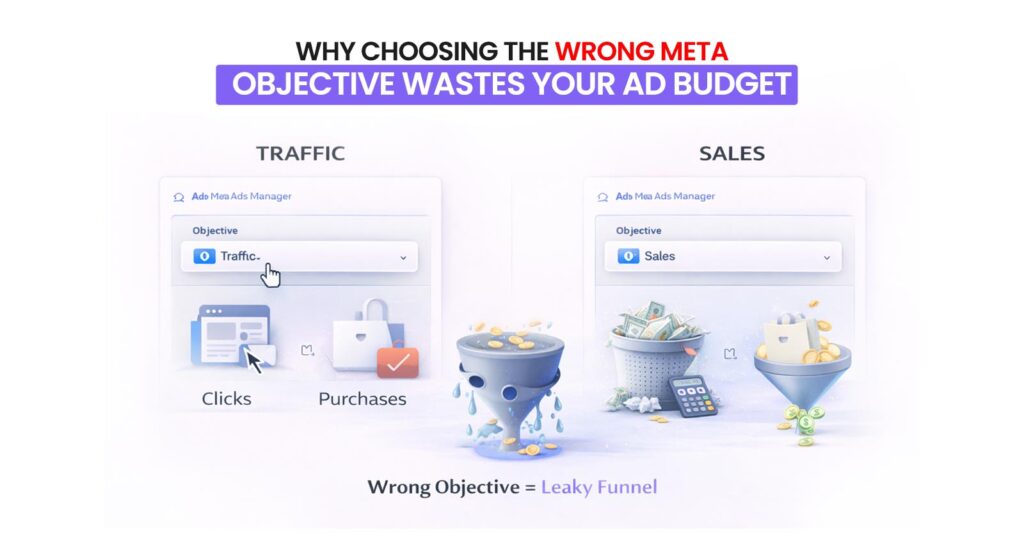
Here’s a harsh truth many advertisers still overlook: Meta’s algorithm is ruthless about objectives. If you tell it the wrong objective, it optimizes for the wrong actions, and your budget gets spent chasing clicks or engagement that don’t generate revenue.
Choose Traffic when your goal is sales, and Meta will deliver users who click but rarely purchase. Pick Engagement for lead generation, and you’ll end up with likes and comments, not actual customers.
According to marketers analyzing Meta ad trends in 2026, misaligned campaign objectives remain one of the top reasons for poor ROAS. (Source: Medium).
Real Example of Objective Mismatch That Hits Home
An e-commerce fashion brand spent $8,900 per month on Engagement-objective campaigns. While likes and comments were high, ROAS was just 1.8x, meaning the campaigns were losing money after product and fulfillment costs.
The fix? They switched to Sales as the campaign objective, added lookalike audiences from real purchasers, implemented a full retargeting funnel, and built dedicated landing pages matching the ad promise.
Results after 90 days with the same budget show that the ROAS climbed to 7.4x, the monthly revenue reached $65,860, and profit hit $56,960. The only fundamental change? Telling Meta exactly what they wanted, purchases, not engagement.
How to Fix It
Use the table below to quickly match your business goals with the correct Facebook campaign objectives and understand why each choice works.
| Business Goal | Select Objective | Why It Works |
|---|---|---|
| Drive revenue/sales | Sales / Conversions | Meta optimizes for real purchases |
| Generate leads | Leads | Prioritizes form submissions and sign-ups |
| App installs | App Promotion | Targets users most likely to install |
| Awareness | Brand Awareness / Reach | Maximizes visibility and impressions |
| Educate audiences | Video Views | Prioritizes engagement and watch time |
Fix Implementation Checklist
You can also fix the implementation checklist with the help of the given steps:
- Install Meta Pixel + Conversions API to capture accurate signals
- Define standard events: ViewContent, AddToCart, Purchase
- Use Advantage+ Shopping for e-commerce catalog optimization
- Verify events in Meta Events Manager before launch
Your campaign objective is the single biggest lever affecting ROI. Get it wrong, and nothing else matters, but get it right, and every other optimization becomes far more effective.
| If revenue matters, use Conversions or Sales, not Traffic.
Scale smarter with consistent, scroll-stopping video content.
2. Terrible Targeting
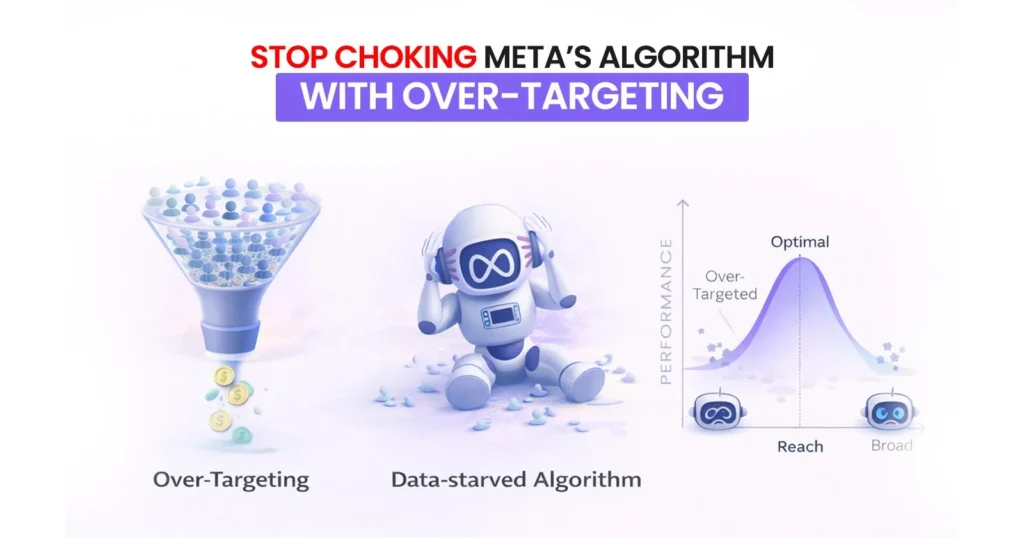
Targeting has changed drastically in 2026. The old approach of stacking every interest under the sun is long dead. But a new mistake is just as costly: over-manually narrowing audiences while Meta’s AI begs you to go broad.
Broad targeting, when combined with Advantage+ audiences and strong signals (customer lists, website visitors, video viewers), consistently outperforms narrow interest stacking. Overly tight targeting spikes CPMs, limits reach, and starves the algorithm of data it needs to optimize effectively.
According to MarketingLTB (2025), retargeting audiences converts up to 10x better than cold traffic. Still, many advertisers pour 80% of their budgets into cold audiences with no warm layers, losing ROI before campaigns even start.
Real Example of Targeting Mistake That Cost Money
A local salon owner targeted “women 25–55 interested in beauty” within 15 miles. Results: CPC $2.80, ROAS 1.1x, barely breaking even. We built three custom audiences that include the website visitors (last 180 days, video viewers (50%), and past purchasers.
These were layered for retargeting.
Same creative and offer, but results changed dramatically: Cost per lead dropped to 64%, whereas ROAS climbed to 5.8x. The difference? Proper audience structure and feeding the algorithm strong signals.
How to Fix It
The table below shows the best ways to structure audiences in 2026, so your targeting drives conversions instead of wasted spend.
| Target Type | How to Use It | Why It Works |
|---|---|---|
| Broad / Advantage+ | Start all new campaigns broadly | Allows Meta AI to optimize delivery efficiently |
| Lookalike audiences | Use 1% high-value customers | Targets users similar to your best buyers |
| Custom audiences | Website visitors, engagers, past purchasers | Prioritizes high-intent users |
| Exclusions | Recent buyers | Avoid paying for conversions that already happened |
| Interest-based | Test only | Layer on top of strong signals, don’t use as a foundation |
Implementation Checklist
Here is the implementation checklist to follow:
- Start with Advantage+ Audience for broad delivery
- Upload customer lists and track website/video engagement
- Separate ad sets for warm (retargeting) and cold (prospecting) traffic
- Exclude recent purchasers
- Use lookalike audiences built from high-value buyers
- Layer interest targeting only as a test, not your core strategy
In 2026, Meta rewards broad targeting paired with strong signals, not manual interest stacking. Poor targeting alone can kill ROI faster than creative issues or scaling mistakes. Feed the algorithm data, not arbitrary interests, and watch your campaigns thrive.
| Interest targeting should be a test, not your foundation.
3. Weak, Outdated, or Boring Creatives
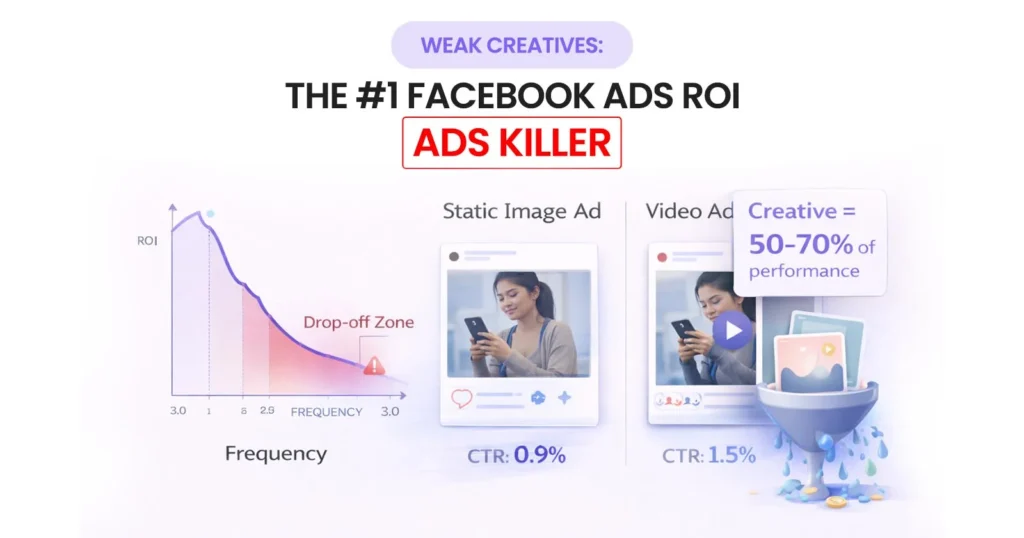
Ad fatigue isn’t a myth; it’s measurable, and in 2026, it’s the first reason killing more campaigns than targeting mistakes or scaling errors. Meta’s algorithm rewards fresh, scroll-stopping creative and punishes stale visuals or copy.
Data shows that frequency above 3.0 starts hurting performance, and once it crosses 5.0, ROI drops drastically. Video ads outperform static images, delivering up to 2% CTR versus 1% for single images, while UGC-style content, talking-heads, and problem-solution hooks dominate in the first 3 seconds.
Real Example of Creative Fatigue That Costs Money
An online course creator ran a single static image ad for six weeks. The results came in the frequency reach of 4.8, the CTR dropped from 2.1% → 0.4%, and the cost per lead tripled.
The fix? They launched 12 new creative variations, UGC testimonials, screen recordings, and before/after visuals, rotated weekly. And after 3 weeks, the frequency stabilized at 2.2 with
ROAS climbed 1.4x → 4.7x.
The difference? Fresh, engaging creatives that let Meta’s algorithm optimize delivery efficiently.
How to Fix It
Use the table below to quickly identify common creative issues and the exact fixes that keep your Facebook ads engaging and high performing.
| Issue | Action to Take | Why It Works |
|---|---|---|
| Single static image | Rotate 8–12 variations per campaign | Keeps frequency low and audience engaged |
| Long-form copy | Use concise, mobile-friendly text | Users read faster, CTR improves |
| No hook | Add a strong visual or verbal hook in the first 3 seconds | Captures attention before scrolling past |
| Stock or generic visuals | Use UGC, testimonials, screen recordings | Builds trust and relatability |
| Ad fatigue | Refresh creatives every 2–4 weeks | Prevents algorithm penalization, maintains CTR |
Implementation Checklist
Here is the proper checklist to follow:
- Test 8–12 creatives per campaign launch
- Prioritize 15–30 second videos with text overlays
- Enable Dynamic Creative Optimization (DCO) so Meta mixes headlines, images, and CTAs automatically
- Monitor frequency daily; pause any ad >3.0 that is losing money
- Focus on the first 3 seconds: hook your viewer instantly
In 2026, your creatives drive 50–70% of campaign success. Weak, repetitive ads bleed money, while fresh, engaging, and well-tested visuals unlock Meta’s full ROI potential.
| If your ad doesn’t hook in 3 seconds, it’s invisible.
4. No Retargeting Funnel
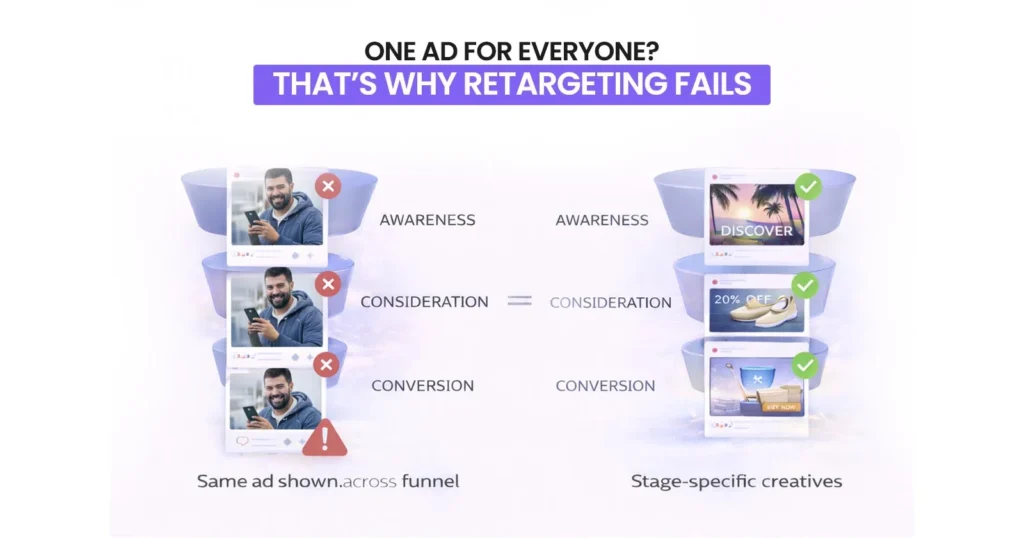
Cold traffic is expensive and chasing it without a warm funnel wastes ad spend. Many advertisers blast the same offer to everyone, hoping for conversions. Warm audiences, people who have already engaged with your brand, are far more likely to buy. Retargeting can deliver 3–10x higher ROAS compared to cold traffic.
A structured funnel also helps Meta’s algorithm optimize delivery efficiently, ensuring ads are shown to high-intent users rather than random clicks.
Real-World Example
A skincare brand moved 35% of its ad spend to retargeting campaigns. Cold traffic converted at just 1.8%, but warm audiences (website visitors and AddToCart) converted at 8–12%.
Overall account ROAS jumped from 2.1x → 4.3x, showing how even a partial shift to a funnel can double returns without increasing budget.
Common Retargeting Issues & How to Fix Them
The table below highlights the most frequent retargeting mistakes and their exact solutions:
| Issue | Action to Take | Why It Works |
|---|---|---|
| Cold-only campaigns | Build a 3-level funnel: Cold → Warm → Hot | Prioritizes high-intent users and improves conversions |
| Warm audiences not defined | Use website visitors, video viewers, AddToCart events | Meta targets users most likely to convert |
| Hot audiences ignored | Target past purchasers & high-value lookalikes | Increases upsell and repeat purchase revenue |
| Same ad for all stages | Customize creatives for each funnel stage | Reduces ad fatigue, increases engagement |
Implementation Checklist
Follow this checklist to make your retargeting funnel work efficiently:
- Identify warm and hot audiences from website, videos, and customer lists
- Separate campaigns for cold, warm, and hot traffic
- Use special offers for retargeting: discounts, bundles, lead magnets
- Exclude recent buyers to avoid wasting ad spend
- Rotate creatives for each audience stage to prevent fatigue
Proper retargeting can unlock 2–5x higher ROAS on existing campaigns without increasing ad spend.
| Retargeting often delivers 3–10x higher ROAS.
5. Set-It-and-Forget-It Syndrome + Poor Tracking
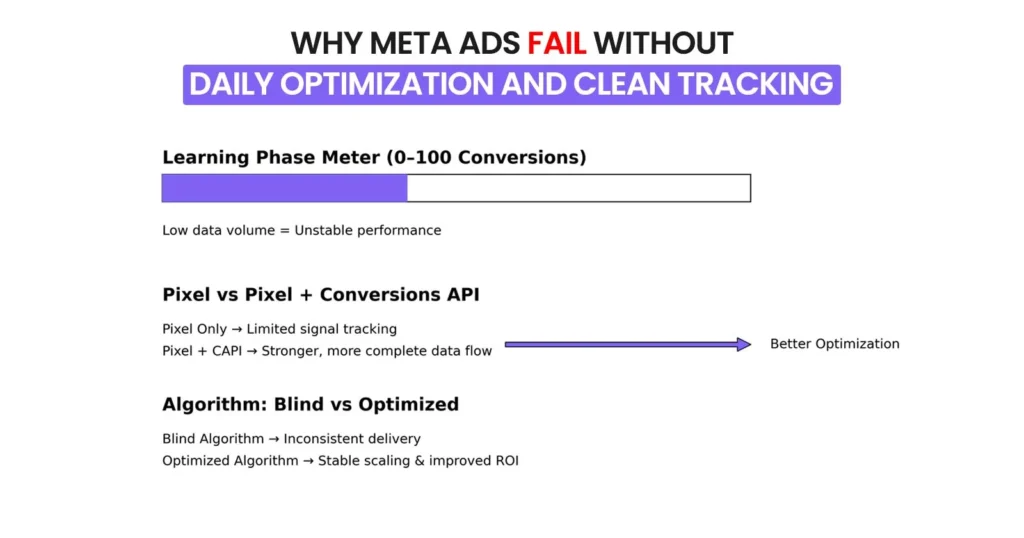
Many advertisers launch campaigns and check them once a week, expecting magic to happen. In reality, Meta’s algorithm requires 50–100 conversions per ad set per week to exit the learning phase and optimize efficiently. Pausing ads too early, ignoring frequency, or failing to monitor CPM trends leads to wasted spend and underperforming campaigns.
Even strong creatives and audiences can’t save a “set-it-and-forget-it” approach. Proper tracking is equally critical. Without Meta Pixel + Conversions API, you’re flying blind, losing 25–40% of purchase events after iOS privacy updates. This incomplete data prevents the algorithm from delivering to high-intent users.
Real-World Example
An e-commerce brand launched a new product and paused ads after 24 hours due to high CPC. Frequency had not been monitored, and only the standard pixel was installed.
Result: CTR dropped, ROAS stayed at 0.8x, and the learning phase never completed. After adding Conversions API, letting ads run 72 hours, and monitoring daily, ROAS climbed to 3.2x within one week.
How to Fix It
The table below highlights common mistakes and the exact fixes for proper learning and tracking:
| Issue | Action to Take | Why It Works |
|---|---|---|
| Pausing ads too early | Wait 48–72 hours before judging performance | Allows learning phase completion and better optimization |
| Not monitoring frequency | Check daily for ads >3.0 frequency | Prevents ad fatigue and declining CTR |
| Ignoring pixel/Conversions API | Implement Meta Pixel + Conversions API | Captures all events and improves the algorithm targeting |
| Scaling too fast | Duplicate winners, increase budgets gradually 10–25% | Avoids learning phase reset and cost spikes |
Implementation Checklist
Use this checklist daily to keep campaigns optimized and tracking accurate:
- Let new ads run 48–72 hours before pausing or judging performance
- Monitor frequency, relevance scores, and CPM trends daily
- Set automated rules: pause ad sets if CPA > target for 3 days and <30 conversions
- Duplicate winning ad sets instead of increasing budgets 2–3x overnight
- Ensure Meta Pixel + Conversions API is tracking all key events
Daily attention and proper tracking can unlock 2–3x higher ROAS without additional ad spend.
| Judge trends, not single-day ROAS.
6. Scaling Too Fast or Having Unrealistic ROAS Expectations
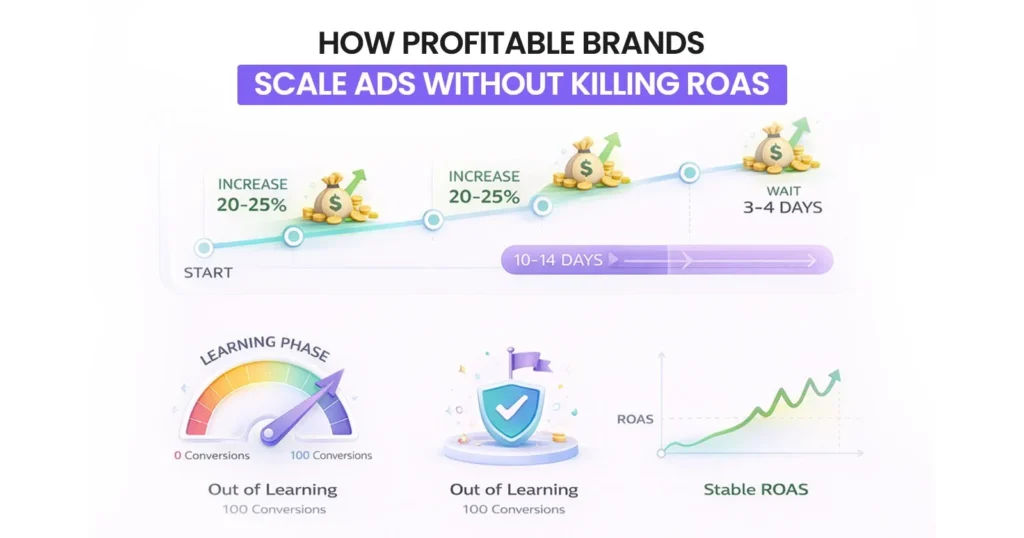
Expecting 5x ROAS on day one with a new offer is one of the most damaging Facebook ads mistakes advertisers still make. In 2026, profitable scaling is less about speed and more about control. Meta’s algorithm rewards stability. When budgets spike too fast, learning resets, CPMs rise, and even winning campaigns collapse overnight.
Realistic ROAS expectations protect momentum. It looks like break-even or 1.5–2x ROAS during testing, 3x+ ROAS once optimized, and 4x+ ROAS is excellent for most e-commerce brands.
Real-World Example
A DTC brand found a winning campaign at $300/day, consistently delivering 4.5x ROAS. Confident it would scale linearly, they increased spending to $1,500/day overnight.
Within 48 hours, CPMs spiked 30–40%, the learning phase reset, and ROAS crashed to 1.6x. The ad didn’t fail; the scaling did. They reverted budgets and applied gradual 20% increases every 3–4 days. The campaign scaled safely to $1,200/day while holding 4.1x ROAS.
How to Fix It
The table below highlights why most scaling attempts results in ad fails and how profitable brands scale without breaking performance:
| Issue | Action to Take | Why It Works |
|---|---|---|
| Scaling too fast | Increase budgets 20–25% every 3–4 days | Prevents learning phase reset |
| Scaling unproven ads | Scale only profitable ad sets | Protects ROAS consistency |
| Expecting instant 5x ROAS | Aim for 1.5–2x during testing | Keeps decisions realistic |
| Budget jumps during learning | Wait until ad sets exit learning | Improves delivery accuracy |
Implementation Checklist
Use this checklist to scale winning campaigns without killing performance:
- Scale only ad sets that are profitable and out of learning
- Increase budgets 20–25% max every 3–4 days
- Duplicate winning ad sets instead of aggressive budget jumps
- Monitor CPM, frequency, and CPA after every increase
- Accept slightly lower ROAS at higher spend, profit beats ratios
Reckless scaling resets everything good. Patience with controlled increases turns winners into scalable revenue engines.
| Patience scales profit. Impatience kills it.
Facebook Ads Mistakes vs Fixes (ROI Comparison)
Facebook ad performance usually doesn’t fail because of one big mistake; it collapses due to several small ones stacking together. This comparison table breaks down the most common Facebook Ads mistakes, why they destroy ROAS, and the exact fixes that unlock scalable performance.
| Mistake | Why It Kills ROI | Fix | Expected Lift |
|---|---|---|---|
| Wrong Objective | Algorithm optimizes for clicks, not buyers | Switch to Conversions / Sales | 2–4x ROAS |
| Bad Targeting | High CPMs, low relevance, weak intent | Broad targeting + custom audiences | 40–60% lower CPA |
| Stale Creatives | Frequency >3 causes ad fatigue | Launch 8–12 new ads every 2–4 weeks | CTR +50–100% |
| No Retargeting | Misses warm, high-intent users | Build a 3-level funnel (Cold → Warm → Hot) | 5–10x higher conversion rate |
| No Optimization Routine | Budget bleeds on losing ads | Daily 10-minute checks + rules | 25–40% better ROAS |
| Unrealistic Scaling | Learning phase resets, costs spike | Increase budgets 20–25% gradually | Stable, scalable growth |
How ShortVids Can Help Brands Avoid These Facebook Ads Mistakes
ShortVids is a full-service video editing and content production partner that helps brands and businesses solve one of the biggest hidden drivers, poor ad creatives and inconsistent content output. With our unlimited editing subscription, we deliver high-quality ads, short-form videos (Reels, TikToks), long-form content, and UGC-style pieces suitable for Meta and other platforms.
Instead of scrambling to hire editors or juggling freelancers, brands can tap into ShortVids’ team of vetted editors, motion designers, and creative strategists. In this way, they can produce scroll-stopping, conversion-ready ads on demand. Their services and workflow support fast turnarounds, unlimited revisions, and scalable output, so your campaigns always stay fresh, engaging, and optimized for performance.
Case study (real example):
Colin Mathew, with a growing content brand want to improve its content strategy by standardizing creatives and increasing output velocity with ShortVids. Within weeks, they eliminated rushed edits, met posting deadlines consistently, and saw stronger engagement across paid and organic campaigns. Thus, proving that creative consistency directly supports better ad performance.
| When creatives scale smoothly, performance follows.
Your Takeaway!
If your Meta ads aren’t profitable, don’t blame the platform. Fix the fundamentals first, including objectives, creatives, tracking, and funnel structure. Most Facebook ad mistakes are structural, not tactical. Clean data, strong creatives, and patient optimization win in 2026. Audit your account honestly, fix one problem at a time, and let Meta’s algorithm work with you, not against you. Ready to turn losing Facebook campaigns into consistent winners? Call ShortVids today!
Frequently Asked Questions
Yes, when structured correctly. Accounts with proper tracking, creatives, and funnels still achieve 2–5x ROAS.
In most cases, yes. Advantage+ performs best when creatives and conversion data are strong.
Minimum 5–10. Creative diversity is now critical for stable performance.
At least 48–72 hours. Short-term decisions often kill good campaigns.
Misaligned objectives combined with weak creatives as this breaks optimization from day one.
Book a Call Today
- Fixed monthly plans starting at $999
- 24-hour turnaround time (or less) on all short-form edits
- 3-layer quality check system on every video
- No more chasing freelancers or managing editors
- Scale up to 50+ videos/month without hiring in-house
- Content team trained on platform trends, scroll-stopping hooks & storytelling
- Fully managed by professionals – you just upload & approve
- Response time: Under 1 hour (US & GCC time zones)
Cut your production costs, not your standards.