

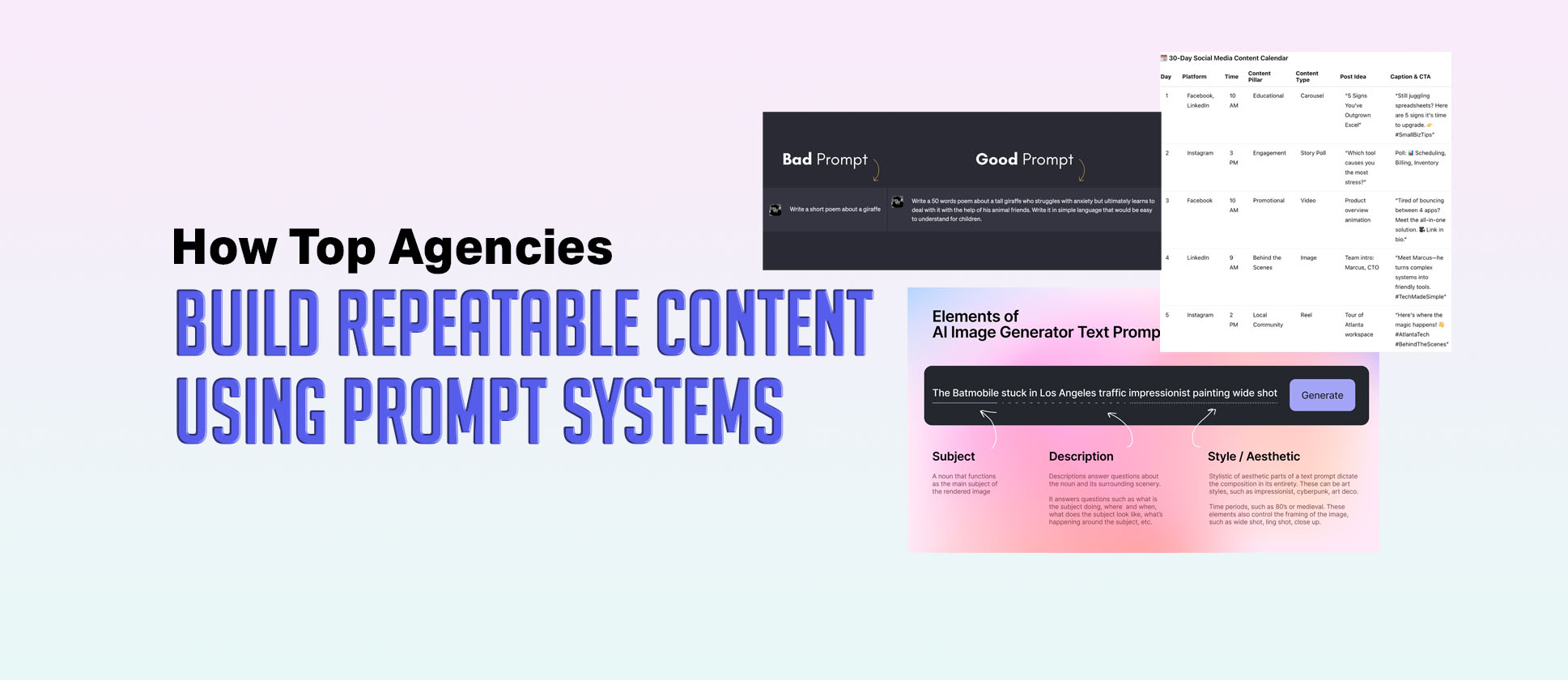
Most agencies don’t have an AI problem, but they have a repeatability problem. You can experiment with clever prompts and get decent output once or twice. The real test begins when you need the same quality, same structure, and same brand voice, every single day, across editors, platforms, and clients. That’s when many teams hit a wall.
Today, 78% of organizations use AI in at least one business function. Yet only a fraction sees consistent, scalable value because most rely on ad-hoc prompting instead of structured systems. (AutoFaceless Team)
Prompt-driven content systems treat prompts not as hacks or experiments, but as infrastructure, just like a publishing calendar or QA pipeline. This turns AI from a tool into a repeatable engine that delivers reliable output across teams and channels.
In this guide, we’ll break down why repeatability beats creativity, how constraints improve quality, and why systemized prompting outperforms one-off usage every time.
Quick Summary
TL;DR: Agencies scale content reliably when prompts are treated as systems, not one-off experiments. Prompt-driven content systems lock in structure, tone, and brand rules, turning AI into repeatable infrastructure. This reduces revisions, speeds onboarding, and ensures consistent output at scale. Platforms like ShortVids operationalize these systems so agencies can grow volume without sacrificing quality. #tldr
- Core Components: Defined Prompt Frameworks → Fixed Structure & Tone Rules → Platform-Specific Constraints → Team-Usable Documentation → Built-In QA → Scalable Editor Execution → Continuous Optimization
- Outcome: Predictable, brand-consistent content at scale with faster turnaround, fewer revisions, happier clients, and lower editor burnout
What Is a Prompt-Driven Content System?
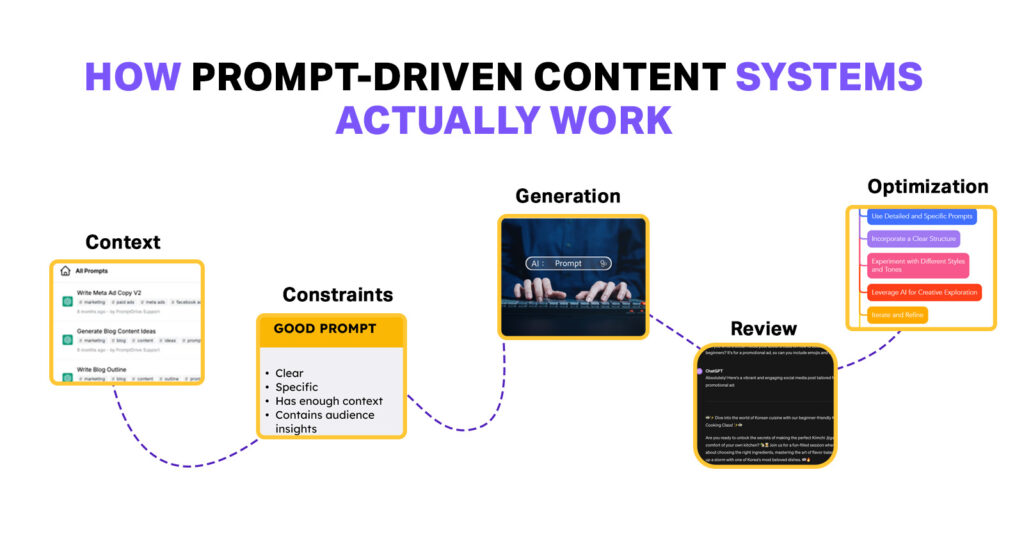
A prompt-driven content system is more than a clever instruction you write once. It’s a documented, reusable framework that turns AI prompts into predictable, brand-safe output, no matter who uses them. When content teams rely on casual prompting, quality fluctuates, revisions skyrocket, and workflows break down.
In contrast, structured systems create institutional knowledge that scales across teams and platforms. According to industry data, marketing teams that implement structured AI workflows report up to 90% consistency in brand voice and style, drastically reducing time-to-publish. (Source: NAV43)
In practice, prompt systems act like content creation pipelines, with clear inputs, rules, outputs, and checkpoints. They eliminate guesswork and make it easier for anyone on your team to generate content that matches a brand’s tone, structure, and desired outcomes. Teams that adopt this approach waste less time in revision loops and build an audit trail for continuous improvement.
| Characteristics | What It Means |
|---|---|
| Fixed Inputs | Defined context like tone, audience, brand voice |
| Defined Outputs | Target word count, CTA format, structure |
| Usage Rules | Step-by-step instructions editors follow |
| Version Control | Track prompt updates and improvements |
Agencies using frameworks like those don’t hope for great output; they design for it. Their editors follow prompt blueprints that ensure every short-form video script, caption, and hook delivers consistent results.
Why Treating Prompts as Infrastructure Changes Everything
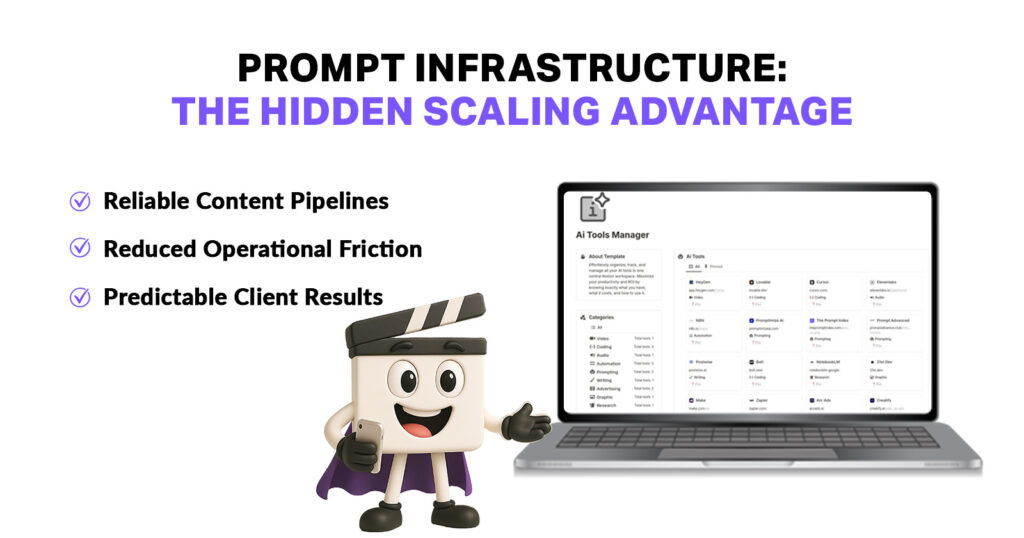
When prompts are treated as infrastructure, they stop being fleeting experiments and become operational assets that power predictable, scalable content workflows. Instead of depending on individual creativity or on-the-fly improvisation, your team gains a framework that delivers consistent quality, faster turnaround, and brand alignment at scale.
According to McKinsey, nearly 90% of companies have invested in AI, yet fewer than 40% report measurable productivity gains. It happens largely because AI is still applied to isolated tasks instead of being embedded into end-to-end workflows. This gap isn’t about creativity being less important; it’s about repeatability and reliability becoming the real differentiators for agencies that want to scale.
Agencies often rely too heavily on star performers, which creates bottlenecks and risks inconsistencies in content output. Systems help remove this dependency.
Reducing Human Dependency
Without systems, every editor becomes a single point of failure. A star performer might produce excellent output one day and something inconsistent the next. Infrastructure prompts ensure that any trained editor can generate consistent content, independent of individual style or memory.
Faster Revisions, Less Chaos
Revisions are a massive time sink for agencies. By locking in format, structure, and brand rules at the prompt level, teams eliminate guesswork and drastically reduce back-and-forth with clients and reviewers.
Built-In Brand Consistency
When output standards are encoded into prompt systems, brand voice becomes an automated outcome, not a hope. Even as teams scale, clients see predictable, on-brand messaging every time.
| Aspect | Clever One-Off Prompts | Prompt-Driven Systems |
|---|---|---|
| Ownership | Individual | Team-wide |
| Consistency | Unpredictable | Repeatable |
| Scaling | Breaks easily | Built for growth |
| QA Control | Manual | Built-in |
| Training | None | Documented |
This is the reason why agencies rely on repeatable systems that empower any editor to produce excellent output, quickly and reliably.
What’s the Difference Between Personal Prompts and Team-Usable Prompts?
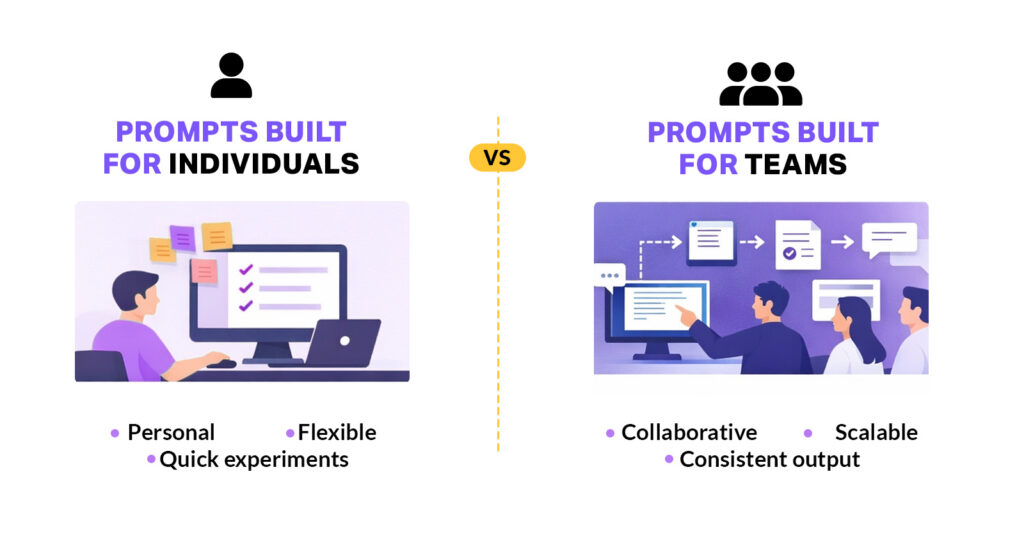
Not all prompts are created equal. Many content creators rely on personal prompts, shortcuts in their head that work for them. They can be quick and flexible, but they fail when someone else tries to use them. For agencies, where multiple editors, platforms, and clients are involved, this inconsistency becomes a bottleneck.
Team-usable prompts, on the other hand, are designed to work without the original creator. They document context, structure, tone, and rules so that any team member can produce the same high-quality output reliably. Moving from personal prompts to team systems is what allows agencies to scale content, maintain brand voice, and reduce errors, revisions, and client friction.
Personal Prompts: Flexible but Fragile
Personal prompts usually rely on context only, you know, change frequently, aren’t documented, and often produce inconsistent results. They work for experimentation or individual creators, but break down in team settings.
Team-Usable Prompts: Structured and Scalable
Team-usable prompts are fully documented, context-complete, designed for handoff, and version-controlled. They act as operational assets, ensuring repeatable quality across editors and campaigns. Any trained team member can follow the framework and generate output that matches brand standards.
Example
❌ Personal prompt:
“Write a short video script like we usually do for TikTok.”
✅ Team-usable prompt:
“Write a 30–45 sec TikTok script for a service-based brand.
Tone: confident, direct, non-salesy
Structure: Hook (3 sec) → Problem → Clear takeaway → Soft CTA
Avoid emojis. Avoid hype words. End with curiosity.”
Key Differences Between Personal and Team-Usable Prompts
The table below shows how personal prompts and team-usable prompts impact content output, handoff, and usability.
| Aspect | Personal Prompts | Team-Usable Prompts |
|---|---|---|
| Ease of Handoff | Hard, requires explanation | Easy, anyone can use it |
| Reproducibility | Low, varies per user | High, output is predictable |
| Editing Burden | High, often needs rewriting | Low, fewer revisions needed |
| Training New Editors | Time-consuming | Quick, guided by a framework |
| Context Dependence | Relies on creator’s memory | Self-contained, explicit |
This version highlights actionable operational differences rather than repeating earlier “ownership/QA/training” points.
Why Does Repeatability Matter More Than Creativity for Agencies?
Creativity alone doesn’t scale, especially in agency workflows handling multiple clients, editors, and platforms. Most agencies don’t fail due to a lack of talent; they fail because output quality fluctuates depending on who is working, how much context they retain, and how tight the deadlines are.
Without repeatable systems, content becomes unpredictable, revisions pile up, and client satisfaction suffers. Agencies that rely purely on creative improvisation often spend more time fixing errors than delivering value.
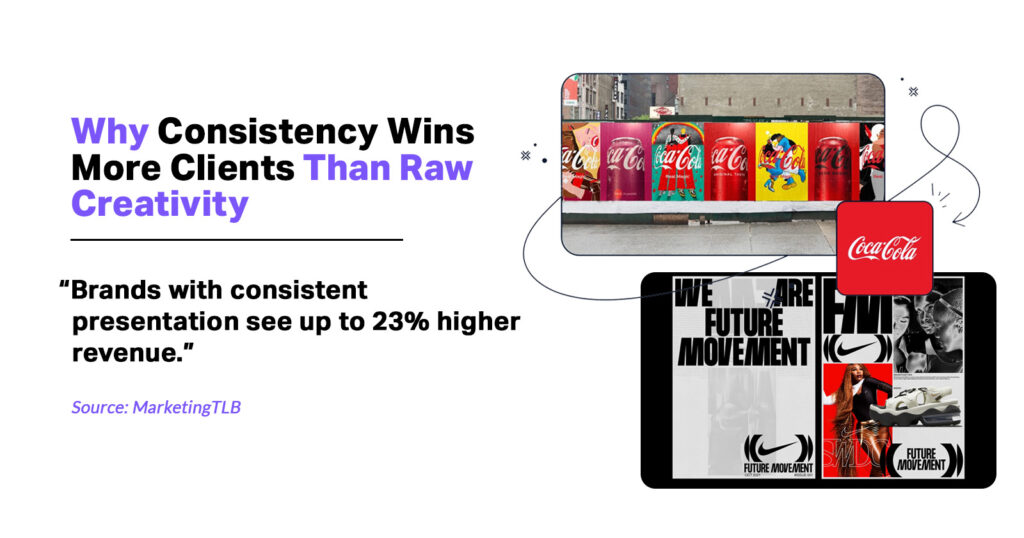
Repeatable systems, on the other hand, lock quality into the process, reduce creative fatigue, and make output predictable, regardless of the editor or day. Teams using structured prompt systems see measurable benefits:
- Faster onboarding of editors: new team members can follow documented prompts and produce high-quality content quickly.
- Easier QA and fewer client complaints: predictable output minimizes revisions and keeps brand voice consistent.
At scale, short-form content requires reliable execution, not constant reinvention. Agencies prioritize systemized prompting first, ensuring every piece of content meets quality standards consistently, while still leaving room for creativity inside the structure. This approach improves margins, boosts productivity, and maintains client trust.
How Do Constraints Actually Improve Output Quality?
Sometimes, we think giving AI or editors total freedom will spark the best ideas. In reality, it often leads to messy, inconsistent results that require more revisions. Constraints don’t stifle creativity; they guide it, helping teams produce content that’s clear, consistent, and on-brand every time.
Effective prompt constraints include:
- Word count limits
- Tone Rules
- Structure templates
- Platform-specific formatting
- Banned phrases or styles
Example: Constrained vs unconstrained output
The table below illustrates how applying constraints transforms content from inconsistent to polished, brand-safe output.
| Without Constraints | With Constraints |
|---|---|
| Rambling scripts | Tight hooks |
| Mixed tone | Brand-safe voice |
| Over-selling | Clear value |
| Inconsistent CTAs | Predictable flow |
Prompt Systems vs One-Off Prompt Usage: What Actually Scales?
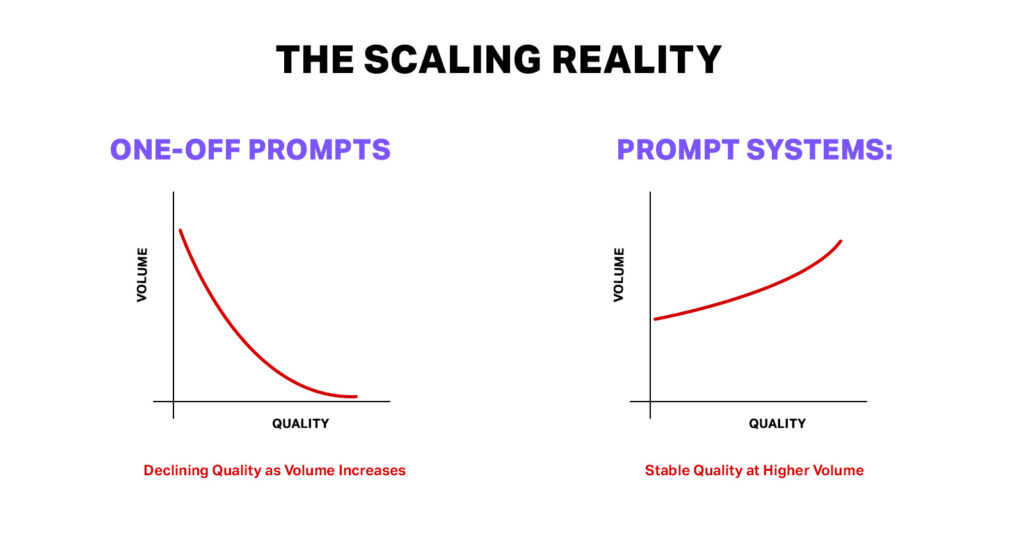
One-off prompts work well for solo creators, small experiments, or low-risk content where consistency isn’t critical. They allow quick output without much structure, which can be useful for testing ideas or generating casual content.
However, as soon as marketing teams grow, output volume increases, or clients expect consistent results, one-off prompts start to break down. Revisions pile up, brand voice drifts, and training new editors becomes time-consuming and error-prone.
Systemized prompts, on the other hand, are built for scale and reliability. They provide a repeatable framework that ensures output is predictable, regardless of who executes it. Training editors becomes faster because they have a clear structure to follow, and errors are minimized because the rules are baked into the system.
Creativity still exists; it just happens within defined guardrails that maintain content quality and consistency.
Key benefits of systemized prompt usage include:
- Predictable output: every piece matches brand voice and style
- Faster editor onboarding: clear frameworks reduce training time
- Fewer errors and revisions: standardized rules prevent costly mistakes
- Scalable workflows: teams handle higher volume without quality loss
Learn more: Common Video Editing Mistakes That Can Cost Big Time
How Are Agencies Using Prompt Systems to Scale Content Faster?
Scaling content is about working smarter. Agencies that succeed rely on repeatable systems rather than one-off prompts. They standardize prompts per platform, lock structures for each content type, define tone and CTA rules, and keep everything documented centrally.
This ensures consistent quality, faster content creation, and easier onboarding of new editors. Structured prompts turn AI into a reliable teammate rather than a guessing game.
Real-World Example:
HubSpot has shared how its content and marketing teams use structured AI workflows and predefined prompt frameworks to support large-scale content production. By embedding AI into repeatable processes instead of isolated use cases, HubSpot improved efficiency while maintaining consistency across blogs, emails, and campaigns. Source: HubSpot Blog – How HubSpot Uses AI in Marketing
Thus, the results for agencies using prompt systems is clear:
- Faster turnaround
- Happier clients
- Lower editor burnout
This structured approach makes scalable, high‑quality content production not just possible, but repeatable.
How ShortVids Uses Prompt Systems to Power Scalable Content
ShortVids doesn’t rely on talent chaos. It relies on repeatable, documented systems that keep quality high no matter how much volume increases. Our video editing work process starts with clear prompt frameworks tailored to every content type, from short-form social videos to ad edits and platform-specific formats.
Each editor follows the same documented rules for tone, structure, CTA placement, and brand voice. It means outputs are predictable and aligned with client expectations every time. Quality assurance is baked into the workflow rather than being an afterthought, reducing revision loops and keeping timelines tight.
A great example from ShortVids’ own case studies is Gene Slade’s success story. Gene, founder of Lead Ninja, was producing about 50 videos per month before partnering with ShortVids. Once he adopted ShortVids’ AI Creation system, his output jumped to 150+ varied video formats monthly without losing brand personality or quality. This consistent production helped keep his brand visible and significantly boosted engagement and lead generation.
The key benefit here is that agencies no longer scramble to manage editors, revise inconsistent content, or juggle platform nuances manually. With ShortVids’ prompt-driven infrastructure, agencies get scalable production, consistent brand voice, and faster turnaround.
Your Takeaway!
If your content quality changes with who’s on shift, you’re scaling risk, not results. Prompt-driven systems turn AI into dependable infrastructure instead of guesswork. Agencies serious about growth stop chasing clever prompts and start building repeatable workflows. ShortVids does this for you, so you can scale content fast, stay consistent, and deliver without quality cracks. Ready to scale? Partner with ShortVids Agency today.
Frequently Asked Questions
It’s a structured framework of reusable prompts designed to produce consistent, scalable output across teams, not just one-time results.
No. Small teams benefit even more because systems reduce dependency on individual editors and speed up execution.
No, they remove chaos so creativity can happen inside clear boundaries.
Short-form video scripts, hooks, captions, and CTAs benefit massively from structured prompting.
ShortVids builds prompt frameworks into its editing workflows, ensuring consistent quality across all client content.
Book a Call Today
- Fixed monthly plans starting at $999
- 24-hour turnaround time (or less) on all short-form edits
- 3-layer quality check system on every video
- No more chasing freelancers or managing editors
- Scale up to 50+ videos/month without hiring in-house
- Content team trained on platform trends, scroll-stopping hooks & storytelling
- Fully managed by professionals – you just upload & approve
- Response time: Under 1 hour (US & GCC time zones)
Cut your production costs, not your standards.