

AI content tools are more powerful than ever. In 2026, models like GPT-4o, Claude 4, Gemini 2.0, and Grok-3 can reason better, follow instructions more accurately, and handle long-form content with ease. Yet most AI-generated content still feels painfully average.
It’s not because the models are weak. It’s because the instructions feeding those models are weak.
In fact, nearly 97% of companies that use AI for content editing or creation say they review or edit the AI output before publishing. Whereas 80% manually review it for accuracy, showing that raw AI output rarely meets quality standards without human intervention. (Ahrefs)
This guide breaks down exactly why AI content fails, the prompt mistakes responsible for it. Plus, how professional teams, especially those using structured systems like ShortVids are fixing the issue at scale.
Quick Summary
TL;DR: Content teams fail at scale not because AI models are weak, but because prompts are vague, inconsistent, or missing context. Agencies that treat prompts as structured systems – defining audience, intent, tone, and constraint- consistently produce content that ranks, converts, and scales. Using role-based, repeatable, and versioned prompts reduces guesswork and improves quality. #tldr
- Core Components: Defined Prompt Frameworks → Role-Specific Instructions → Versioning & QA → Structured, Scalable Workflows → Continuous Optimization
- Outcome: Predictable, brand-aligned, high quality AI content at scale with fewer revisions and faster turnaround.
Why Do Most AI Prompts Ruin AI Output?
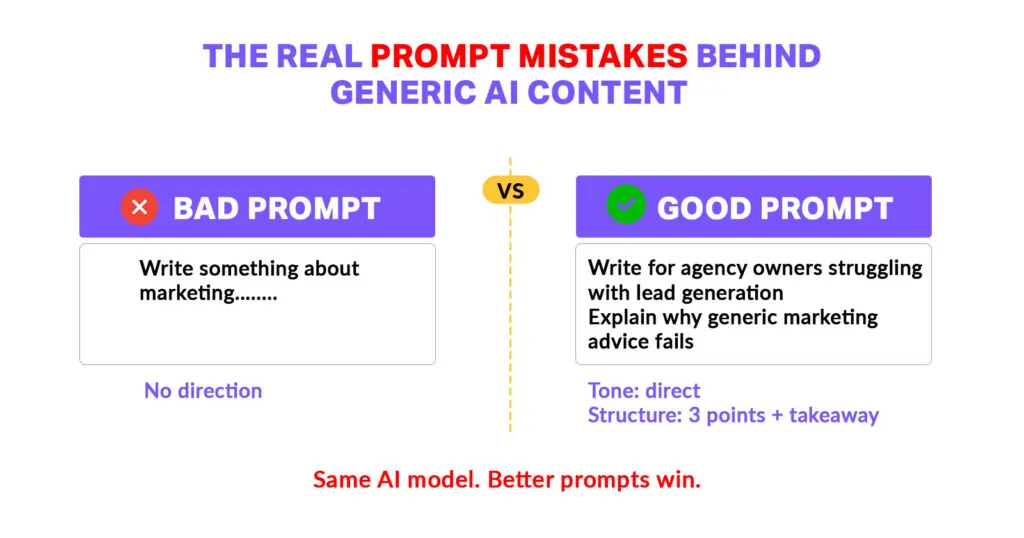
Most people treat AI prompting like a shortcut, one sentence in, perfect content out. That expectation alone guarantees disappointment. In reality, prompting is a skill, not a magic wand. Without clarity and structure, even the most advanced models struggle to generate coherent, relevant, and actionable content.
Research shows that the quality of the prompt dramatically influences the accuracy and usefulness of the output.
The Prompt Errors Behind Bad AI Content
When prompts lack clarity, structure, or boundaries, AI fills the gaps with safe assumptions. The breakdown below shows how each mistake directly impacts output quality.
| Problem | Typical Bad Prompt | What the Model Does | Result |
|---|---|---|---|
| Vagueness | “Write something about marketing” | Defaults to common training patterns | Generic, Wikipedia-style fluff |
| No context | “Create a blog post about remote work” | Chooses safe, neutral viewpoints | Bland, forgettable |
| No structure | “Give me 10 productivity tips” | Dumps unordered bullets | Messy, unprofessional |
| No tone/persona | “Write a LinkedIn post about AI” | Uses corporate default voice | Robotic and impersonal |
| No constraints | “Make it engaging” | Guesses what engaging means | Clichés and repetition |
| Overloaded prompt | “Write a 2,000-word SEO article on AI ethics with history, humor, future trends, stats…” | Loses focus, hallucinates | Incoherent output |
Real Life Example of Prompt Quality Affecting AI Output
A 2025 peer-reviewed study on prompt quality found that when the same language model (ChatGPT-4) was fed three different prompt versions. These versions range from minimal detail to highly structured; the quality score of generated feedback increased significantly with better prompts. The most sophisticated prompt achieved near-ideal scores (15/16), while the most basic prompt produced much lower-quality responses in repeated trials. (Source: Mdpi)
None of these issues come from the AI “not being smart enough.” They come from forcing the model to guess instead of guiding it. Poor prompts leave too much ambiguity, and the AI fills gaps with its statistically most likely guess, which is often boring, bland, or irrelevant.
Why Asking AI to “Make It Human” Prompts Actually Backfires?
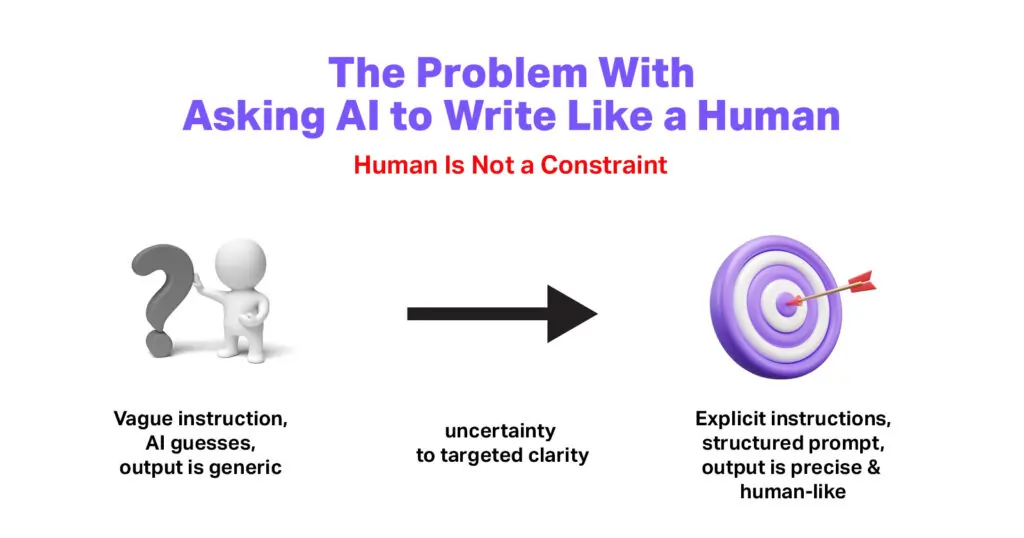
On the surface, telling AI to “make it human” feels logical. After all, the biggest complaint about AI content is that it sounds robotic. But this instruction usually makes things worse, not better. The problem isn’t that using AI for content creation makes it not sound like a human; it’s that humans are too vague to act on without rules.
“Make it human” is one of the most common and most useless prompt instructions. Why? Because humans aren’t a measurable constraint.
AI doesn’t understand “natural” or “human” concepts. It understands patterns. When those patterns aren’t clearly defined, the model defaults to the safest, most overused language it has seen millions of times during training.
That’s why you keep seeing phrases like:
- “In today’s fast-paced world…”
- “It’s important to note that…”
- “Let’s dive into…”
These phrases aren’t mistakes but defaults.
Why “Make It Human” Fails as a Prompt Instruction
These common prompt phrases sound helpful, but they quietly push AI toward generic content.
| Vague Instruction | How AI Interprets It | What You Actually Get |
|---|---|---|
| “Make it human” | Use commonly seen conversational phrases | Clichés and filler |
| “Sound natural” | Avoid extremes, stay neutral | Flat, corporate tone |
| “Be engaging” | Mimic high-engagement patterns | Clickbait or hype |
| “Write like a person” | Average across millions of voices | No clear personality |
When you don’t define how to sound human, the model chooses the most statistically safe option, which is usually the least interesting one.
What Actually Works Instead
Instead of vague tone requests, high-performing prompts rely on explicit rules and constraints. Replace abstraction with instruction:
- Sentence length limits (short vs long)
- Banned phrases (remove filler and clichés)
- Target reader profile (who you’re talking to)
- Clear writing objective (inform, persuade, convert)
Bad instruction: “Make it sound human.”
Better instruction: “Write in short, direct sentences. Avoid clichés. Speak to business owners as peers. No metaphors. No filler.”
This approach removes guesswork from the model. It no longer has to interpret what human means, it simply follows clear, repeatable rules.
How Does Missing Context Become the Real Failure Point?
Context is the difference between usable content and noise. Without it, AI isn’t wrong, it’s simply guessing. And when a model guesses, it defaults to safe assumptions, broad language, and middle-of-the-road viewpoints. That’s how you end up with content that sounds fine on the surface but fails to connect, convert, or stand out.
Most weak generative AI output isn’t caused by bad writing ability. It’s caused by missing context. This aligns with broader content marketing research showing that 82 % of the most successful marketers attribute their success directly to understanding their audience, meaning content that lacks audience context underperforms significantly. (Source: Content Marketing Strategy)
Context Most Prompts Fail to Include
- Who is the reader? (role, experience level, pain points)
- What problem are they trying to solve?
- What action should they take next?
- Where will this content live? (blog, landing page, LinkedIn, email)
Context-Rich Prompt Example
“Write this for agency owners who already use AI tools but struggle with consistency and quality. The goal is education with a soft conversion toward structured content systems like ShortVids.”
That single paragraph sharply narrows the model’s decision space, resulting in clearer, more relevant output.
What Are The 5 Elements Of a Good Prompt?
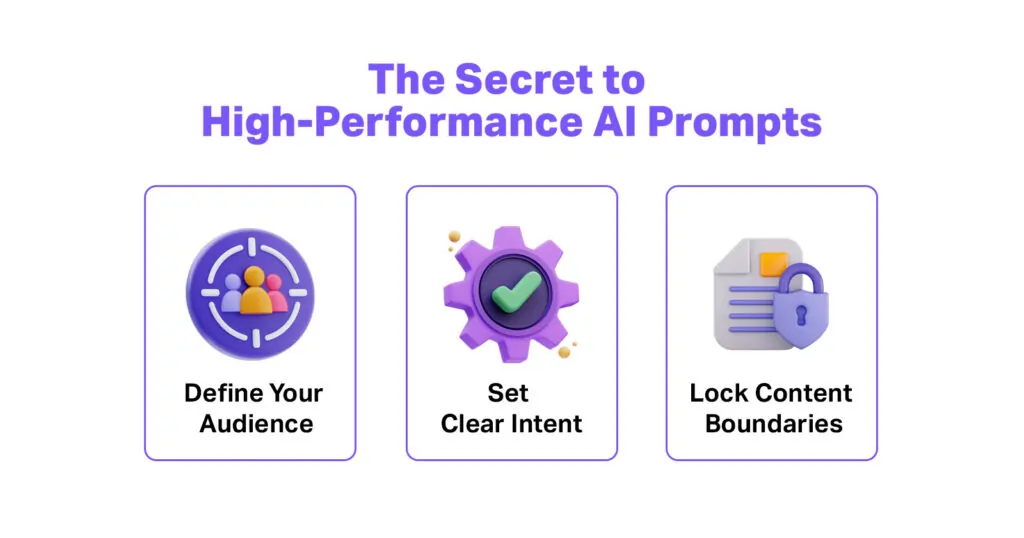
A well-crafted prompt isn’t just a sentence but a mini creative brief for AI. The more precisely you define the audience, the desired outcome, and any boundaries, the less the model has to guess. Without this clarity, even advanced models produce generic, unfocused, or irrelevant content.
High-performing prompts set expectations upfront and guide the AI step by step, which is why structured prompts are the secret behind consistent, high-quality output.
Professional prompts typically define five key elements:
- Audience: Who is reading this? What is their role, awareness level, and main pain point?
- Intent: What action should this content drive (clarity, sign-up, trust, decision, or conversion)?
- Voice: Define the tone, style, and personal guidelines (confident, simple, direct, human).
- Structure: Specify format requirements such as headings, sections, bullet points, or tables.
- Constraints: What to avoid (clichés, fluff, over-storytelling, filler phrases, jargon).
| Element | What to Define | Example |
|---|---|---|
| Audience | Role + pain point | Agency owners scaling content |
| Intent | Outcome | SEO education + conversion |
| Voice | Tone rules | Direct, no fluff |
| Structure | Format | H1, 5 H2s, tables, FAQs |
| Constraints | What to avoid | No clichés, no storytelling |
What’s the Difference Between Operational Prompts and Creative Prompts?
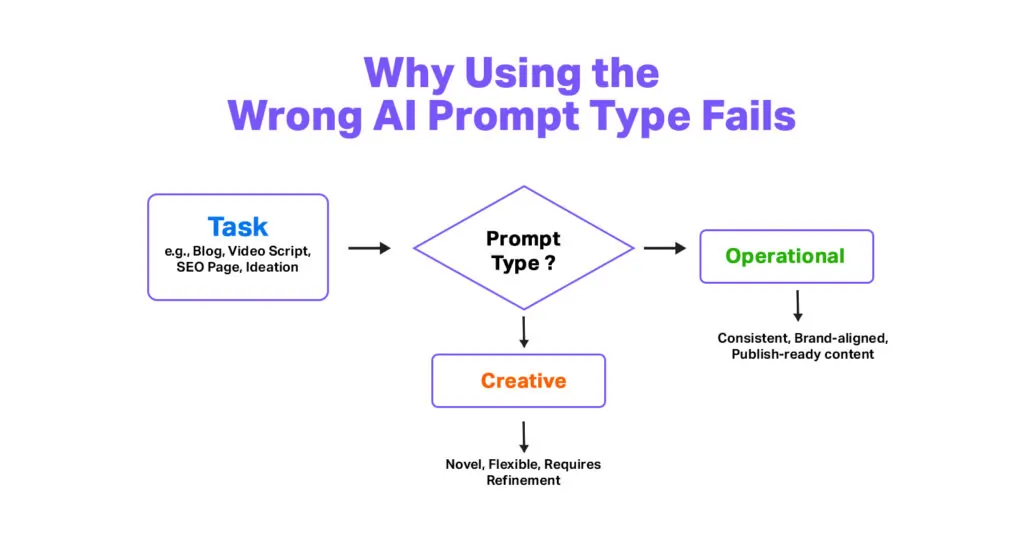
One of the biggest mistakes teams make is using the same type of prompt for every task. Operational content and creative content have very different requirements and mixing them often produces inconsistent results. Understanding the distinction is key to scaling AI content effectively.
Operational Prompts
Before diving into examples, here’s a quick look at where operational prompts are used and what they focus on:
| Used For | Focus On |
|---|---|
| Blogs | Consistency |
| Video scripts | Speed |
| SEO pages | Accuracy |
| Repeatable content | Reliability |
Operational prompts are structured and precise. They ensure content aligns with brand voice, format, and audience expectations every time.
Creative Prompts
To contrast, here’s how creative prompts differ in purpose and focus:
| Used For | Focus On |
|---|---|
| Ideation | Variety |
| Hooks | Exploration |
| Campaign angles | Experimentation |
Creative prompts prioritize novelty and flexibility rather than strict structure.
Trying to scale content with creative prompts leads to inconsistency. Operational content needs locked systems, not open-ended creativity.
How Do Prompt Systems Outperform One-Off AI Usage?
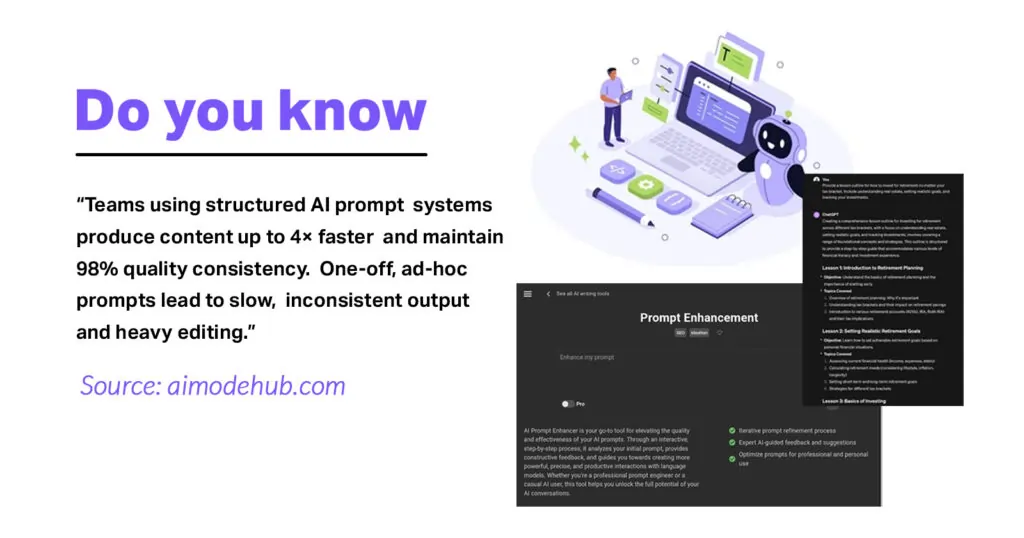
Many teams still rely on one-off prompts and hope for the best, a “prompt and pray” approach. The results are often inconsistent. Tone, style, and structure can vary wildly between outputs, leaving teams to spend hours editing and revising. This method is slow, unreliable, and impossible to scale effectively.
In contrast, prompt systems create a structured workflow for content generation. Every prompt includes clear instructions about audience, intent, tone, format, and constraints. This ensures that AI output is consistently aligned with brand and business objectives, reducing the need for heavy revisions.
Teams using these systems experience faster, more predictable results.
Why Agencies Prioritize Execution Over Simple AI Access
Most subscription‑based content partners give you access to tools or AI features, but that’s only half the battle. What separates high‑performing agencies from average ones is execution, consistency, and repeatability, not just access to AI.
Access alone leaves the quality and structure up to chance. Execution means using systems that ensure every piece of content serves a clear purpose and aligns with brand goals. Top creative teams don’t just ask AI to generate something.
In fact, they operationalize prompt logic, standardize output formats, align writing to strategic goals, and remove endless revision loops. This is why agencies using structured frameworks produce consistent, business‑aligned content even at scale.
How ShortVids Helps Turn Better Prompts Into Real Content Results
Structured prompts only matter if you have a reliable execution partner to turn them into consistent output. That’s exactly where ShortVids shines, as a subscription‑based creative partner that operationalizes high‑performance prompting systems, so your AI content creation isn’t just generated but ready to publish.
ShortVids helps teams standardize prompt logic, keep brand voice aligned, reduce revisions, and scale production without quality loss. It ensures content actually serves strategic goals rather than being generic or unfocused.
For example, Colin Matthew partnered with ShortVids to manage his video output while focusing on lead generation and coaching. Through consistent, professionally edited content, Colin’s subscriber base grew to over 23,000 organically, turning structured content into measurable growth for his brand.
We support structured prompting and execution, so that agencies get predictable quality at scale, not random results.
Your Takeaway!
If AI content isn’t performing, stop blaming the model. Poor prompts create poor outcomes, every time. Define context, lock boundaries, and think in systems, not commands. Platforms like ShortVids prove that when prompts are operationalized, AI finally delivers content that ranks, converts, and scales. Ready to stop guessing and start publishing high-quality AI content consistently? Book a call with ShortVids today and see how structured prompts and execution systems can transform your content workflow.
Frequently Asked Questions
AI content still feels generic because most prompts are vague, context-free, and unconstrained.
No, you can’t fix the content quality by just switching the AI model. Weak prompts produce weak results across all models.
A good prompt should be as long as needed to fully define the audience, intent, structure, tone, constraints, and any other critical details.
Yes, Structured prompts produce consistent, search-aligned content in a broader way.
No, we support scalable content workflows across various formats and niches.
Book a Call Today
- Fixed monthly plans starting at $999
- 24-hour turnaround time (or less) on all short-form edits
- 3-layer quality check system on every video
- No more chasing freelancers or managing editors
- Scale up to 50+ videos/month without hiring in-house
- Content team trained on platform trends, scroll-stopping hooks & storytelling
- Fully managed by professionals – you just upload & approve
- Response time: Under 1 hour (US & GCC time zones)
Cut your production costs, not your standards.