

AI editing tools promised speed, cost savings, and limitless scale, and for basic tasks, they delivered. Short-form edits, bulk repurposing, and early-stage content pipelines became faster almost overnight. But once agencies and brands push beyond a few videos a week, cracks begin to show.
Inconsistent tone. Missed context. Declining quality over time. Endless revisions that quietly erase any cost advantage. According to SEO Sandwitch, nearly 42% of marketers report brand voice inconsistency when relying heavily on AI-generated content. That ends up forcing teams to step in and manually correct outputs at scale. It’s actually a workflow problem.
Now, agencies are confronting a hard truth: AI-only editing does not scale sustainably. Not for brands protecting authority and for those with monetized channels chasing retention. Not for performance-driven teams that need repeatable quality. This guide explains why AI-only workflows break down under volume and the hidden costs that most teams underestimate. Above all, how hybrid AI + human editing models like ShortVids stabilize output without slowing production.
Quick Summary
TL;DR: AI-only editing fails to scale because it cannot maintain brand consistency, tone, pacing, or audience engagement over high-volume content. Agencies succeed when AI handles repetitive tasks while humans control storytelling, hooks, brand voice, and final approvals. Hybrid workflows reduce revisions, prevent quality loss, and make scaling predictable. ShortVids enables this approach, delivering reliable output without slowing production. #tldr
- Core Components: Raw Footage → AI Preprocessing → AI Template Editing → Human Narrative & Hooks → Human QA & Final Review → Multi-format Output → Performance & Feedback Loops
- Outcome: Consistent, high-quality videos at scale, faster turnaround, higher engagement, and brand-aligned storytelling achieved through a structured AI + human workflow.
Why Does AI Editing Struggle to Maintain Consistency at Scale?
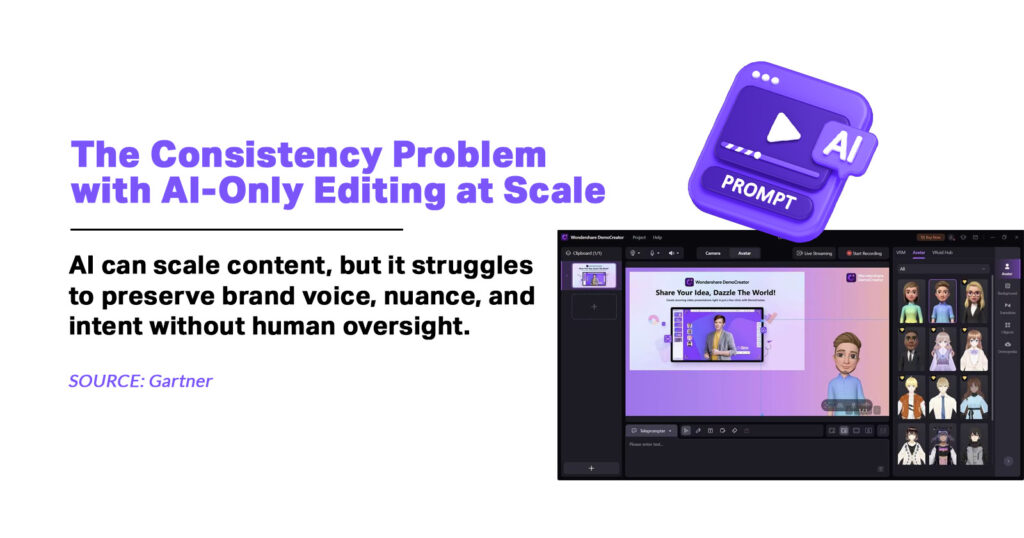
AI editing tools perform well in controlled, repetitive environments. The moment volume increases or brand nuance enters the equation; consistency starts to erode. This is a structural limitation. AI systems generate each edit in isolation, relying on probability patterns rather than accumulated editorial judgment.
The core issue is straightforward: AI lacks long-term editorial memory. It does not retain brand decisions, pacing preferences, or narrative intent across dozens or hundreds of outputs. As content libraries grow, this leads to subtle but compounding issues. Tone shifts between uploads, hooks that feel mechanically optimized rather than strategically placed, and visual styles that slowly drift off brand.
Research published by MIT Sloan Management Review confirms this limitation. A controlled field study found that AI-generated content becomes more error-prone as contextual complexity increases, especially when tasks require consistency and judgment across repeated outputs. Crucially, the study showed that introducing structured human oversight significantly reduced errors without increasing review time, stabilizing output quality at scale.
This explains why problems feel manageable at low volume but escalate quickly as output increases. Early inconsistencies go unnoticed. At scale, they become visible to both audiences and algorithms, leading to declining retention and reduced distribution.
How AI Consistency Breaks as Volume Grows
As content volume increases, small inconsistencies turn into systemic issues. The table below shows how AI-only editing performance degrades at different production levels and why scale exposes its limitations.
| Output Level | AI Performance | Impact |
|---|---|---|
| Low volume | Minor errors | Low risk |
| Medium volume | Noticeable drift | Brand dilution |
| High volume | Repeated inconsistencies | Performance decline |
This is why AI-only channels often see fast initial growth, followed by a plateau or decline once scale exposes the gaps.
What Are the Hidden Costs of “Cheap” AI Editing at Volume?
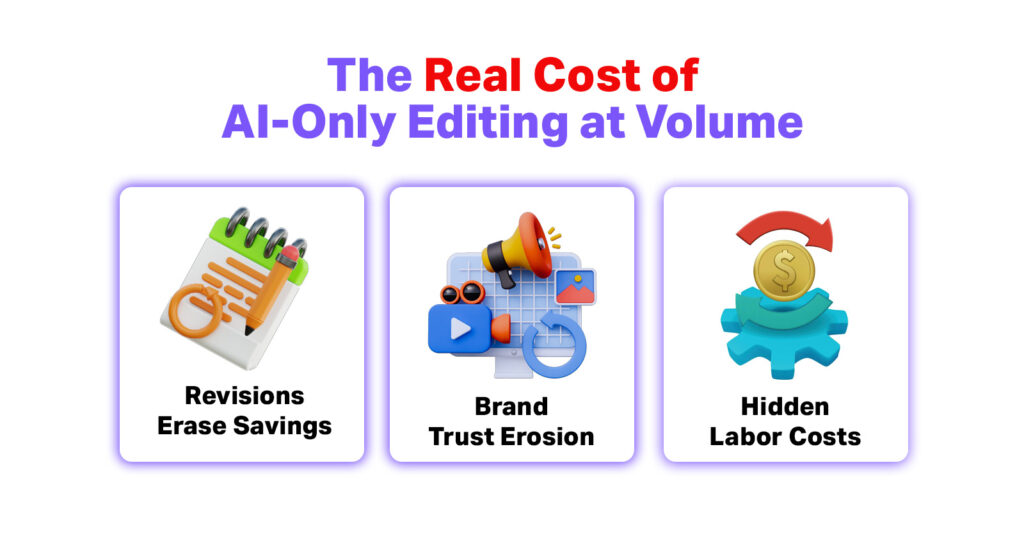
On paper, AI editing looks inexpensive. In practice, it introduces costs that most agencies don’t track, and those costs can quickly outweigh apparent savings. At volume, the highest cost isn’t the licensing fee or subscription; it’s the human hours spent correcting output that never should have gone live.
Every AI‑generated mistake triggers a chain of manual work: fixing inaccuracies, re‑exporting files, re‑uploading content, and explaining revisions to clients. Before long, agencies often end up spending more hours correcting AI output than they saved using it in the first place. A McKinsey report found that 20–30% of AI productivity gains are lost to rework caused by quality issues, effectively canceling out cost advantages.
Why Brand Damage from AI Errors is Hard to Measure
Even small inconsistencies in AI content can accumulate over time, creating a noticeable impact on your audience. While speed and cost savings are attractive, the hidden consequences often outweigh the benefits. Brand perception and trust can erode silently before teams realize the damage.
Key consequences include:
- Lower watch time
- Reduced audience trust
- Declining conversion rates
Cheap Edits Can Backfire Quickly
AI may save money upfront, but when errors damage brand credibility, the costs multiply. Rework, corrections, and trust restoration require human hours and resources. Once audience confidence declines, no automation alone can recover it, making “cheap” AI edits expensive in the long run.
Major risks to monitor:
- Increased revision workload and operational costs
- Negative impact on long-term audience retention
- Degraded brand authority across platforms
Where Does AI Fail in Professional Editing Workflows?
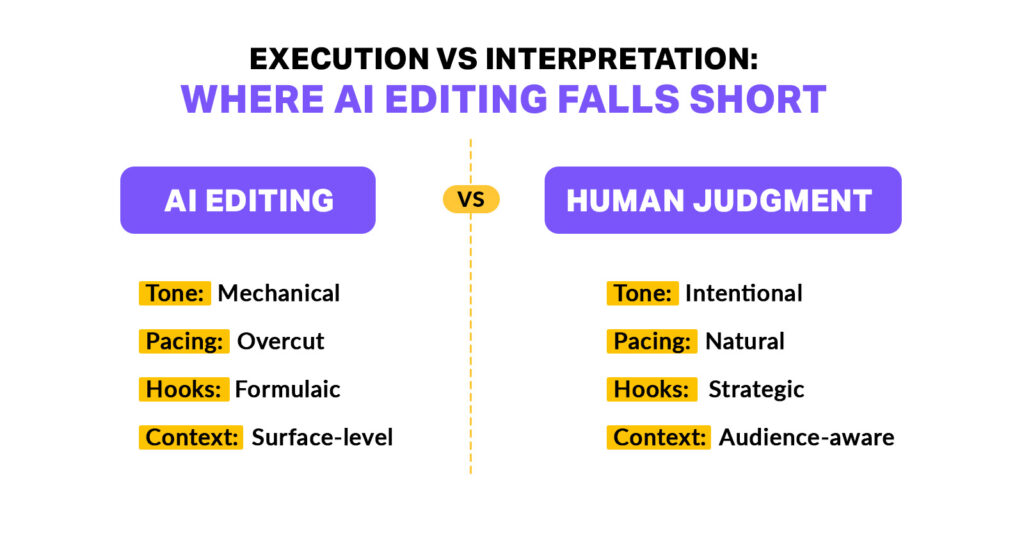
AI excels at speed, repetition, and pattern recognition, making it a powerful tool for routine editing tasks. But when content requires judgment, context, or emotional nuance, AI often falls short. Professional editing is about shaping a story, maintaining brand voice, and engaging audiences meaningfully. These are areas where AI alone struggles, even with advanced content models.
Tone and Emotional Intent
AI struggles to distinguish subtle differences in tone, which often results in content creation that feels mechanical. It cannot reliably separate authority from arrogance, energetic enthusiasm from noise, or urgency from clickbait. Without human judgment, hooks may misfire, dialogue may feel unnatural, and the emotional resonance of the content suffers.
These tone inconsistencies can reduce engagement and make the content appear off brand, especially across multi-video series production or campaigns.
Narrative Pacing
AI frequently mishandles pacing. Key moments may be overcut, emotional beats rushed, or natural breathing space removed. This disrupts flow, weakens storytelling, and reduces viewer retention, particularly in long-form or educational content where timing is critical. Human editors can read context, adjust pacing intuitively, and ensure the narrative guides the audience as intended.
Context Awareness
AI lacks a deep understanding of audience maturity, funnel stage, or brand positioning. It edits what it sees in the raw footage, ignoring subtler strategic goals like audience segmentation or conversion priorities. Without human guidance, the output may miss key messaging cues, resulting in content that looks polished but fails to perform.
Common AI Editing Failures vs Human Judgment
The table below highlights where AI editing commonly falls short compared to human-guided workflows.
| Editing Aspect | AI-Only Output | Human-Guided Output |
|---|---|---|
| Tone | Mechanical/inconsistent | Brand-aligned / intentional |
| Pacing | Overcut / rushed | Adaptive / context-aware |
| Hook Placement | Formulaic | Strategic/effective |
| Context | Surface-level | Audience-informed / goal-driven |
| Emotional Impact | Weak/flat | Resonant/engaging |
This is why ShortVids never ships raw AI output without human QA.
How Do Human QA Stabilize High-Volume Output?
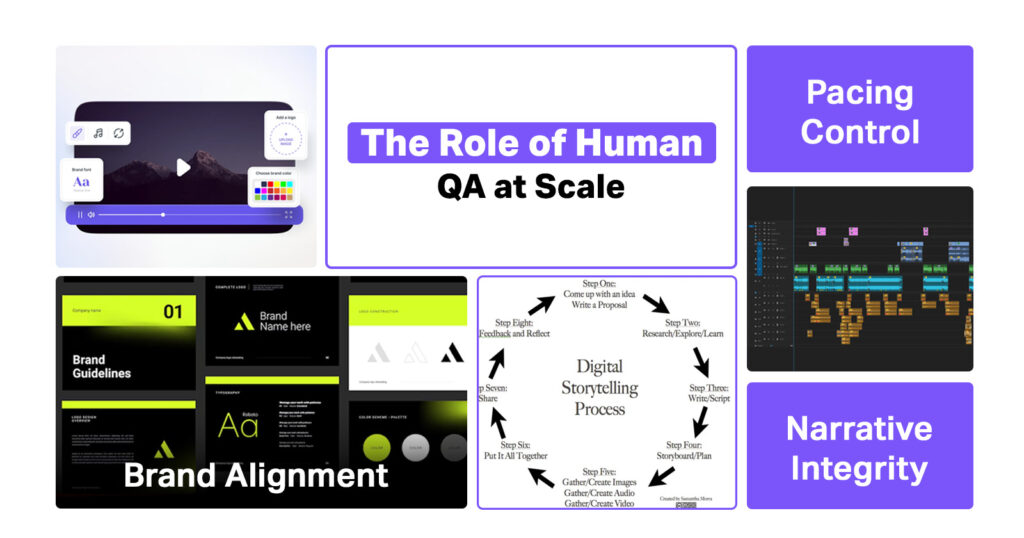
AI alone cannot guarantee consistent quality at scale. The solution is not to replace AI automation tools, but to strategically control through human oversight. Hybrid workflows focus human attention on high-impact moments, ensuring brand alignment, pacing, and narrative intent are preserved. This approach maintains speed while preventing the compounding errors that arise in AI-only pipelines.
What Humans Do Better Than AI
Human editors excel at tasks AI struggles with, especially when it comes to judgment and nuance. They can detect subtle shifts in tone, evaluate whether content aligns with brand voice, and adjust pacing to maximize retention. Humans also enforce visual consistency and ensure that platform-specific best practices are applied, which AI cannot reliably do. This ensures content feels intentional, engaging, and on-brand across all videos.
Key human oversight tasks include:
- Evaluate brand alignment
- Detect subtle tone shifts
- Adjust pacing for retention
- Enforce visual consistency
- Apply platform-specific judgment
How ShortVids Structures QA
ShortVids doesn’t rely on full manual editing, which would slow production. Instead, AI handles bulk tasks like trimming, basic cuts, and assembling footage, while humans focus on validation and correction. This hybrid approach allows content creation teams to scale without sacrificing quality. Human checkpoints are inserted strategically to catch errors, improve storytelling, and maintain consistent brand standards across all outputs.
Results of this hybrid QA approach:
- Faster turnaround than traditional teams
- Far higher consistency than AI-only workflows
- Reliable quality at scale without sacrificing speed
How Can Feedback Loops Improve AI Output Without Retraining Models?
One of the biggest misconceptions is that improving AI output requires retraining models. In reality, structured feedback loops can enhance AI performance without touching the model itself. By documenting approved styles, rejected patterns, and brand-specific rules, human editors create an operational memory that improves the behavior of generative AI across multiple outputs.
This ensures consistency, reduces errors, and maintains alignment with brand standards, even at scale. Practical application of feedback loops is straightforward. Flagging overused transitions prevents repetition, adjusting hook styles based on analytics improves future engagement, and standardized QA checklists enforce quality without slowing production.
Over time, AI becomes predictable and reliable, producing output that aligns with both audience expectations and performance goals. For high-volume content teams, this predictability is far more valuable than raw “intelligence,” and it allows agencies to scale without constant manual intervention.
Why Are Agencies Moving to Hybrid Editing Teams?
As agencies scale content production, speed alone is no longer enough; reliability matters more than ever. Teams need consistent quality at high volume, predictable turnaround times, fewer revisions, white-label delivery, and stable costs. AI-only workflows can deliver speed, but they struggle to meet these critical requirements.
Hybrid editing teams address this gap. By combining AI-powered efficiency with human editorial oversight, agencies get the best of both worlds: fast production without sacrificing brand alignment, pacing, or audience engagement. Platforms like ShortVids also optimize for platform-specific formats and maintain scalable pricing, making them ideal for high-output agencies.
The results speak for themselves: faster publishing cycles, improved retention, reduced revision requests, and content that performs consistently. In 2026, successful agencies recognize that scaling is about controlled output, not just quantity, and hybrid teams make that possible.
AI-Only vs Hybrid Editing: What Actually Scales?
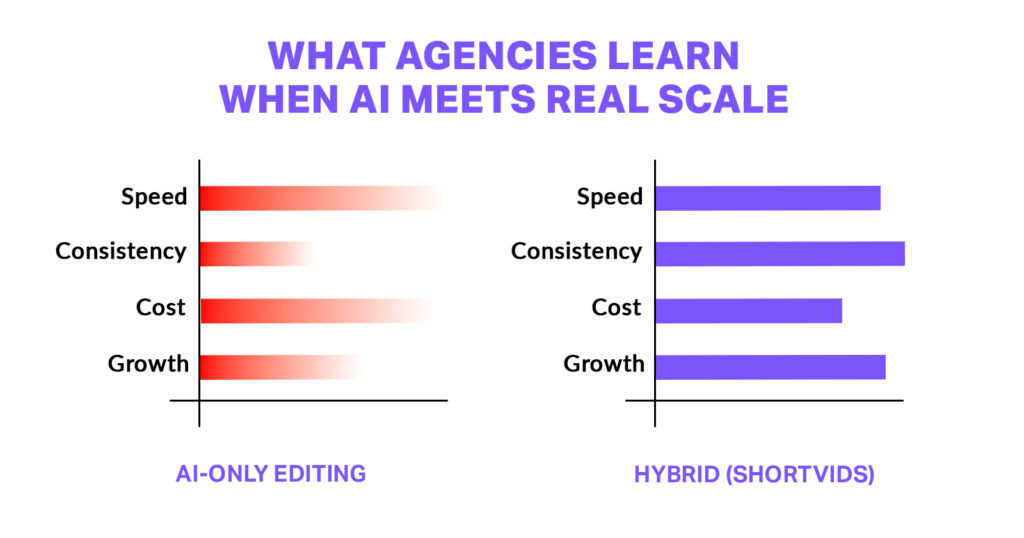
When evaluating scalability, agencies need to look beyond speed and output. AI-only workflows may seem fast, but they often fail to maintain quality, brand consistency, and audience engagement as volume increases.
Hybrid models combine content automation with human oversight, ensuring reliability across every piece of content. The table below highlights how AI-only and hybrid approaches compare across the factors that truly matter for scaling content.
| Factor | AI-Only Editing | Hybrid(ShortVids) |
|---|---|---|
| Speed | High | High |
| Consistency | Low at scale | Stable |
| Revisions | Frequent | Minimal |
| Brand control | Weak | Strong |
| Cost predictability | Deceptive | Transparent |
| Long-term growth | Unstable | Sustainable |
What Should Agencies Do Instead of Choosing AI or Humans?
The most effective strategy isn’t choosing between AI and humans, it’s combining both. Agencies like ShortVids rely solely on one approach: either sacrifice speed or compromise quality. The winning formula is a hybrid workflow, where generative AI handles repetitive tasks while humans safeguard brand integrity, tone, and audience engagement.
This balance allows teams to scale reliably without overwhelming resources. Human editors create operational memory through feedback loops, QA standards, and performance tracking, while AI executes repetitive editing at scale. Smart agencies leverage this combination to eliminate busywork, standardize quality, avoid video editing mistakes, and reduce revisions. Key practices include:
- Using AI to handle bulk trimming, cuts, and assembly
- Applying human judgment for tone, pacing, and narrative intent
- Building feedback loops to guide AI output without retraining models
- Standardizing QA checklists to maintain consistent quality
- Measuring performance metrics instead of raw output volume
Case Study: For the global industrial brand Weidmann Group, ShortVids delivered over 750 polished edits, enabling standardized messaging across 30+ locations. This hybrid workflow reduced editing costs by half, improved content output consistency, and freed internal teams for strategic work.
Your Takeaway!
AI-only editing breaks when consistency, trust, and scale matter most. Hybrid teams fix this by combining speed with judgment. If you want content that performs at volume without constant revisions, controlled AI workflows are the only sustainable path. ShortVids helps agencies scale smarter without losing quality. Ready to stop fixing AI mistakes and start scaling reliably? Talk to ShortVids today.
Frequently Asked Questions
Yes, for drafts, internal content, or low-stakes experiments. Not for branded or monetized channels.
No. Strategic QA is faster than endless revisions caused by AI mistakes.
Unlikely, because editing is judgment-driven, not rule-based.
At key checkpoints: hooks, pacing, brand tone, and final output.
Agencies prefer us for consistency, speed, white-label delivery, and predictable results at scale.
Book a Call Today
- Fixed monthly plans starting at $999
- 24-hour turnaround time (or less) on all short-form edits
- 3-layer quality check system on every video
- No more chasing freelancers or managing editors
- Scale up to 50+ videos/month without hiring in-house
- Content team trained on platform trends, scroll-stopping hooks & storytelling
- Fully managed by professionals – you just upload & approve
- Response time: Under 1 hour (US & GCC time zones)
Cut your production costs, not your standards.