

YouTube has changed fast. What worked two years ago doesn’t always work now, especially for creators building faceless channels. One week, everyone says YouTube Shorts are killing long form. Next, creators swear long videos are the only way to make real money.
So what’s the truth?
If you’re confused about faceless Shorts vs long form, you’re not alone. Creators are stuck choosing between fast reach and long-term income, between virality and trust, between watch time vs reach. In 2025, data shows faceless Shorts formats are driving a significant performance lift with a 58% retention boost and widespread adoption of AI editing tools. This makes Shorts one of the most efficient ways for faceless channels to rack up views and engagement early on. (AWISEE Youtube Shorts Stats)
But reach and retention alone don’t equal sustainability, and that’s where most creators make the wrong decision.
This guide breaks down YouTube Shorts vs long videos with zero fluff. You’ll see what each format is actually optimized for, how the algorithm treats them differently, and how to build a faceless content strategy that grows views and revenue.
Quick Summary
TL;DR: Faceless YouTube growth relies on balancing Shorts for reach and long-form videos for trust and monetization. Creators who use a structured Shorts → long-form funnel maximize views, engagement, and revenue, while avoiding common pitfalls of single-format dependence. Outsourcing production and optimization, like with ShortVids, accelerates scalability and sustainable growth. #tldr
- Core Components: Shorts → Discovery & Topic Testing → Engagement Data → Long-Form → Authority & Monetization → Algorithm Optimization → Strategic Funnel
- Outcome: Scalable, profitable faceless channels with consistent growth, diversified revenue, and minimized burnout.
Combine Shorts and long-form for real growth!
What Are YouTube Shorts Really Optimized For?
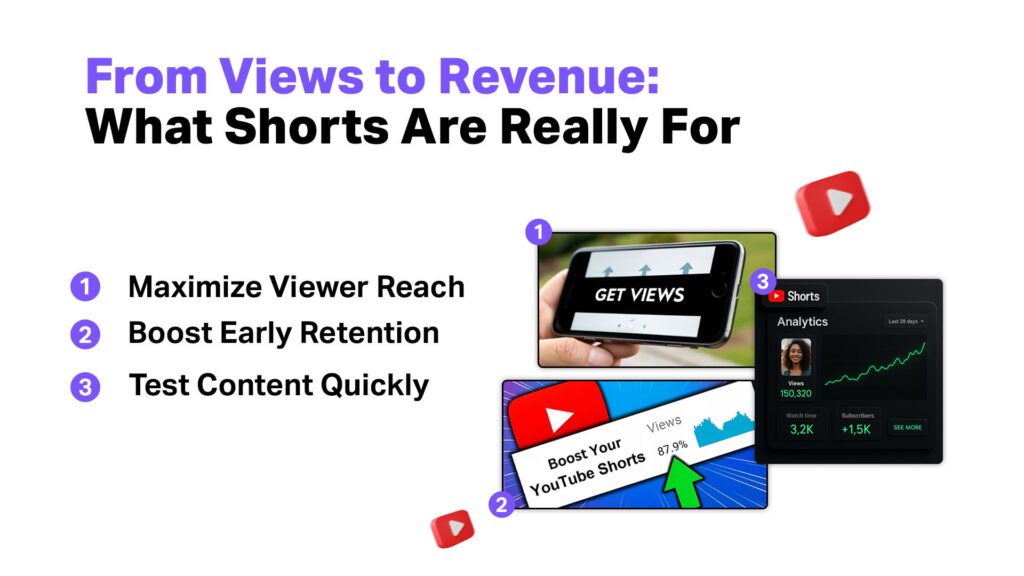
YouTube Shorts are not mini long-form videos. They are a high-velocity discovery engine, built to push content to massive audiences fast, especially audiences that don’t know you yet.
In fact, YouTube Shorts now receives 70–200 billion views per day globally, dwarfing most long-form view counts and positioning Shorts as YouTube’s most aggressive reach surface to data.
However, reach doesn’t equal revenue. Typical YouTube Shorts monetization payouts sit around $0.01–$0.06 per 1,000 views, while long-form videos earn anywhere from $1.61 to $29.30 per 1,000 views through standard ad placements (GizmoBase).
In simple terms, Shorts are fast for exposure, but long form videos still dominates when it comes to income and depth.
Shorts Are Built for Reach, Not Loyalty
The Shorts feed prioritizes non-subscriber distribution first. Every Short is tested with small audience batches, then rapidly scaled if early engagement signals hit the right thresholds. This is why YouTube Shorts’ growth often looks explosive even for brand-new faceless channels.
The signals that matter most are:
- Retention in the first 1–3 seconds
- Completion rate
- Replays
- Swipe-stopping visuals
If those metrics perform, Shorts travel far, regardless of channel size.
Why Faceless Shorts Perform So Well
Faceless content fits the Shorts ecosystem naturally. Viewers don’t expect personality or brand familiarity in a scrolling feed; they respond to clarity, pacing, and visual hooks. Formats like AI voiceovers with captions, stock footage with bold text, or fast screen recordings consistently outperform because editing quality matters more than identity.
Where Shorts Fall Short
Short form videos are not optimized for trust or deep monetization. Subscriber loyalty is weaker, conversions are inconsistent, and CPMs remain low. That’s why creators who rely solely on Shorts often hit a ceiling, even with millions of views.
YouTube Shorts: Strengths vs Limitations
Before deciding whether Shorts fit your channel, it helps to see the trade-offs clearly. YouTube Shorts are powerful, but only when you understand what they give you and what they don’t.
| Positive Aspects of YouTube Shorts | Negative Aspects of YouTube Shorts |
|---|---|
| Massive reach potential, even for brand-new faceless channels | Extremely low CPMs compared to long-form videos |
| Optimized for discovery through the Shorts feed | Weak subscriber loyalty and repeat viewership |
| Fast feedback loop for testing hooks and topics | Limited trust-building due to short attention spans |
| No need for personal branding or on-camera presence | Poor conversion for affiliates, products, or services |
| Can go viral without search or browse traffic | Revenue is inconsistent and difficult to scale |
This table makes one thing clear: Shorts are a reach accelerator, not a revenue engine. They work best when paired with long-form content that captures attention after discovery.
Turn views into revenue with smarter content strategy!
What Is Long-Form YouTube Optimized For?
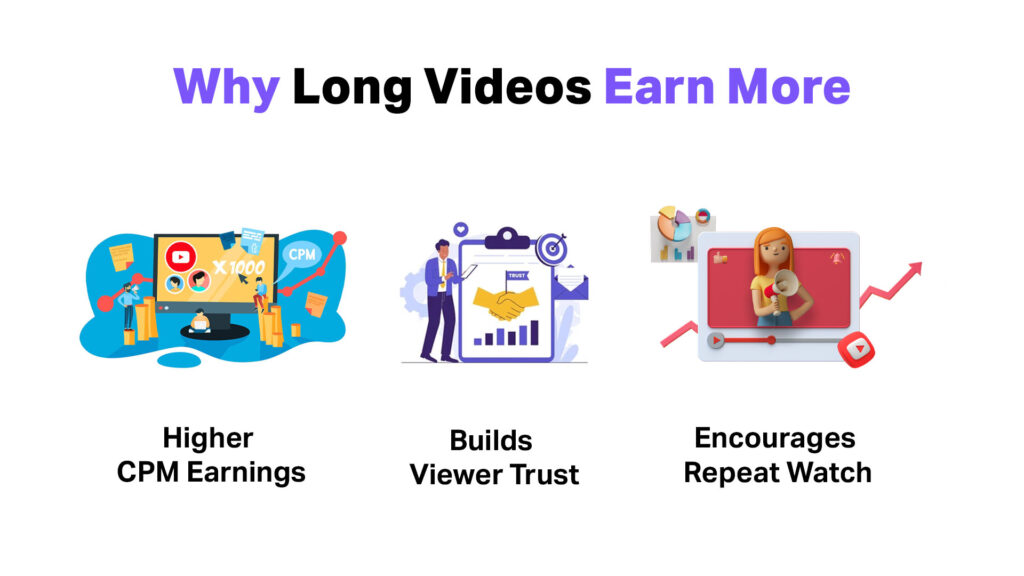
Long-form YouTube videos are built for a completely different outcome. Unlike Shorts, which chase speed and scale, long videos are designed to hold attention, build trust, and generate predictable revenue over time. This format thrives on depth, not velocity.Data supports this shift.
According to YouTube monetization benchmarks and creator revenue studies, long-form videos earn 5–10× higher CPMs than Shorts, with rates commonly ranging from $1.61 to $29.30 per 1,000 views, depending on YouTube Channel niches and viewer intent (GizmoBase). That’s why long-form remains the backbone of profitable YouTube businesses even as Shorts dominate reach.
Long Videos Are Built for Trust and Monetization
Long-form content is primarily distributed through Browse, Suggested, and Search, meaning YouTube recommends these videos based on viewer behavior and relevance, not randomness. When someone watches one of your long videos, YouTube tracks how long they stay, whether they continue watching other videos, and whether they return later. That’s where money lives.
A Forbes case study highlighted a faceless YouTube channel that scaled to 138,000 subscribers and over 32 million views, earning $800–$1,000 per day using long-form content alone, without on-camera presence or personal branding. This proves faceless doesn’t mean low trust when structure and value are strong.
What the Long-Form Algorithm Rewards
For any sustainable long-form YouTube strategy, the algorithm focuses on:
- Session watch time
- Watch time per viewer
- Viewer satisfaction
These signals tell YouTube your content keeps people on the platform and YouTube rewards that behavior with more visibility.
Why Faceless Long-Form Still Works
Faceless long videos succeed because viewers care more about clarity, structure, and usefulness than who’s on camera. Explainers, documentary-style narration, list-based education, and voiceover storytelling consistently perform because they deliver depth and authority.
Long-Form YouTube: Benefits vs Limitations
To clearly understand what long form video trends bring to your channel, it helps to weigh their strengths against their limitations. The table below breaks down the key benefits and potential drawbacks of investing in long-form content.
| Benefits of Long-Form YouTube | Limitations of Long-Form YouTube |
|---|---|
| Higher CPMs and stable revenue | Slower initial discovery |
| Builds trust and authority | Requires stronger video scripting |
| Encourages repeat viewers | Longer production cycles |
| Supports mid-roll ads | Less viral by default |
| Strong affiliate and product conversion | Results take time |
Long-form isn’t about instant wins. It’s about compounding growth, trust, and on your YouTube Channel monetization, which is why it pairs best with Shorts, not against them.
How YouTube’s Algorithm Treats Shorts vs Long Videos
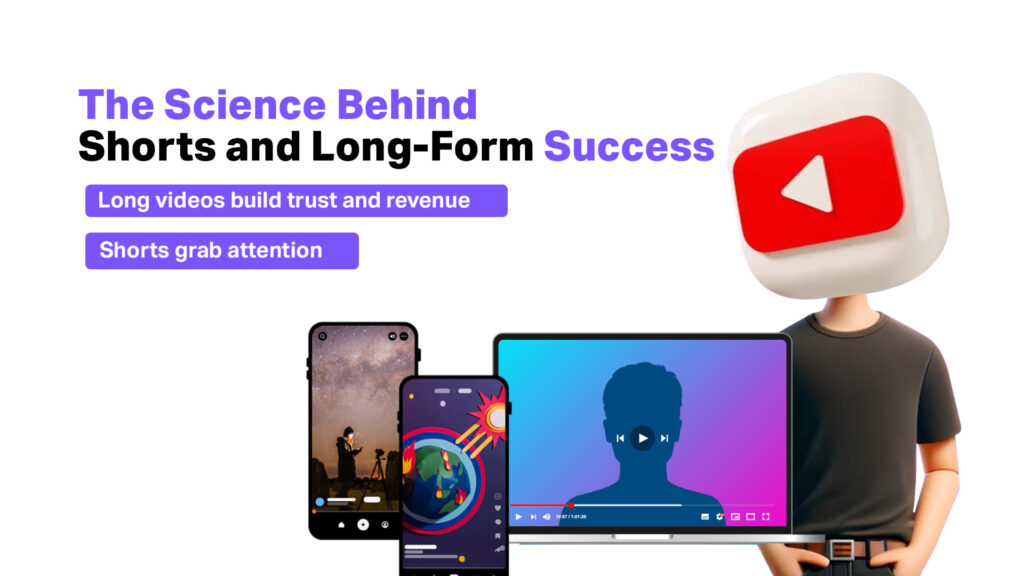
Understanding how YouTube’s algorithm treats Shorts versus long-form videos is crucial for any content strategy for Faceless content. Many creators fail not because their content is bad, but because they misalign their format with the algorithm’s intent. Knowing the difference can prevent wasted effort and false growth signals.
Distribution Differences Between Shorts and Long Form
Before diving deeper, it’s helpful to compare the core features and triggers of each format:
| Feature | Shorts | Long Form |
|---|---|---|
| Primary Goal | Discovery | Retention |
| Audience | Mostly new viewers | Returning + new viewers |
| Algorithm Trigger | Completion & replays | Watch time & satisfaction |
| Monetization Power | Low | High |
| Trust Building | Weak | Strong |
Shorts are designed for mass reach and rapid discovery, whereas long-form videos thrive on watch time, satisfaction, and repeat engagement. That’s why the idea that “Shorts are killing long form” is a myth. Shorts themselves won’t destroy your channel, but relying on them exclusively can create serious pitfalls.
The Hidden Risk of Relying Only on Shorts
Many creators fall into the subscriber trap when using Shorts as a standalone growth tool. Many subscribers often don’t:
- Watch long videos
- Click notifications
- Convert into loyal fans or buyers
This creates false growth signals, your subscriber count rises, but your monetization and engagement don’t. You might see huge view spikes but minimal income or lasting loyalty.
The Smart Way to Combine Reach and Retention
YouTube itself advises using Shorts primarily as a top-of-funnel tool to expose new viewers to your content quickly. Long-form content should then capture those viewers, build trust, and monetize effectively.
Aligning your content with these algorithmic behaviors ensures both formats work together, rather than against each other, maximizing reach and revenue simultaneously.
Should You Focus on Shorts or Long Videos at Different Channel Stages?
Many creators struggle to decide whether to prioritize Shorts or long videos, and the answer isn’t one-size-fits-all. Your strategy should evolve depending on your channel size, goals, and YouTube monetization stage.
Stage 1: New or Small Faceless Channel
Best Mix: 70% Shorts / 30% Long Form
For new channels, Shorts are your fastest route to discovery and initial data. They help you identify trending topics, test hooks, and see what content keeps viewers engaged. Long-form videos at this stage serve as experiments for retention and depth, giving you early insights into what type of content your audience will binge or subscribe to.
Stage 2: Growing Channel (10k–100k subs)
Best Mix: 50% Shorts / 50% Long Form
At this stage, Shorts are no longer just discovery tools; they should funnel viewers toward your long-form content. Use Shorts to tease highlights, emphasize key moments, and capture attention quickly, while your YouTube long videos build watch time, authority, and a loyal subscriber base. This is the stage where a Shorts-to-long funnel becomes a critical growth mechanism.
Stage 3: Monetization-Focused Channel
Best Mix: 30% Shorts / 70% Long Form
Channels focused on revenue should lean heavily on long-form content. This is where CPMs, mid-roll ads, affiliate links, and conversions live. Shorts still play a supporting role by amplifying launches and maintaining reach, but trust and engagement now outweigh viral YouTube Videos. Most full-time faceless creators operate here, using Shorts strategically rather than as their primary growth driver.
Why Do Most Creators Fail by Choosing Only One Format?
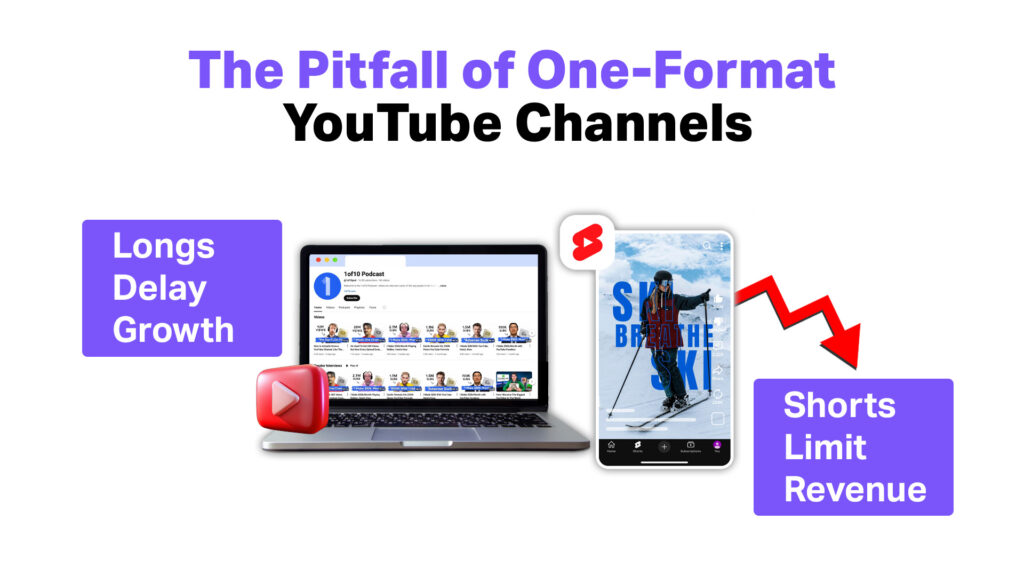
YouTube doesn’t reward isolated formats; it rewards ecosystems. Creators who rely solely on Shorts or long-form often hit early ceilings, despite strong content.
Shorts-Only Creators
Shorts can generate massive views, but revenue caps early due to low CPMs ($0.01–$0.06 per 1,000 views). Subscriber loyalty is weak; most Shorts viewers don’t watch your long-form content or convert. High platform dependency creates volatility; one algorithm tweak can tank visibility overnight.
Long-Form-Only Creators
Long-form videos build authority, but discovery is slower. Growth may feel invisible in the first 10k–50k subscribers. Production is time-intensive, raising the risk of burnout.
The creators who succeed understand that watch time vs reach is not a competition, it’s a balance. The smart strategy leverages each format for its core strength: Shorts for rapid discovery, long-form for retention and monetization.
How Should You Build a Sustainable Faceless Content Strategy?
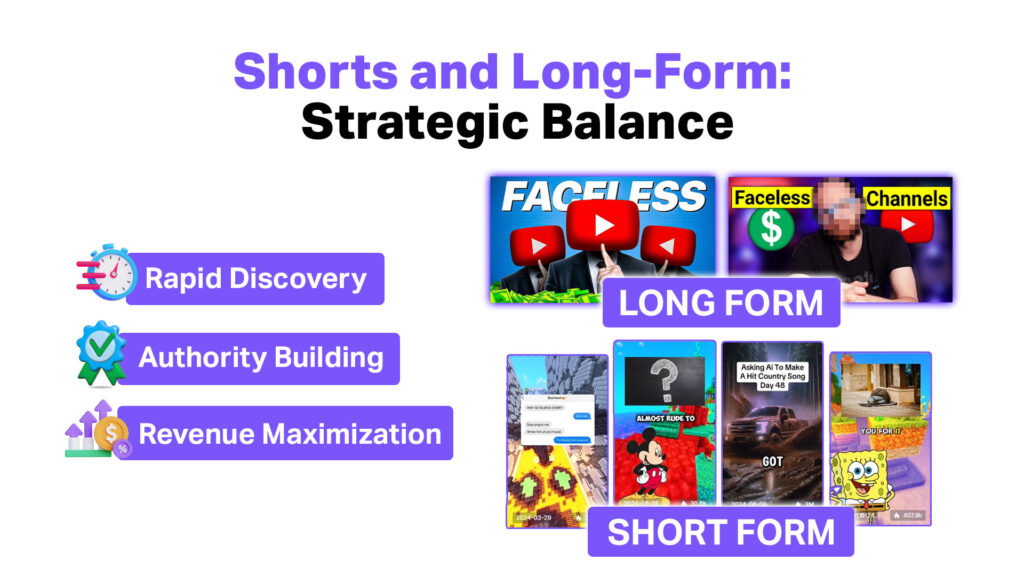
Building a successful faceless YouTube channel requires using both Shorts and long-form content in harmony. Shorts generate rapid reach and insights, while long-form videos build trust, authority, and revenue. When combined strategically, they create a full YouTube sales funnel ecosystem that maximizes both growth and monetization.
Shorts vs Long-Form: How to Use Each
Before implementing your strategy, it helps to visualize where each format adds value and how they complement each other:
| Content Type | Primary Purpose | Key Actions/Usage | Example |
|---|---|---|---|
| Shorts | Discovery, topic testing, and reach | – Test hooks and trending topics quickly- Capture attention in the first 3–5 seconds- Gather engagement data | “This AI Tool Replaced Freelancers” |
| Long Form | Retention, authority, monetization | – Deep-dive into the topic- Build trust and brand credibility- Maximize CPMs, affiliates, and product revenue | “How Businesses Are Replacing Freelancers With AI Tools (Step-by-Step)” |
Practical Example: If a Short titled “This AI Tool Replaced Freelancers” goes viral, your long-form follow-up should be “How Businesses Are Replacing Freelancers With AI Tools (Step-by-Step)”. This Shorts → Long-Form funnel transforms fleeting attention into sustained engagement, loyalty, and revenue, making your faceless YouTube channel successful and profitable.
How ShortVids Turns Shorts and Long-Form Into a Profitable Funnel
Scaling faceless content is about creating high-quality, optimized content at scale without burning out. ShortVids specializes in helping creators and brands leverage both Shorts and long-form videos effectively. We have an extended creative team to produce, edit, and optimize content for maximum reach and revenue.
A prime example is Gene Slade, who partnered with ShortVids to scale his content output from 50 to 150+ videos per month. Through a mix of Shorts and long-form content, Gene significantly increased his visibility, engagement, and monetization, demonstrating how a structured content strategy and professional editing support can turn faceless videos into a growth engine.
By outsourcing editing and production, creators and businesses can focus on strategy, ideas, and audience engagement. While ShortVids ensures videos are optimized for algorithmic performance, retention, and monetization. Whether testing new topics with Shorts or building authority with long-form content, our services enable a scalable, sustainable, and profitable content ecosystem.
Your Takeaway!
If you’re choosing between faceless Shorts vs long form, you’re asking the wrong question. Shorts win reach. Long-form wins trust and money. The creators who grow fastest and last longest, use Shorts to open the door and long videos to close the deal. Build both with intention, and YouTube works for you, not against you. Let ShortVids turn your Shorts and long-form videos into a fully optimized, revenue-generating YouTube machine, start today!
Frequently Asked Questions
No. Shorts affect discovery, not long-form recommendations. Poor strategy causes the conflict, not the format.
Start with Shorts for data and discovery but introduce long-form early to build depth.
Yes, but earnings are limited compared to long-form monetization and funnels.
Only if you don’t funnel correctly. Aligned content improves performance.
Hook fast, solve one problem, and direct viewers toward deeper content.
Book a Call Today
- Fixed monthly plans starting at $999
- 24-hour turnaround time (or less) on all short-form edits
- 3-layer quality check system on every video
- No more chasing freelancers or managing editors
- Scale up to 50+ videos/month without hiring in-house
- Content team trained on platform trends, scroll-stopping hooks & storytelling
- Fully managed by professionals – you just upload & approve
- Response time: Under 1 hour (US & GCC time zones)
Cut your production costs, not your standards.