

AI didn’t break content teams, but the unstructured prompting did. Most agencies don’t struggle because AI is “bad.” They struggle because everyone is prompting differently, expecting consistent output, and wondering why quality quietly drops over time. One strategist writes prompts from scratch. Another editor tweaks them. A producer copies something from Slack. Six weeks later, the same task produces wildly different results. This is where scalable prompt libraries change everything.
A scalable prompt library is a full-fledged operational system. One that standardizes outcomes, protects quality, and still leaves room for creative judgment. When built correctly, prompt libraries reduce revisions, speed up production, and make AI usable across teams. Marketing teams using AI report 44% higher productivity, saving an average of 11 hours per week. (Pipeline.Zoominfo)
In this guide, we’ll break down how high-performing agencies structure scalable prompt libraries. And why bad prompts silently damage output, and how teams using systems like ShortVids turn prompts into scalable production assets.
Quick Summary
TL;DR: Content teams fail at scale not because of AI, but because prompts are unstructured and inconsistent. Agencies scale content reliably when prompts are treated as systems, not one-off tasks. Role-based, versioned, and categorized prompts lock in quality and reduce revisions. Platforms like ShortVids make this operational with scalable prompt libraries at scale. #tldr
- Core Components: Defined Prompt Frameworks → Role-Specific Instructions → Versioning & QA → Structured, Scalable Workflows → Continuous Optimization
- Outcome: Predictable, brand-consistent content at scale with faster turnaround, fewer revisions, and lower editor burnout.
Stop prompt chaos, start consistent content workflows today!
What Problems Do Content Teams Face Without a Prompt Library?
Content teams don’t feel the damage right away. Output still goes live, but as volume increases, small inconsistencies start compounding into real workflow issues. Prompts get written on the fly, copied between AI tools, and casually edited, creating hidden friction across the team.
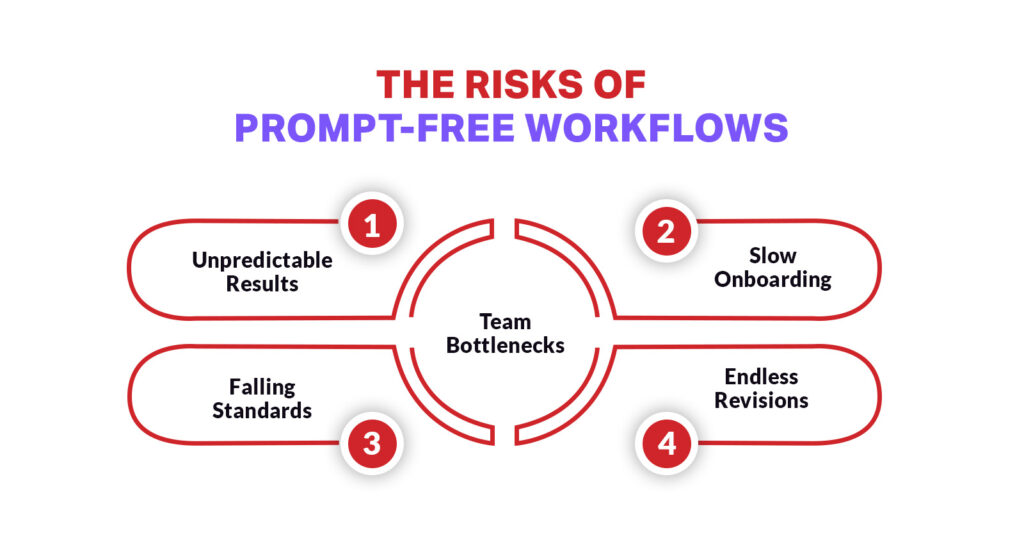
What usually breaks first:
- Inconsistent outputs for the same task across writers and editors
- Quality drift as prompts get copied, shortened, or “improvised”
- Revision overload because outputs don’t match expectations
- Dependency on senior staff to “fix” AI results
- No way to onboard new team members into the AI workflow
Learn More: How You Can Automate Your Content Workflows With AI
A strong example is Mongoose Media, a Shopify-focused agency in Orlando. Before standardizing AI prompts, long-form blog production was slow and uneven across writers. After introducing standardized prompt frameworks, the team began producing SEO-ready blogs in under two hours. Furthermore, they deliver over 40 posts for a client in six months without hiring additional staff.
The takeaway is simple: The problem isn’t AI capability. It’s operational discipline. Without a shared prompt system, AI behaves unpredictably. And unpredictability is the enemy of scale. This is why agencies that successfully scale content don’t ask, “What’s a good prompt?”
But they ask, “What’s our standard prompt for this job?”
Fix inconsistent outputs with structured prompt library systems!
Why Do Traditional Prompting Methods Fail at Scale?
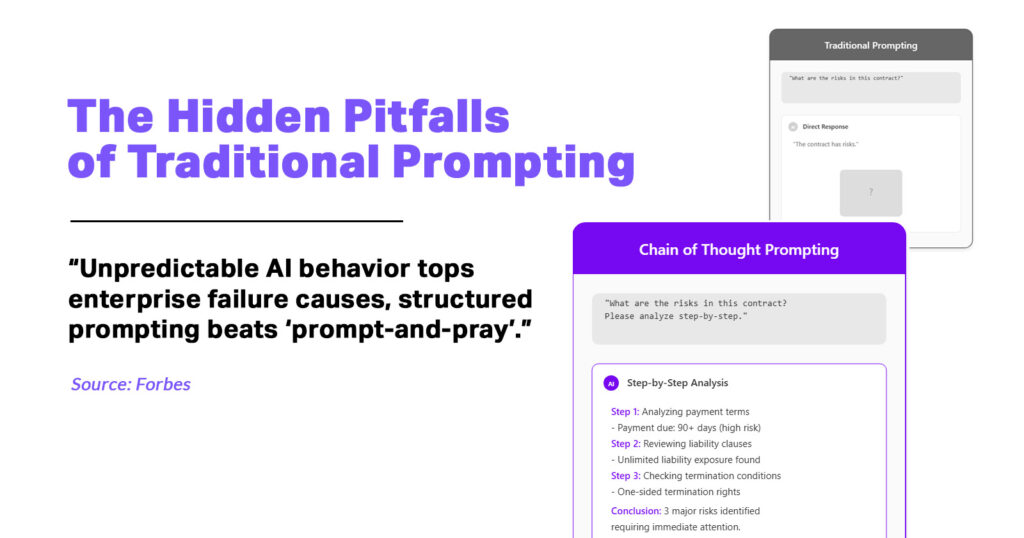
Most teams don’t fail because their prompts are bad. They fail because those prompts were never designed to scale. What works for a single writer or a small batch of content starts to break down once the output volume increases and multiple roles touch the same workflow. Without structure, inconsistency becomes inevitable.
Traditional prompting relies too heavily on individual judgment, undocumented assumptions, and informal tweaks. As teams grow, these weaknesses surface fast, showing up as quality drops, revision overload, and growing distrust in AI outputs.
Prompts Are Treated as Disposable
Most prompts are written for immediate use, not long-term reuse. There’s no versioning, no ownership, and no review process. Over time, prompts get shortened or altered, quietly stripping away the constraints that originally produced good results.
Output Expectations Live in People’s Heads
Editors know what “good” looks like but prompts rarely encode that judgment. When expectations aren’t explicitly defined, AI content fills the gap with safe, generic output, forcing humans to correct issues that could have been prevented upfront.
No Role Clarity
Strategists, editors, and producers need different outputs, yet they often use the same prompt. This role confusion leads to misaligned results and unnecessary revisions because the prompt isn’t optimized for the decision-maker using it.
Creativity Gets Blamed Instead of Structure
When output quality drops, teams blame AI creativity. In reality, the issue is structural. Research shows that well‑structured prompts can increase task accuracy by up to ~37% compared with unstructured inputs, yet most teams never operationalize this consistently.
This is why most platforms avoid ad-hoc prompt Engineering; prompts are treated as systems, not shortcuts. Here’s a table summarizing the failures related to prompting issues:
| Prompting Issue | What Teams Do Today | What Breaks at Scale |
|---|---|---|
| Disposable Prompts | Write one-off prompts for immediate tasks | Quality degrades as prompts are copied, shortened, or altered |
| Unwritten Expectations | Rely on editor’s judgment instead of the prompt rules | AI produces generic output that needs heavy revisions |
| No Role Separation | Use the same prompt for strategists, editors, and producers | Outputs miss intent and increase back-and-forth |
| Blaming “Creativity” | Assume AI lacks creativity when results are weak | Structural prompt flaws go unaddressed |
| No Governance | No versioning, review cycle, or ownership | Inconsistency grows as output volume increases |
How Should Scalable Prompt Libraries Be Categorized for Maximum Efficiency?
A scalable prompt library is a modular system designed to reduce creative fatigue and keep output consistent as teams grow. When prompts are organized by function, teams stop guessing which prompt to use and start executing faster. This approach also makes onboarding easier and quality easier to control.
High-performing teams structure scalable prompt libraries around what the prompt is meant to achieve, not the content format.
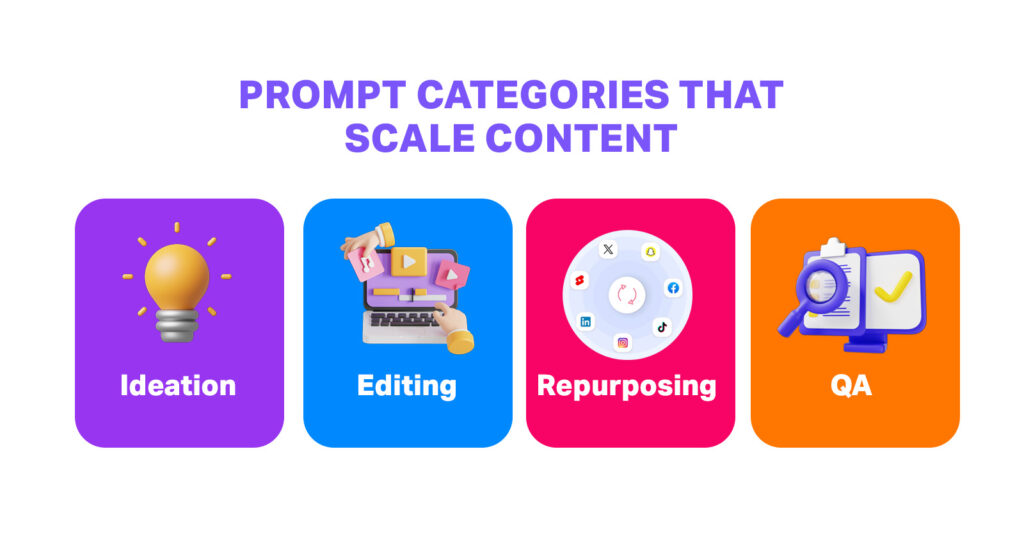
Core Prompt Categories That Scale
Each category serves a specific operational purpose and removes ambiguity from how AI is used across the team.
- Ideation Prompts
Used for generating angles, hooks, outlines, and content variations without starting from scratch. - Editing Prompts
Designed to refine clarity, tighten structure, and enforce brand tone while preserving intent. - Repurposing Prompts
Used to adapt content across platforms, such as blogs into shorts, emails, or social captions. - QA & Compliance Prompts
Focused on accuracy checks, SEO alignment, brand consistency, and error detection before publishing.
This structure ensures the same task always uses the same cognitive framework, regardless of who runs the prompt.
Prompt Categories vs Outcomes
A simple category-to-outcome mapping helps teams choose the right prompt without trial and error.
| Prompt Category | Primary Goal | Business Impact |
|---|---|---|
| Ideation | Speed and breadth | Faster content planning cycles |
| Editing | Quality control | Fewer revisions |
| Repurposing | Distribution efficiency | More reach per asset |
| QA & Compliance | Risk reduction | Fewer errors and rework |
How Do Role-Based Prompts Improve Output Consistency?
One prompt cannot serve everyone and trying to use one is the fastest way to dilute quality. Content breakdowns usually happen when different roles expect different outcomes from the same instruction. Role-based prompting fixes this by aligning prompts with decision-making responsibility.
Instead of vague commands like “Edit this to sound better,” teams define who is prompting and what judgment that role represents. This removes ambiguity, reduces revisions, and ensures AI outputs match intent the first time.
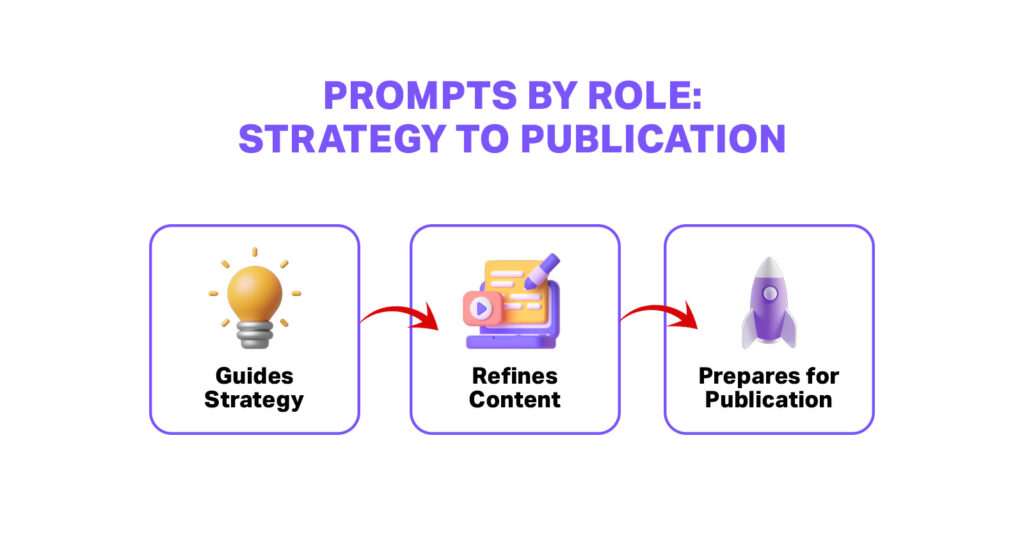
Strategist Prompts
Strategist prompts focus on positioning, audience intent, and messaging hierarchy. They guide AI to think at a campaign or funnel level rather than execution details.
Example: “Does this outline align with top-of-funnel search intent and primary buyer pain points?”
Editor Prompts
Editor prompts prioritize clarity, structure, tone, and flow. They ensure content meets quality standards without changing meaning or strategy.
Example: “Remove redundancy, tighten transitions, and maintain brand tone without altering intent.”
Producer Prompts
Producer prompts emphasize speed, formatting, and delivery readiness. They help transform approved content into publishable assets efficiently.
Example: “Format this article for CMS upload with H2s, meta fields, and internal links.”
This role separation prevents creative conflict and keeps feedback loops short. Teams using role-based prompts report 25–35% faster turnaround times, according to benchmarks shared by HubSpot partner agencies.
Why Should Prompts Be Versioned Like Code?
Prompts don’t usually fail all at once, they decay over time. Small edits, shortcuts, and well-meaning “optimizations” slowly strip away the constraints that made them effective. Without versioning, teams lose track of what actually works.
Versioning isn’t a technical process. It’s an accountability system that protects output quality as more people touch the workflow.
What Prompt Versioning Looks Like in Practice:
- v1.0 – Initial tested prompt
- v1.1 – Improved constraints after QA feedback
- v2.0 – Updated for new platform or format
Each version answers:
- What changed?
- Why it changed?
- Who approved it?
This prevents silent degradation, where prompts get shortened, copied, or “optimized” until they no longer do their job.
Our team also follows the same logic internally at ShortVids. Prompt updates are treated like workflow updates, not creative experiments. That’s how quality stays stable even as output volume scales.
How Do Bad Prompts Quietly Destroy Content Quality?

Bad prompts rarely break workflows overnight. Instead, they erode quality gradually, making the decline hard to trace. Content starts sounding generic, editors step in more often, and teams quietly lose confidence in AI outputs without knowing what changed.
The warning signs are consistent: manual edits increase, editors override AI instead of guiding it, and output reliability drops. Because the shift happens slowly, teams adjust their behavior rather than fixing the root cause. AI becomes something to “clean up” instead of a system to trust.
Most prompt failures are structural. They lack clear constraints, don’t define what success looks like, mix multiple roles into one instruction, or over-optimize for speed at the expense of quality.
Over time, this creates what teams call AI fatigue, not because AI underperforms, but because prompts are unmanaged. A maintained prompt library stops this decay by locking quality directly into the workflow.
How Can Teams Standardize Output Without Killing Creativity?
Creative teams don’t resist standardization because they hate systems, they resist it because they fear losing voice. That concern is valid when prompts are rigid or overly prescriptive. The real solution is designing prompts that guide outcomes without dictating expression.
Here’s how high-performing Teams do it:
- Standardize structure, not ideas
- Define constraints, not opinions
- Lock outcomes, not phrasing
Prompts should clearly state:
- What must be true
- What cannot change
- Where flexibility is allowed
Creativity thrives inside boundaries. That’s how agencies scale marketing or output without flattening voice or slowing teams down.
What Does a Scalable Prompt Library Actually Look Like?
A scalable prompt library is practical, not complex. It’s designed so anyone on the team can quickly find the right prompt, understand its purpose, and use it without second-guessing.
| Prompt Name | Role | Category | Version |
|---|---|---|---|
| Blog Outline – SEO | Strategist | Ideation | v2.1 |
| Copy Tightening | Editor | Editing | v1.4 |
| Blog→Shorts | Producer | Repurposing | v3.0 |
| Final QA Check | Editor | QA | v2.0 |
This isn’t a theoretical framework or a best-practice checklist. This is how teams maintain quality, speed, and consistency while scaling output across multiple contributors.
How ShortVids Can Help Build Scalable Prompt Libraries?
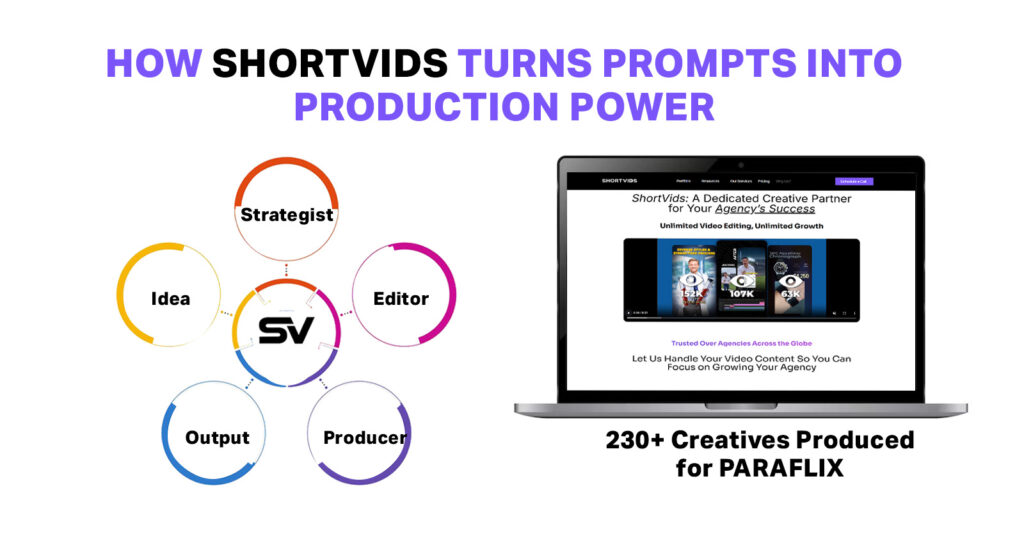
When content teams struggle to scale, the actual issue is execution. ShortVids acts as a strategic partner that operationalizes content workflows so teams can produce high-volume, high-quality outputs without chaos or manual bottlenecks. Their system blends creative oversight with structured production, mirroring the principles of a scalable prompt library in action.
One strong example is Namami Inc. They use ShortVids as an extended creative partner to streamline video content production and maintain consistent brand messaging across formats. We help them in removing bottlenecks and turning ideas into scalable assets.
Another case study shows Cody Blundell, who scaled his personal brand and PARAFLIX content with ShortVids. Our team produced 230+ high‑quality creatives that stayed on message while freeing up time for strategic priorities.
Thus, by combining strategic planning with repeatable workflows and role-specific output frameworks, we help teams mirror the benefits of a prompt library. That is predictable quality, faster delivery, and creativity that thrives inside boundaries.
Your Takeaway!
If your content quality drops as volume rises, the problem isn’t talent or AI. It’s the lack of a prompt system. Treat scalable prompt libraries like production assets, not clever shortcuts. Build libraries, assign roles, version changes, and protect quality at scale. Take control of your content workflow today with ShortVids, streamline prompts, scale output, and maintain consistent quality across every asset. Schedule a Callfor your scalable content system now!
Frequently Asked Questions
A centralized, versioned collection of prompts designed for specific roles and tasks to ensure consistent output quality.
Whenever output quality shifts, platforms change, or new formats are introduced, usually monthly or quarterly.
Yes. Smaller teams benefit even more because they reduce dependency on individual judgment.
No. They remove ambiguity, so creativity is applied where it matters.
ShortVids operationalizes prompts across roles and workflows to maintain quality while scaling content output.
Book a Call Today
- Fixed monthly plans starting at $999
- 24-hour turnaround time (or less) on all short-form edits
- 3-layer quality check system on every video
- No more chasing freelancers or managing editors
- Scale up to 50+ videos/month without hiring in-house
- Content team trained on platform trends, scroll-stopping hooks & storytelling
- Fully managed by professionals – you just upload & approve
- Response time: Under 1 hour (US & GCC time zones)
Cut your production costs, not your standards.