

Quick Summary
TL;DR: You can outsource ad creative production without surrendering control of your brand. Keep ownership of positioning, product claims, customer insight, decision rights and final approvals — and delegate research, concepting, scripting, design, editing and variation production to a specialist team. The brands that lose control did not lose it because they outsourced; they lost it because they outsourced without a system. This guide gives you that system. #tldr
Scale your creative output without losing the brand!
Get Three Ad Concepts for Your Business
For a business already spending meaningfully on paid acquisition, the biggest risk is usually not outsourcing. It is continuing with a slow, fragmented creative pipeline that cannot feed the testing volume modern platforms demand. Meta now explicitly encourages creative diversification — building meaningfully different assets for different personas and use cases rather than minor edits of one idea. (Source: Meta for Business)
That means your production model has to solve two problems at once: produce enough genuinely different ideas to support real testing, and preserve the positioning, identity and truth that make those ideas recognisably yours. This guide gives you the operating model, brief, approval process, quality checks, cost framework and provider scorecard to do both — the same system behind ShortVids Ads as a Service.
What Is Outsourced Ad Creative Production?
Outsourced ad creative production is a working model in which an external specialist handles some or all of the research, ideation, scripting, design, editing and variation production for your paid ads, while your business keeps ownership of brand strategy, claims, budget and final approval. It is not the same as outsourcing your entire advertising function — a brand can keep campaign strategy, media buying and budget control internal while an external team supplies the concepts and assets.
| The strongest model is not “hand everything away.” It is a controlled partnership where each side owns the work it is best equipped to do.
What an outsourced creative team can handle
Customer and competitor research, creative-angle development, ad concepts and testing hypotheses, hooks and scripts, storyboards, static image ads, carousels, motion graphics, video ads and editing, UGC-style creative, platform adaptations, controlled variations, creative QA, and performance-review recommendations.
What the brand should continue to own
Fundamental positioning, product truth and approved claims, offer and pricing, customer-data ownership, legal and compliance approval, media budget and account-access policy, final creative approval, and the decision to launch, pause or scale.
Why Outsourcing Is Becoming a Creative-Capacity Decision
Video and paid-social production are no longer occasional campaign activities. Wyzowl’s 2026 survey reports that 91% of businesses use video as a marketing tool, and lack of time is the most common production barrier. Some teams turn to an AI video editor as a quick fix for smaller, one-off edits, but for brands running paid campaigns at volume, that speed often comes at the cost of consistency and quality control — which is exactly where outsourcing to a dedicated production team pays off. (Source: Wyzowl 2026) But volume is not the same as testing quality — uploading 20 near-identical edits creates 20 files, not 20 learning opportunities.
Building the capacity internally is expensive. U.S. Bureau of Labor Statistics May 2024 median annual wages give a sense of the salary-only cost of a real creative function:
- Art directors: $111,040
- Market research analysts: $76,950
- Writers and authors: $72,270
- Film and video editors: $70,980
- Graphic designers: $61,300
(Source: U.S. Bureau of Labor Statistics) These figures exclude benefits, recruitment, software and management overhead — and one small in-house team still caps your output at its own capacity. Outsourcing is most valuable precisely when it removes that capacity constraint.
Why Brands Feel They Lose Control After Outsourcing
When an external team produces off-brand work, the reflex is to blame outsourcing itself. In practice, most failures trace to missing inputs and undefined decisions — not to the model. The six most common causes:
1. The brand lives in people’s heads, not a usable system. A logo and colour palette are not a brand operating system.
2. The brief has references but no objective. “Make it like this ad” describes a surface, not the customer, objection or hypothesis.
3. Nobody knows who decides. One person edits the message, another changes the visuals, a third adds an offer late.
4. Concepts are approved only after full production. The first real review happens after the final edit, making strategic changes slow and expensive.
5. Performance data never returns to the creative team. Without spend, CTR, CVR and CPA, the team cannot separate preference from market response.
6. Feedback is scattered across Slack, WhatsApp, email and calls. Important rules get buried instead of centralised.
The correction is not “keep every task internal.” It is to build controls around inputs, decision rights, review points and learning.
The CONTROL Framework for Outsourcing Without Losing the Brand
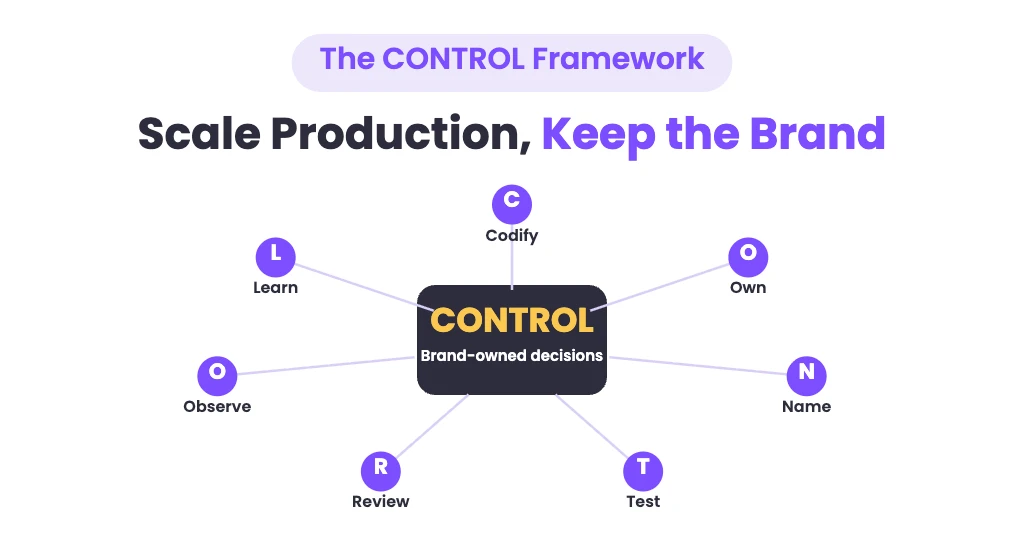
ShortVids uses a seven-part framework to organise the relationship between a brand and an external creative team.
C — Codify the brand. Turn the brand into instructions another professional can apply: positioning, segments, the problem solved, differentiators and proof, tone, visual identity, and approved vs prohibited claims. Boundaries make creative freedom useful, not restricted.
O — Own the decision rights. Name one accountable owner for each decision: concept, script, claims, visual execution, consolidated feedback and final launch. If five people can independently redirect the work, it becomes a compromise.
N — Name the testing objective. Every concept should state its audience, funnel stage, hypothesis and what will count as useful evidence. “We need five videos” is a production request; “we need to learn whether customer proof or product demonstration converts better” is a test.
T — Test concepts, not cosmetic changes. Diversification means distinct persuasive ideas for different personas and use cases — not a new caption colour.
R — Review in stages. Three gates: concept approval, script/storyboard approval, final creative approval. This stops a production review from becoming an unexpected strategy meeting.
O — Observe performance. Give the team the minimum data to learn: spend, impressions, CTR, CPC, retention signals, conversion rate and CPA. Google defines CTR as clicks ÷ impressions and conversion rate as conversions ÷ eligible interactions. (Source: Google Ads Help) Avoid one universal benchmark across different categories and offers.
L — Learn and document. Close every cycle with a retrospective: which concepts earned spend, which audiences responded, which proof improved qualified action, and what the next concept should test. The deliverable is an expanding body of knowledge — not just another batch of files.
Concepts, Variations and Adaptations Are Not the Same Thing
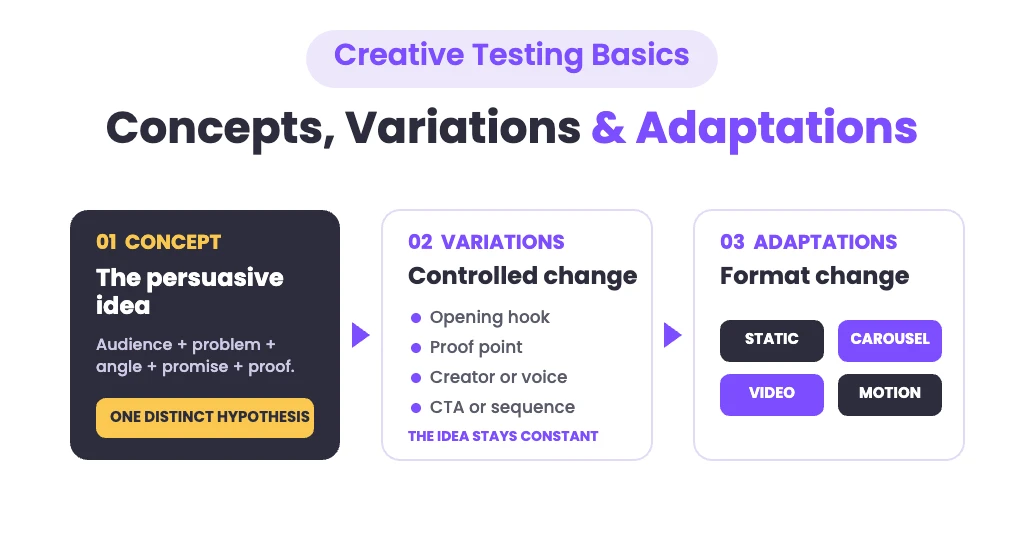
This distinction is one of the most important safeguards in outsourced production. A concept is the core persuasive idea — audience + problem + angle + promise + proof. A variation changes a controlled element inside that concept (a different hook, proof point, creator or CTA). A format adaptation expresses the approved concept in a different format (static, carousel, vertical video, motion, UGC).
One concept can produce several variations and adaptations — but a batch of adaptations should never be reported as a batch of original concepts. When you brief a partner, specify the number of concepts, variations and formats separately, so “20 ads” does not quietly mean one idea exported twenty ways.
The Performance Creative Brief Your External Team Needs
A useful brief is short enough to complete and detailed enough to prevent guessing. Every brief should cover: the product, the campaign objective (purchase, qualified lead, booked call, trial), the specific audience and awareness level, funnel stage, the customer problem and desired outcome, the primary objection, the offer, the single concept, the hypothesis, the proof mechanism, the hooks to test, the CTA, the formats, brand rules, claims and disclaimers, references, deadline and the measurement event.
| A strong brief gives the team a strategic problem to solve, not a request to “make a SaaS video.”
A Seven-Stage Outsourced Creative Workflow
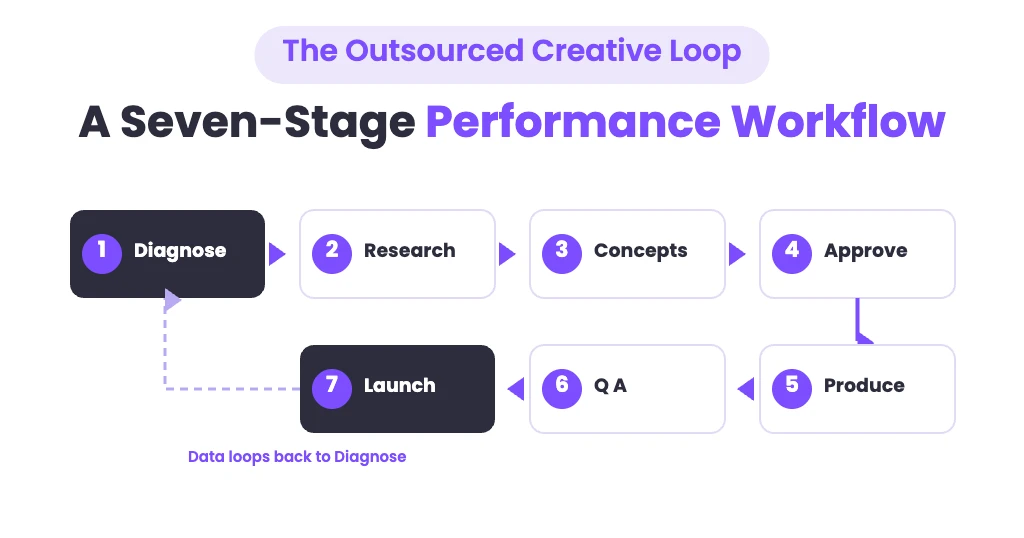
1. Diagnose the real constraint — concept diversity, format range, speed or QA. 2. Research reviews, sales calls, support tickets, competitor positioning and winning/losing patterns to produce testable customer truths. 3. Develop concepts around distinct problems, outcomes, objections and proof types. 4. Approve concepts and scripts before expensive production begins. 5. Produce and adapt in the formats that best express the idea — not video for its own sake. 6. Complete QA at three levels: strategic, brand and production. 7. Launch, learn and iterate — return results to the creative team so the next concept is better informed.
Google Ads supports controlled video experiments in which creative is the single variable. (Source: Google Ads Help) The purpose of testing is not to crown a permanent winner after one short run, but to accumulate reliable directional learning.
How Often Should Creative Be Refreshed?
There is no universal calendar. Refresh decisions should weigh spend and audience size, frequency, declining CTR or conversion rate, rising CPA, sentiment shifts, and whether the platform still allocates spend to the asset. TikTok’s Smart+ guidance flags a doubling of CPA, a halving of ROAS versus normal, or falling creative CTR and CVR as signals to refresh. (Source: TikTok Ads Manager Help) The practical answer: build the next concepts before the current winners collapse. A creative pipeline is an inventory system — which is exactly what an always-on partner protects.
Outsourced Team vs Freelancer vs Agency vs In-House
| Model | Best for | Main risk |
|---|---|---|
| Freelancer | Occasional production or one specialist task | Capacity and strategy depend on one person |
| In-house team | Continuous demand, stable budget | Fixed cost; output capped by headcount |
| Traditional agency | Broad campaigns needing strategy + media | Retainer cost; variable speed and volume |
| Creative subscription (AaaS) | Continuous concepts and assets without new headcount | Quality depends on briefing and strategist ownership |
| Hybrid | Internal ownership + external scale | Responsibilities must be explicit |
For many established advertisers, the hybrid model is most practical: internal leaders own the business truth and decision rights, while an external team turns that truth into tested creative at volume. See how the agency model fits.
How Much Does Outsourced Ad Creative Production Cost?
Providers charge per hour, per asset, per project, on retainer, on subscription or as a dedicated pod. The right comparison is not cost per exported file. Three better metrics:
- Effective cost per usable concept = (external fee + internal management cost) ÷ concepts approved and launched.
- Creative utilisation rate = assets launched ÷ assets delivered × 100.
- Learning yield = concepts that produced a clear decision ÷ concepts tested.
A cheap provider becomes expensive if most assets are never launched or repeat the same idea. Before signing, confirm whether the price covers strategy or production only, how many original concepts are included, what counts as a variation, who manages the work, how revisions are handled, whether working files and performance review are included, and whether filming or media buying are separate.
Where ShortVids fits
ShortVids AaaS is a done-for-you performance creative department for qualified brands and agencies — research, concepts, hooks, scripts and production across static, carousel, motion and video, with creative-testing support based on your available performance data. Plans start from $999/month; media buying is not included in the core creative engagement unless separately contracted. See current plans on the pricing page.
First-Party Example: TrimRx
TrimRx is a U.S. telehealth company offering medically supervised weight-management programmes. According to ShortVids’ published case study, the brand was reusing ads without structured angle iteration, had no systematic hook-testing process, and carried production and workflow gaps against an approximate $650,000 advertising budget. ShortVids became an extended creative partner supporting concepts, hook development and ongoing production. The most defensible result is operational: TrimRx gained a continuous creative pipeline without building and coordinating an equivalent internal team — while retaining claim review and approval, which matters in a regulated category.
Supporting Example: Namami
Namami, a digital marketing agency, needed to fulfil varied client video requirements without an internal video department. Per ShortVids’ published case study, ShortVids acted as an extended production team across different client styles, centralising delivery — with consistent multi-format output, faster turnaround, lower production burden and maintained brand alignment across clients.
Supporting Example: Skyroad Studios
Skyroad Studios managed 10–15 active client accounts and needed more editing capacity. Skyroad retained the client relationships and creative standards; ShortVids supplied scalable execution — a clean example of production being outsourced while ownership stays in-house.
Common Outsourcing Mistakes and How to Prevent Them
Choosing on aesthetics alone. A polished portfolio proves production skill, not research, concept development or claims control. Review the provider’s briefs and testing logic. Asking for files instead of learning. “Give us 20 ads” rewards volume; specify concepts, variations, formats and hypotheses. Moving the whole system at once. Start with a real paid pilot, one offer, a controlled batch. Skipping concept approval. Approve the concept and script before full production. Using too many approvers. Assign one accountable owner and send consolidated feedback. Hiding data. Share the minimum relevant performance report. Treating AI as the strategy. Use AI inside a human-owned research, approval and QA process — it cannot decide which customer truth to test. Expecting guaranteed ROAS. Creative is one part of a system that also includes offer, price, audience, landing page and media execution.
Your Takeaway
Outsourcing ad creative production should increase your execution capacity, not dilute your identity. Keep control of positioning, customer truth, claims, data, decision rights and final approvals. Delegate research support, concepts, hooks and scripts, static/carousel/motion/video production, controlled variations, QA and iteration. The partnership works when the brand supplies truth and authority while the external team supplies specialised thinking, production capacity and disciplined testing.
Get Three Ad Concepts for Your Business
Share your offer, audience, funnel and current creative challenge, and the ShortVids team will identify three potential creative directions built for testing. Get My Three Ad Concepts →
Frequently Asked Questions
What is outsourced ad creative production?
A model in which an external specialist handles research, concept development, scripting, design, editing and variation production, while the brand keeps positioning, claims, budget and final approval.
Will outsourcing weaken brand consistency?
Not if the relationship uses a documented brand system, named decision owners, staged approvals and centralised feedback. Inconsistency usually comes from missing inputs, not from outsourcing itself.
What is the difference between a concept and a variation?
A concept is a distinct persuasive idea. A variation changes a controlled element within it, such as the hook, proof or CTA. A format adaptation expresses the same concept as a static, carousel, video or motion asset.
How many ad concepts should a business test each month?
There is no universal number. It depends on budget, conversion volume, audience size, production capacity and how fast creatives fatigue. Focus on distinct concepts, not exported file count.
Is media buying included in ad creative production?
Not automatically. Creative production and media buying are different functions. In ShortVids’ core AaaS engagement, media buying is separate unless specifically contracted.
Who owns the finished creative assets?
Ownership depends on the contract. Confirm ownership of final exports, raw footage, project files, licensed materials and creator permissions before starting.