

Has this ever happened to you as well? Like you are sitting at your desk and staring at a blank document while your deadline is basically breathing down your neck. You need three scripts drafted and two blog outlines finished before lunch. That’s where LLM content creation comes in, like your favourite superhero. Instead of spending hours brainstorming and writing from scratch, you can now collaborate with AI to speed up the entire process.
Large language models have completely changed how businesses and creators approach their content workflow. Tools like ChatGPT and Perplexity have become essential sidekicks for businesses and content teams everywhere, using LLM content creation daily.
The shift toward AI Content Creation Tools isn’t just some passing trend that’ll disappear tomorrow. It’s fundamentally changing how we think about producing quality material at scale. 80% of Marketers have used (or currently use) AI tools to help create marketing content. These tools handle the heavy lifting of initial drafts and research summaries while you focus on adding that human touch that makes content truly resonate.
Whether you’re a solo creator managing multiple platforms or a business managing content for various clients, large language models for content help you maintain consistency without burning out.
Quick Summary
TL;DR: Use LLM content creation and AI content creation tools to turn short prompts into ready‑to-edit scripts, blogs, and social posts so you ship more high‑quality content while ShortVids handles your overall standout video execution. #tldr
Core flow: Ideas → Outlines → Drafts → Edits → Repurposing
Why it matters: Faster production, lower costs, consistent tone, and scalable output for creators and teams with limited time and budgets.
Tools (start simple):
- ChatGPT
- Claude
- Perplexity (writing)
- Surfer / Clearscope (SEO)
- Jasper / Descript (scripts)
- Zapier / Make (automation)
Turn ideas into content faster with AI!
What’s LLM Content Creation & How It Works?
LLM content creation refers to using large language models to generate and assist with various content tasks throughout your production pipeline. When you Type A Prompt into ChatGPT or Claude, asking for a video script outline or blog intro, the model predicts the most relevant next words based on patterns it learned during training. These AI writing tools have been trained on massive amounts of text data and can understand context while generating human-like responses.
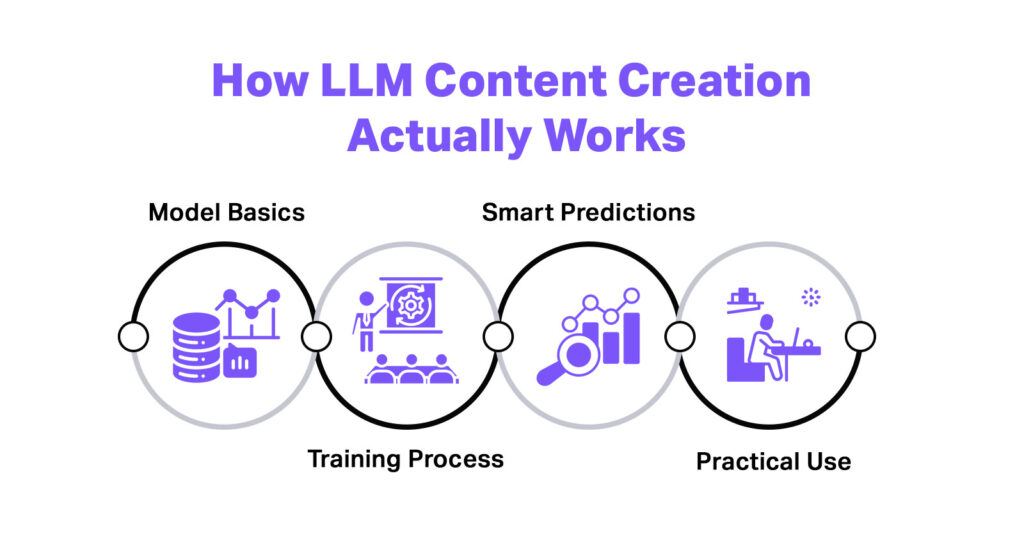
Understanding Models
Large language models basically function like super-powered autocomplete systems that understand nuance through LLM content generation capabilities. The model reconstructs knowledge from training patterns rather than truly knowing information. They analyse your input and generate responses by calculating probability distributions across billions of parameters.
For example, GPT-3 was trained on roughly 499 billion tokens (text pieces) drawn from web data, books, and more. When businesses use these AI content creation tools for Scripts and blogs, they’re tapping into systems that mimic various writing styles effectively.
Training Process
During training, the system adjusts its internal parameters to better predict what text should come next in sequences. This is why LLM content creation feels surprisingly coherent because the model learned statistical relationships between words and concepts naturally.
These models learn by processing huge datasets containing books and articles, plus countless web pages, through advanced AI Content Automation Systems. For content creators, this means AI generates relevant material following a logical structure. This helps you:
- Gives smoother, logical content.
- Saves time on structuring ideas.
- Produces on-topic drafts instantly.
- Keeps the tone consistent.
Practical Application
When you’re working on a script for your client’s YouTube Video, and you feed AI writing tools a prompt describing your topic, the model generates text by selecting likely next tokens repeatedly. Each token represents a piece of a word, and the model chains these together, forming sentences.
Every time GPT-3 generates one token during inference, it uses calculations involving all 175 billion parameters. This LLM content generation approach lets you produce first drafts incredibly quickly while maintaining reasonable quality standards throughout your workflow.
Boost your content output with AI-driven workflows!
How Do LLMs Affect Traditional Content Creation Workflows?
The integration of large language models for content has completely changed how teams approach their daily workflows using AI content creation tools. At ShortVids, we’ve seen how this technology helps businesses produce more content without compromising their brand voice or quality standards through efficient LLM content creation practices. Previously, content creation followed a linear path where one person handled ideation, while another wrote, and someone else edited. Now, AI assists at every stage of the process, which allows creators to move faster and experiment more freely.
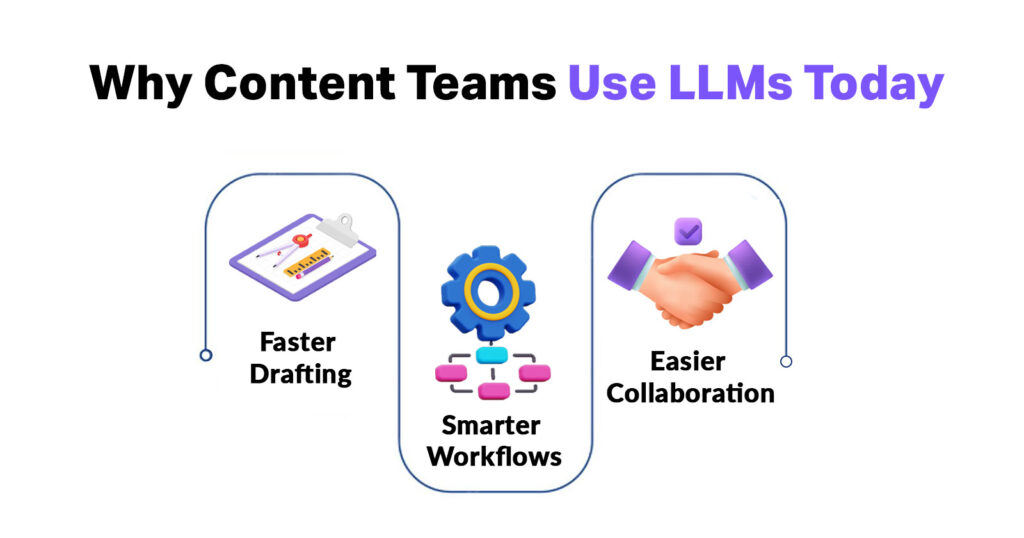
Workflow Integration
Modern content teams blend AI content automation directly into their project management tools and editing platforms seamlessly. Instead of starting every piece from absolute zero, creators now use AI Content Creation tools to generate multiple angle options within seconds.
This shift means writers spend less time staring at blank pages and more time refining ideas into polished final products. 86% of content teams report increased efficiency after integrating AI, and 83% of teams have adopted at least one AI tool.
Speed Enhancement
When you need to draft three different versions of a social media script, you can generate all three variations almost instantly using AI writing tools like ChatGPT or Perplexity. What used to take an entire afternoon now happens through LLM content generation in a fraction of that time, efficiently.
The Info-Tech Research Group notes that CarMax uses GPT-3 to summarise customer reviews into concise web copy. They reduced what would have taken 11 years of manual work to just a few months. This acceleration doesn’t mean sacrificing quality but rather reallocating your energy toward strategic decisions and creative refinement instead of mechanical writing tasks.
Collaboration Changes
Nearly 90% of marketers now say they use generative AI tools at work, and 71% use them weekly or more. Teams collaborate differently when large language models for content enter the picture because everyone can access the same generative capabilities. Junior creators produce work that matches senior-level structure and coherence more quickly through LLM content creation assistance.
The barriers to entry for content production have lowered significantly, which democratises the creative process across organisations and individual creators, Building Their Brands consistently. This benefits you because:
- Teams work faster with shared AI support.
- Junior creators produce stronger drafts.
- Everyone keeps brand messaging aligned.
- Content output becomes more consistent.
Roles Of LLMs In the Content Creation Process?
LLM Content Creation touches nearly every phase of producing material from that first spark of an idea, all the way through final distribution. Understanding where AI adds the most value helps you leverage these capabilities effectively without falling into the trap of over-reliance or losing your authentic voice in content. These AI content creation tools serve as brainstorming partners and research assistants, plus drafting tools and editing companions.
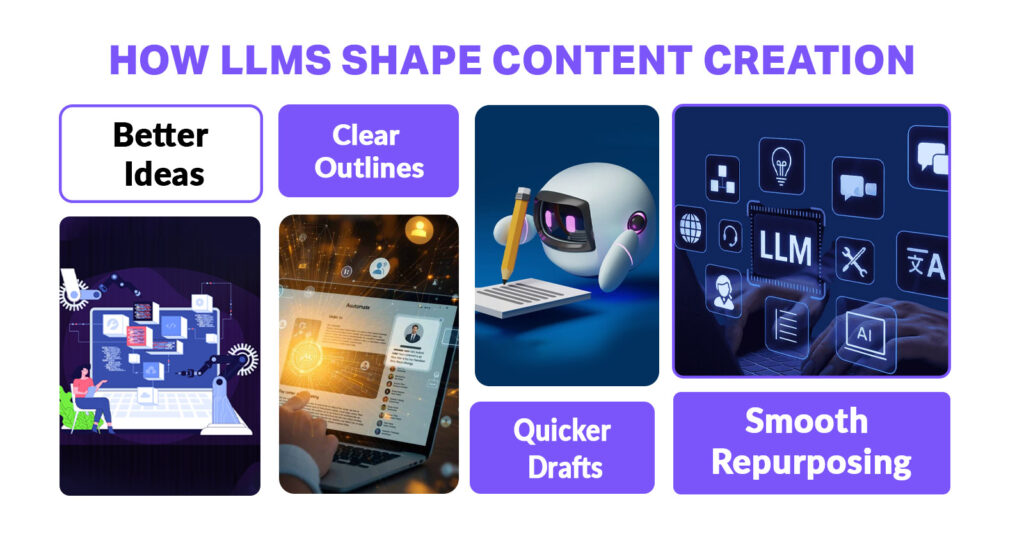
Ideation Support
AI writing tools excel at suggesting topics and angles, and hooks you might not have considered on your own. Generating fresh content ideas consistently ranks among the biggest challenges creators face regularly in their Workflows. 79.3% of marketers use generative AI for ideation and brainstorming.
You can describe your niche or audience to the AI and receive dozens of content concepts within moments through LLM content generation. This doesn’t replace your creative judgment but rather amplifies your ability to identify promising directions.
Outline Creation
71.7% of marketers use AI for outlining content. Once you’ve settled on a topic through AI content automation, structuring your content logically becomes the next hurdle to clear. Large language models help you build comprehensive outlines that cover all relevant points without missing crucial elements.
For video scripts or long-form articles, having a solid skeleton from AI content creation tools makes the actual writing phase dramatically smoother and faster for Online Businesses.
Drafting Assistance
The initial draft often feels like the most daunting part of content creation for many people working daily. With LLM content creation, you can produce complete first drafts that capture your main points and follow a coherent structure. This helps you Autopilot Your Content Creation.
These drafts definitely need human refinement, but they provide excellent starting material from AI writing tools that save hours of writing time effectively. HubSpot, besides ideation, uses AI to generate first drafts of blog posts (via their AI tools), after which human writers refine the content to match brand voice and strategy.
Editing Help
Refining your content becomes easier when you have large language models for content that suggest improvements to clarity and flow, plus grammar corrections. This iterative editing process helps you polish content faster than traditional solo revision would allow for businesses.
From Wyzowl’s 2024 survey, 86% of marketers say AI tools save them time and make them more efficient. You can paste sections of your work and ask for specific feedback or alternative phrasings through LLM content generation.
Repurposing Content
34.3% of marketers use generative AI for repurposing existing content. This multiplies the value you extract from every piece you create through efficient LLM content creation workflows. Taking one piece of content and Repurposing it into multiple formats used to require significant manual effort before AI content automation existed.
Now, AI content creation tools let you turn a long-form blog into social media snippets or video scripts or email newsletters with minimal friction.
Why Does LLM Content Creation Matter for Businesses and Creators?
The adoption of large language models for content represents more than just a new tool in your creative arsenal. It fundamentally changes what’s possible in terms of output volume and consistency, plus the ability to compete in crowded markets through AI content creation tools. For businesses managing multiple clients, YouTubers, and other creators building personal brands, AI-powered content tools level the playing field and open doors that were previously locked without expensive resources.
Competitive Advantage
Companies using AI content automation can respond to trending topics faster and maintain regular publishing schedules without hiring massive teams. In saturated markets where everyone produces similar content, speed and consistency become differentiators that matter significantly through LLM content creation.
In small businesses, a survey found that 77% believe AI helps them compete with larger firms. This agility from AI writing tools translates directly into better Audience Engagement and market positioning over time, effectively. This really benefits you in many ways, like:
- Helps you react to trends quickly.
- Keeps posting schedules steady.
- Reduces the need for large teams.
- Improves visibility in crowded markets.
- Boosts engagement by staying active.
Resource Optimization
Small businesses and solo creators often operate with limited budgets and tight time constraints that challenge growth. LLM content generation allows these entities to punch above their weight class by producing professional-quality material without proportional resource investment.
You can allocate your budget toward strategy and distribution instead of pouring everything into basic Content Production through AI content creation tools efficiently. Amarra, a niche fashion wholesaler, uses ChatGPT to write first drafts of its product descriptions. This cut their writing time by 60%, helping them scale content without huge copywriter costs.
Quality Consistency
Large language models for content help standardise tone and structure and messaging while still allowing room for creative variation. This consistency from LLM content creation builds trust with your audience and strengthens your brand identity across every touchpoint naturally.
Maintaining a consistent Brand Voice across dozens or hundreds of content pieces challenges even experienced teams working daily. This is why even Coca-Cola uses AI to analyse consumer data and generate content that stays consistent with its iconic brand voice even across localised campaigns.
Learning Curve
The barrier to entry for Quality Editing and content creation has dropped dramatically thanks to AI content automation assistance now available. A case study from AI for Businesses suggests that 62% of CMOs prioritise LLMs for content creation, highlighting that enterprises believe the tools are accessible and scalable.
New creators can produce work that looks polished and professional from day one using AI writing tools effectively. This democratisation through LLM content generation means more diverse voices enter the content landscape while businesses can onboard team members more quickly.
What Are the Benefits of Using LLMs for Content Creation?
Adding AI writing tools into your workflow delivers tangible advantages that impact your bottom line and Creative Satisfaction. Understanding these advantages helps you make informed decisions about integrating AI into your processes effectively. From raw speed improvements to cost savings and scalability, the benefits of LLM content creation extend across multiple dimensions of content production.
Production Speed
Tasks that previously consumed entire days now take mere hours or even minutes with AI content creation tools. The most immediately noticeable benefit involves the dramatic reduction in time required to produce content through LLM content generation. When you’re drafting video scripts for clients or creating social media Content Calendars, this speed advantage from AI content automation compounds quickly without sacrificing quality significantly.
Adore Me, a D2C apparel brand, used generative AI (Writer’s CoWrite) to automate repetitive writing tasks like product descriptions, which significantly accelerated their content production.
Cost Efficiency
Hiring full-time writers or agencies for every content need quickly becomes expensive for most businesses without sufficient budgets. A growing enterprise used Hashmeta AI’s LLM-Operations (LLMO) framework to cut content production costs by 80%. The savings from large language models for content can be redirected toward other growth initiatives, like Paid Advertisements or product development, strategically.
LLM content creation reduces these costs substantially because you need fewer person-hours to achieve the same output volume.
Consistency Achievement
Producing content that maintains the same quality and tone across hundreds of pieces is a major Content Creation Challenge, even for the skilled. AI writing tools follow instructions precisely and generate material that adheres to specified guidelines every single time through LLM content generation. This reliability from AI content automation means your audience receives a consistent experience regardless of which piece they encounter first.
Scalability Potential
With AI content creation tools, scaling up happens almost instantly because the tools don’t experience capacity limits, work or Creative Fatigue. Growing your content output traditionally required hiring more people, which brought complexity and expense to businesses everywhere.
You can expand from five pieces per week to fifty without restructuring your entire operation through efficient LLM content creation workflows. Kevin Farrugia from AdamEnfroy.com produced 700+ long-form articles in 24 months, averaging 3.1 hours per article, by using an AI content framework.
What Are The Limitations of LLMs?
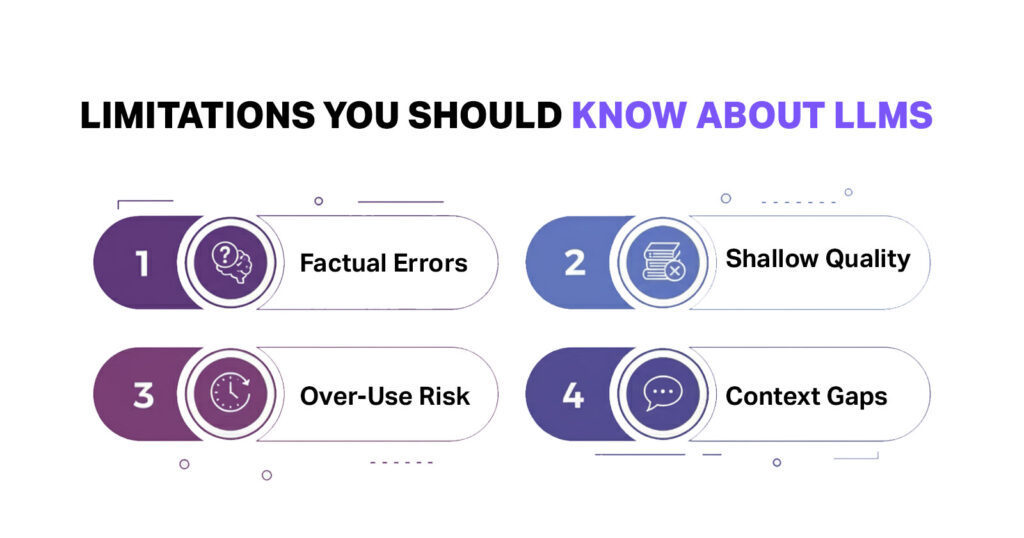
Being aware of these limitations also helps you use AI content creation tools effectively while avoiding common pitfalls that can damage your content quality or reputation. While large language models for content offer impressive capabilities, they definitely come with constraints and challenges that creators must understand clearly, and nobody wants to publish material that contains factual errors or sounds robotic and lifeless, despite using advanced AI content automation systems and AI Automation Tools.
Hallucination Issues
Relying blindly on AI output can lead to embarrassing errors. The models don’t actually verify facts but rather predict plausible-sounding text based on training patterns through LLM content generation. One of the most serious problems with AI writing tools involves their tendency to generate confident-sounding information that’s completely fabricated, unfortunately.
This means you absolutely need to fact-check anything important before publishing when using AI content creation tools daily. In a large empirical study of user reviews of AI-powered mobile apps, about 1.75% of reviews indicated user-reported LLM hallucinations (i.e., factually incorrect or fabricated information).
Quality Concerns
31% of marketers rate “accuracy/quality” as their top concern with Generative AI, more than other issues like trust or skills. AI-generated content often lacks the depth and nuance that comes from genuine human experience and expertise, unfortunately. While the structure from LLM content creation might look fine on the surface, the material can feel generic or superficial upon closer examination.
AI content automation works best as a starting point that requires significant human refinement to reach truly excellent quality standards for businesses.
Over-Reliance Risk
Some creators fall into the trap of letting AI writing tools do absolutely everything, which results in bland content lacking personality and no Storytelling. Using large language models for content as a crutch rather than a tool diminishes the very thing that differentiates you from countless competitors.
Around 39% of marketers say they don’t know how to safely use generative AI, citing the need for human oversight to avoid “garbage in, garbage out.” Your unique voice and perspective are what make your content valuable and worth consuming beyond basic LLM content generation.
Context Limitations
These AI content creation tools work within defined boundaries that you need to respect and work around strategically through proper AI content automation planning. Current language models struggle with truly understanding complex context or maintaining coherence across very long documents, unfortunately and they also can’t access real-time information or understand your specific business nuances without detailed prompting for LLM content creation.
Which AI Content Creation Tools Work Best for Different Needs?
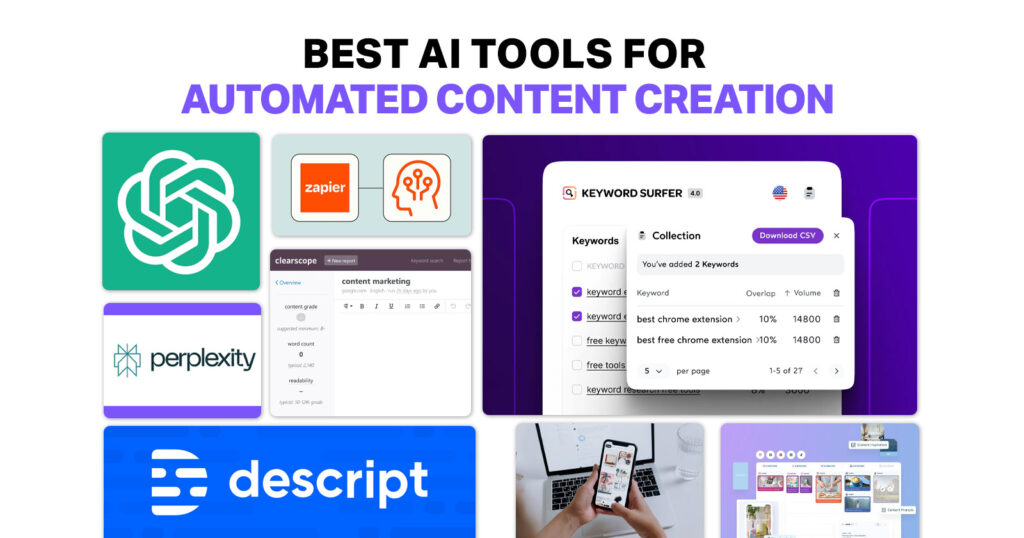
Choosing the right tools for LLM content creation depends on your specific workflow needs and content types, plus budget constraints. The use of AI content creation tools has exploded over recent years, with options ranging from general-purpose writing assistants to highly specialised niche solutions. Let’s explore what works best for different content creation scenarios using large language models for content effectively.
| Category | Tools Mentioned | What They’re Best At | Key Notes |
|---|---|---|---|
| Writing Assistants | ChatGPT, Perplexity, Claude | Drafting, research-backed writing, long-form content | ChatGPT = versatile; Perplexity = research + citations; Claude = strong long-form + context |
| SEO Tools | Surfer SEO, Clearscope | Search-optimised content, keyword suggestions, and structure guidance | Great for boosting rankings and organic visibility |
| Script Generation | Descript, Jasper | Video scripts, podcast scripts, pacing & flow | Works best when paired with human editing (as you do at ShortVids) |
| Automation Platforms | Zapier AI, Make | Automated workflows, scheduled content creation | Useful for social media, email campaigns, and consistent output |
What’s the Future of LLM Content Creation?
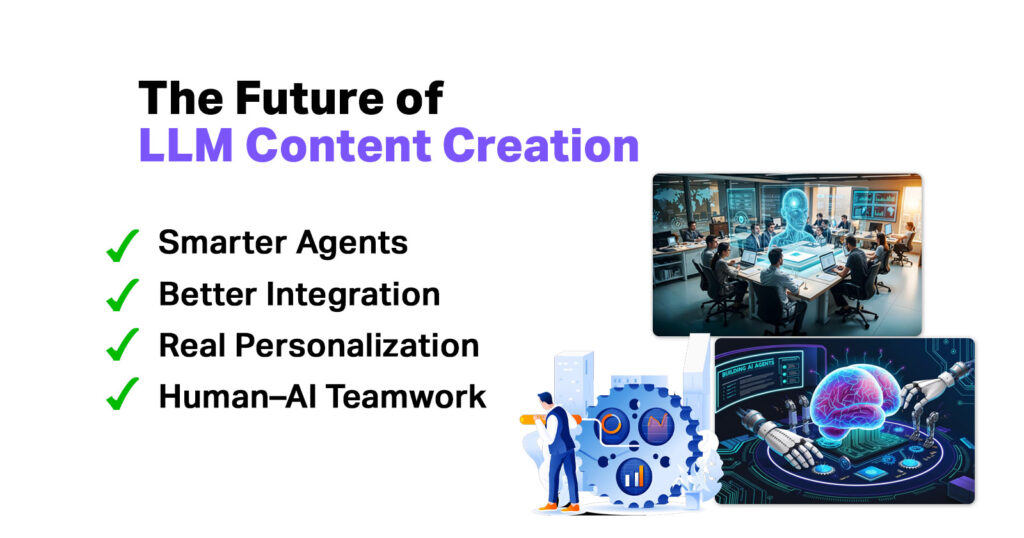
Looking ahead to 2026 and beyond, several trends are already emerging that will shape how creators and businesses approach content production through advanced AI content creation tools. The trajectory of large language models for content points toward increasingly sophisticated systems that understand context better and integrate more seamlessly into creative workflows.
Agent Workflows
Future AI systems will likely function as autonomous agents that can handle entire content projects from research through publication automatically. These AI content automation tools will make decisions and adjust content or Ad Strategies, plus coordinate multiple tasks without constant human supervision. This shift represents a fundamental change in how we think about LLM content creation pipelines and what’s possible with AI writing tools in business contexts. This means that:
- Less supervision will be needed.
- Projects will complete faster.
- Decisions will be smartly automated.
- Tasks will be handled in one flow.
- There will be more time for strategy.
Integration Systems
Your video editing software and project management system, plus Analytics Dashboard, will all incorporate intelligent LLM content generation assistance natively. This seamless integration from large language models for content makes AI feel natural rather than like using separate tools constantly. We’re moving toward unified platforms where AI content creation tools are deeply embedded into every tool you already use daily.
Personalization Advances
Future models will better understand individual creator styles and adapt their LLM content creation outputs to match specific brand voices more accurately. The technology will learn from your Editing and preferences over time through advanced AI content automation capabilities. This personalisation means less time spent refining AI writing tools to sound like you naturally.
Collaborative Intelligence
The relationship between human creativity and AI content creation tools will evolve into true Collaboration, where each party plays to its strengths. Humans provide strategic direction and creative vision, plus an authentic perspective, while large language models for content handle execution and optimisation, plus scaling. This partnership approach represents the most promising path forward for LLM content generation in 2026 and beyond.
Your Takeaway!
From initial ideation through final edits, the AI content creation tools also accelerate every phase while reducing costs significantly. LLM content creation has fundamentally transformed how businesses and creators approach their content workflows in practical ways. The key lies in understanding both the capabilities and limitations of AI content automation while also maintaining your authentic voice throughout the process. At ShortVids, we’ve seen how combining large language models for content with human creativity unlocks further production possibilities that seemed impossible before.
Frequently Asked Questions
LLM content creation uses large language models to automate AI content creation like blogs, emails, and social posts.
LLMs predict next words via token sequences, ensuring coherent content generation from vast training data.
LLMs break text into tokens, analyse semantics and hierarchy using attention mechanisms for context grasp.
Top LLMs for 2026 include OpenAI GPT series, Anthropic Claude, and Google Gemini for creative AI writing tools.
Book a Call Today
- Fixed monthly plans starting at $999
- 24-hour turnaround time (or less) on all short-form edits
- 3-layer quality check system on every video
- No more chasing freelancers or managing editors
- Scale up to 50+ videos/month without hiring in-house
- Content team trained on platform trends, scroll-stopping hooks & storytelling
- Fully managed by professionals – you just upload & approve
- Response time: Under 1 hour (US & GCC time zones)
Cut your production costs, not your standards.