

Most of the agencies and businesses find hiring freelancers from Fiverr and Upwork to be a cost-effective shortcut. A $20 logo or $30 video edit appears affordable upfront, but the hidden costs quickly add up. With that, they come with missed deadlines, inconsistent quality, endless revisions, and brand misalignment. So, the rework expenses at the end can turn a “cheap” project into a multi-hundred-dollar headache.
The stats from Upwork show that 28% of skilled knowledge workers are freelancers; 29% of executives say they couldn’t operate without them.
This guide explores how marketplace freelancers often cost more than they seem, through delays, poor quality, and brand damage. Also, it shows why reliable pros like ShortVids save you time, money, and headaches in the end.
Quick Summary
TL;DR: Freelancers on Fiverr and Upwork may appear inexpensive, but the real cost comes from inefficiencies, rework, missed deadlines, and brand inconsistency. Agency partnership can save time, scale faster, and preserve quality by using managed video production teams like ShortVids. #tldr
- Core Takeaways: Hiring cheap freelancers can lead to hidden costs, including inconsistent work, excessive revisions, and increased management overhead.
- Core Components: Quality Control → Brand Consistency → Predictable Workflow → Time Efficiency → Scalability → Stress Reduction
- Outcome: A content creation system that delivers professional, high-quality results while protecting your brand, maximizing ROI, and reducing the risk of wasted effort.
Stop wasting budget on rework, start scaling smarter!
What Are the Hidden Costs of Cheap Freelancers?
Marketplace platforms host thousands of freelancers with varying skill levels, experience, and work ethics. While some freelancers deliver high-quality results, others may lack the expertise or reliability required for professional, scalable output.
A global report covering employers’ experiences with individual contractors lists “freelancer knowledge of company” and “inconsistent availability” as the top two challenges, with 53% and 52% of employers citing them, respectively.
Similarly, 81% of public sector IT projects overrun schedules, with freelancers cited as a common factor in delays due to inconsistent availability and mismanagement; private sector rates are lower at 52%, but small businesses face similar issues from overbooked hires. (Source: McKinsey via Content Snare, 2025)
Examples:
- A $30 Fiverr video edit requiring five rounds of revisions can cost your business $150-$200 once internal review time is included.
- Hiring multiple freelancers for one brand’s social media channels can lead to inconsistent messaging, diluting brand voice and reducing audience trust.
Cheap freelance work isn’t just about the dollar amount you pay upfront. The hidden costs and time spent managing, revising, and troubleshooting can far exceed the initial savings. For businesses seeking reliability, consistency, and scalability, relying solely on marketplace freelancers introduces measurable risks that affect productivity, marketing performance, and brand reputation.
Businesses face six major hidden costs when working with Fiverr and Upwork freelancers:
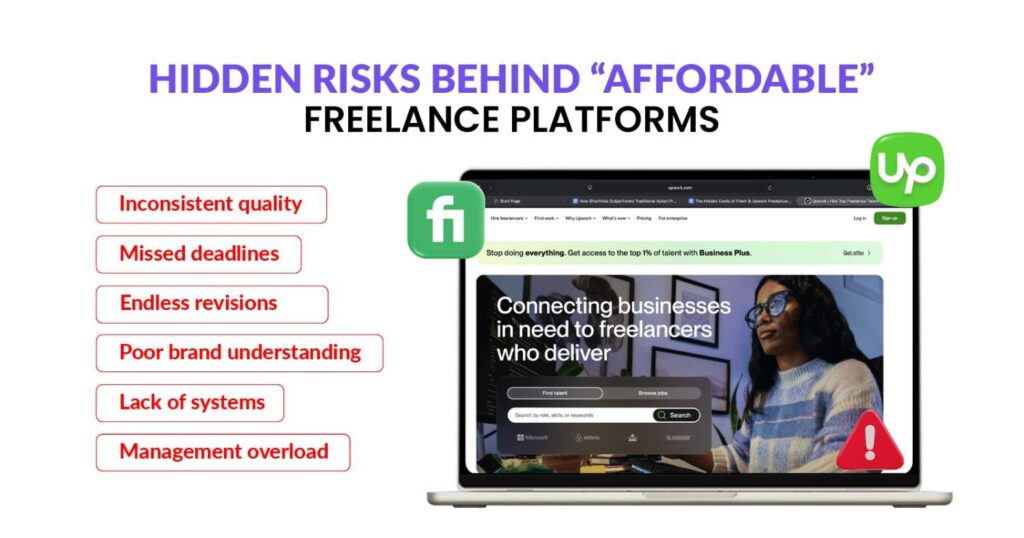
1. Inconsistent Quality and Reliability
One of the biggest risks of hiring Fiverr or Upwork freelancers is inconsistent quality. Freelancers often juggle multiple clients, different time zones, and varying levels of expertise. This leads to deliverables that can fluctuate from one project to another. Their focus may shift, resulting in:
- Variable output quality
- Missed project specifications
- Mismatched tone or style across content
- Generic or template-based work
Unlike agencies, freelancers seldom have structured peer reviews or QA checklists. This increases the chance of overlooked or erroneous work, especially in complex tasks like video editing services, branding, or content creation.
When deliverables come out below expectations, businesses end up spending more time and resources correcting or redoing them, eliminating the cost benefits of the cheap hire.
Example: A $25 blog post may need 3–5 rounds of revisions, eventually costing $100–$150 in time and corrections.
Build a content engine, not freelancer headaches!
2. Missed Deadlines and Project Delays
Freelancers often work independently, which means project timelines are more unpredictable than with a dedicated team. Causes include:
- Time zone differences
- Overcommitted schedules
- Technical issues (laptop crashes, internet outages)
- Sudden unavailability
All this can easily turn a 48-hour project into a week-long ordeal. Missed deadlines directly affect campaign schedules and can lead to lost revenue opportunities.
Many freelancers juggle multiple clients or projects simultaneously, raising the risk of delayed deliveries or missed deadlines.
According to a 2023 report by Harvard Business Review Analytic Services (in partnership with Fiverr, while about 20% of organizations’ work is done by freelancers on average, only 38% of organizations say they manage freelancers effectively.
Impact:
Missed deadlines can disrupt your content calendar, social or ad campaigns, or product launches. Delays often translate into lost opportunities, like missing prime posting times, marketing windows, or client deadlines. Repeated unpredictability drains trust in freelance pipelines, increasing stress on internal teams.
Graphical Representation
| Risk Factor | Freelance Model | Impact on Business |
|---|---|---|
| Multiple concurrent clients per freelancer | High | Delays, low availability |
| Time zone & schedule mismatch | High | Slow feedback cycles, missed updates |
| Lack of structured project management | High | Unpredictable delivery times, irregular |
3. Endless Revisions: The Invisible Money Drain
Many freelancers advertise “unlimited revisions,” but in reality, revisions cost time, effort, and money. The possible reasons can be:
- Freelancers may lack clarity in briefs.
- Each revision requires review, feedback, and resubmission. Overcommitted schedules
- The cycle repeats until you either compromise on quality or pay more.
Why This Matters
Even if the freelancer’s fee is low, the true cost (in human hours, delays, and revisions) can easily double or triple the apparent savings. And this hidden cost often goes unnoticed or untracked in internal budgets.
For Instance: A $30 video edit requiring 5 rounds of revisions effectively costs $150 when factoring in internal team hours.
4. Poor Brand Understanding
Freelancers may lack full context of your brand’s history, audience, tone, and long-term strategy. Without this, their work often fails to reflect a consistent brand voice and identity, leading to mixed messaging. Especially for content involving storytelling, branding, marketing, or long-term positioning, inconsistency can erode audience trust and recognition.
As one industry analysis puts it, outsourcing with no controls can “damage customer experience and brand reputation,” which is far costlier and harder to rectify than a higher upfront cost.
Long-term risks:
- The audience and customers perceive a fragmented or “cheap” brand.
- Decreased engagement or trust, poor conversions.
- More rework and corrections are needed to align content, costing additional time and money.
Table: Brand Impact Comparison
| Factor | Fiverr/Upwork Freelancer | Managed Team (ShortVids) |
|---|---|---|
| Brand consistency | Low | High |
| Platform expertise | Variable | Expert |
| Turnaround predictability | Low | High |
| Revision efficiency | Low | High |
| Total cost (time + money) | High | Predictable |
5. Lack of Systems and Scalability
Freelancers work independently, meaning there’s often no established system, process, or quality control in place. Freelancers operate individually, without standardized workflows:
- No SOPs for content creation
- No structured review or quality control
- Work is project-based, not scalable
This makes scaling content production extremely difficult. Agencies relying on freelancers often face bottlenecks: projects get delayed, quality varies, and lessons learned from one task aren’t documented for the next. In contrast, teams with structured systems can produce multiple assets simultaneously while maintaining brand consistency, reducing both time and long-term costs.
As tasks accumulate, agencies or businesses dependent on freelancers often hit bottlenecks. because scaling requires newly onboarding freelancers, re-briefing each time, and managing every link individually. This reduces scalability and increases overhead.
Without robust systems (review checklists, brand guidelines, revision records), quality drifts and inconsistencies multiply, making long-term brand maintenance inefficient and costly.
Effect: It’s hard to treat freelancers as part of a “production engine.” Instead, every new piece becomes a fresh, fragile project, subject to the same unpredictability, not a dependable pipeline.
Impact: Businesses can’t reliably scale content production without constantly onboarding new freelancers.
6. Management Overload
Managing freelancers requires far more effort than many businesses anticipate. From writing detailed briefs to clarifying instructions, tracking progress, coordinating revisions, and chasing deadlines, internal teams often spend more hours managing freelancers than completing the work themselves.
Learn More: How ShortVids Can Automate Your Content Creation.
- Freelancers require detailed briefs, constant communication, feedback loops, follow-ups, all of which consume internal team time.
- According to analyses on freelancer dependency, many companies underestimate the internal cost of managing external talent. Coordination, revisions, quality control, and follow-up often exceed the time saved by outsourcing.
Outcome
- Internal staff get distracted from core tasks (strategy, growth, and creative thinking).
- The apparent “savings” from cheap hires vanish once you factor in overhead labor hours.
- Over time, freelancer management becomes a bottleneck rather than a relief, ironically making the business less efficient, not more.
Example: An agency spends 10 hours per week managing freelancers, equivalent to $400–$500 in internal resource costs.
Why Cheap Work Ends Up More Expensive
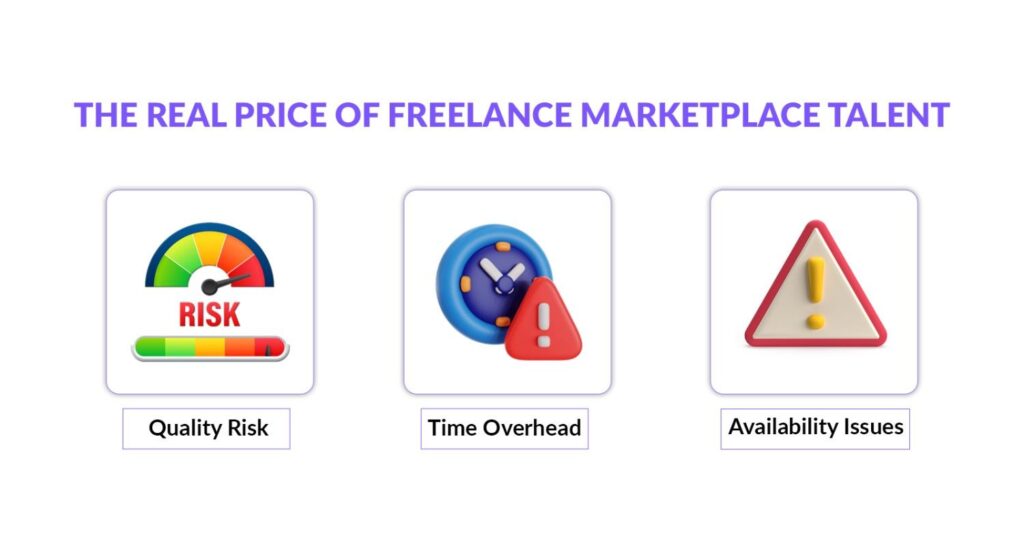
Low-rate freelancers from platforms like Upwork and Fiverr appear inexpensive upfront. In practice, the combination of quality variation, inconsistent availability, and the hidden costs of rework and brand damage frequently makes them far more expensive than hiring professionals or a retained agency.
The Scale of the Freelance Market (and What It Really Means)
- In 2023, 64 million Americans (39% of the U.S. workforce) did some freelance work, generating ~$1.35 trillion in earnings.
- Roughly half of freelancers now provide knowledge-based or creative services (programming, design, video, marketing, writing), not just administrative tasks.
A massive, growing talent pool drives intense price competition and keeps hourly rates low. However, high supply does not equal consistent quality. The same forces that suppress rates also increase variability in skill, work ethic, communication, and reliability, especially at the bottom of the price range.
The Real Risks of Low-Cost Freelancing
Here is the list of multiple risks associated with low-cost freelancing:
Quality and Consistency are Unpredictable
There is no built-in quality control. Two freelancers charging $15–25/hr can deliver results that differ by an order of magnitude in polish, strategic fit, and brand alignment.
Revision and Management Overhead Explode
What is sold as a “$300 video edit” or “$150 blog post” routinely turns into:
- 3–8 rounds of revisions
- 5–15 internal hours of briefing, feedback, and corrections
- Delayed publishing schedules. These untracked hours are paid for by your team’s salary, not the freelancer’s invoice.
Brand Damage is Cumulative and Expensive
One off-brand video or poorly written article chips away at audience trust. Over a year of inconsistent content, the erosion in perception, engagement, and SEO authority can cost far more than any savings on production.
Availability Risk
Top low-cost talent is usually overbooked; many disappear mid-project or become unresponsive when a higher-paying client appears.
The Costs That Never Appear in Platform Reports
Public freelance economy statistics track total earnings and headcount, but they do not measure:
- Hours spent fixing or re-briefing subpar work
- Campaign delays and missed opportunities
- Long-term damage to brand equity from inconsistent messaging
- Higher churn in audience attention and trust
When these factors are included, a $400 “cheap” project routinely exceeds the fully loaded cost of a $1,200–$2,000 agency or specialist deliverable that arrives on brief, on time, and on brand, zero revisions required.
The Psychological Cost of Freelance Platforms
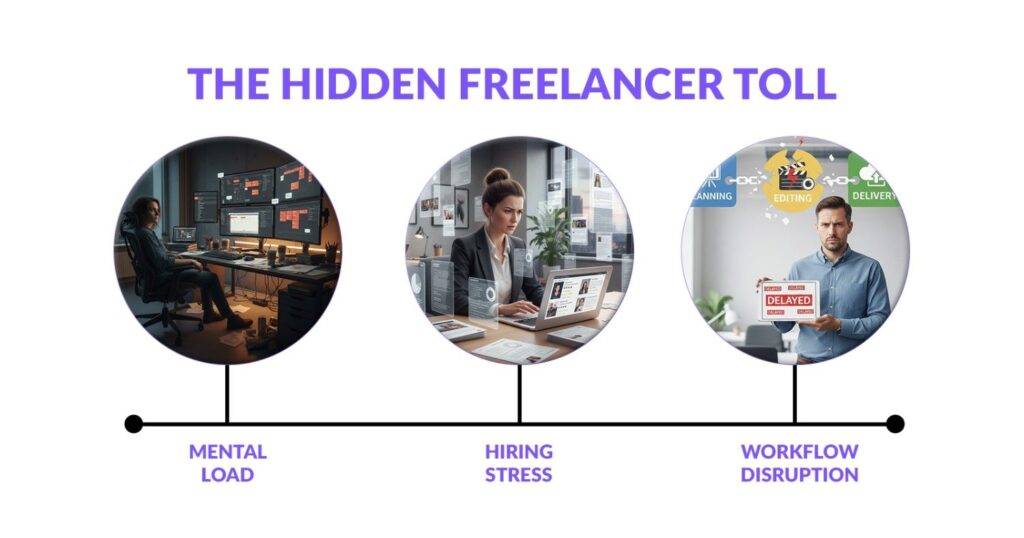
Hiring freelancers directly from marketplaces (Fiverr, Upwork, etc.) creates a hidden psychological tax on internal teams that is rarely accounted for in project budgets. Marketplace freelancers are an unpredictable variable because every project carries uncertainty:
- Will they reply quickly?
- Will the work match the brief?
- How many revisions will be needed?
This unpredictability forces internal teams into constant monitoring, issue anticipation, and last-minute fixes, draining focus and morale.
Decision Fatigue & Cognitive Overload
Screening dozens of profiles, comparing portfolios, negotiating rates, and vetting communication styles triggers decision fatigue.
Real-world example: A marketing manager spends 2–3 hours just to hire one video editor on Fiverr, time taken away from strategy and creative direction before the project even begins.
Ongoing Anxiety from Quality Uncertainty
Teams live with persistent worry:
- Missed deadlines
- Subpar deliverables that harm brand image
- Last-minute scrambles and rework
This “firefighting” mode accelerates burnout, especially in lean teams juggling multiple campaigns.
The real cost of “platform roulette” isn’t just the invoice; it’s the cumulative toll of uncertainty, decision fatigue, anxiety, and disrupted workflows. Structured agency partnerships (like ShortVids ) remove these hidden burdens by delivering predictable deadlines, consistent quality, and full brand alignment, freeing teams to focus on strategy instead of survival.
Why Businesses Need Predictability, Not Luck
Relying on cheap freelancers from marketplaces like Fiverr or Upwork is often compared to playing roulette, you never truly know what outcome you’ll get. The unpredictability of freelance work creates operational risks, inconsistent quality, and delayed deliverables. Businesses that prioritize growth and brand integrity cannot afford to rely on luck.
1. Predictability Eliminates Risk
Agencies like ShortVids deliver standardized processes, fixed timelines, included revisions, and guaranteed quality.
Result: missed campaigns, lost revenue, and unnecessary stress.
2. Operational Efficiency Requires Reliable Workflows
Predictable systems allow internal teams to focus on strategy, creativity, and growth, rather than firefighting. When a freelancer fails to deliver on time or provides inconsistent quality:
- Internal teams spend additional hours coordinating, briefing, and revising.
- Campaign schedules get delayed, affecting multi-channel marketing initiatives.
- Employee morale drops due to repeated stress and workload spikes.
3. Scalability Demands Repeatability
Businesses scaling content production need repeatable processes. Predictability ensures:
- Consistent brand messaging across videos, social posts, and other media.
- Standardized review cycles that reduce revisions and internal effort.
- The ability to plan campaigns months in advance without fearing quality lapses.
Luck is not a strategy. Predictable agency partnerships deliver consistent quality, reliable deadlines, and repeatable workflows, removing risk, slashing internal overhead.
Benefit
Agencies can focus on strategy and growth instead of managing freelancers. That’s what agencies like ShortVids provide.
How ShortVids Solves Freelancer Pain Points
Businesses often turn to marketplaces like Fiverr or Upwork, seeking low-cost solutions, only to encounter hidden costs, missed deadlines, revisions, inconsistent quality, and internal resource drain. ShortVids addresses all these pain points by providing predictable, scalable, and high-quality video production services, effectively replacing the “freelancer roulette” experience with a structured, reliable workflow.
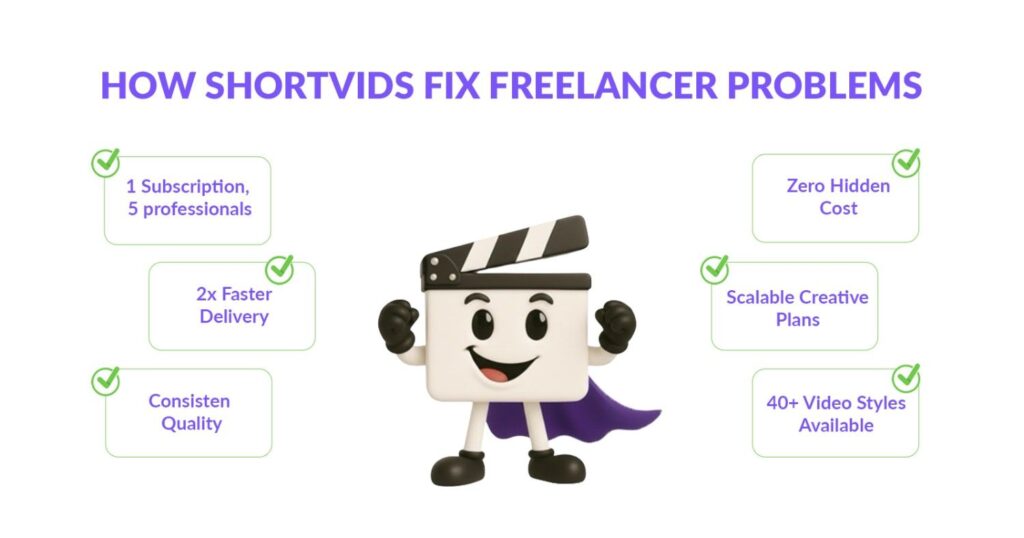
1. Predictable Timelines and Fast Turnaround
Freelancers frequently juggle multiple clients, causing delays that affect campaigns, launches, and revenue streams. ShortVids guarantees fast turnaround times with clearly defined schedules:
- Example: Standard short-form video edits are completed in 24–48 hours, regardless of project volume.
- Teams know exactly when deliverables will be ready, which reduces internal stress and ensures campaigns launch on time.
Impact: Predictable timelines eliminate opportunity costs associated with missed deadlines, critical for time-sensitive campaigns, such as product launches or seasonal promotions.
2. Consistent Quality and Brand Alignment
Low-cost freelancers often produce inconsistent output, risking brand reputation. ShortVids ensures every project meets professional standards:
- All videos follow brand guidelines, tone, and messaging.
- Multiple layers of quality control check for grammar, visual coherence, and storytelling flow.
3. Reduced Internal Resource Burden
Freelancers require extensive internal oversight: briefing, reviewing, and revising work. ShortVids removes this burden:
- Each client is assigned a dedicated project manager who coordinates all tasks.
- Internal teams can focus on strategy, ideation, and creative decisions rather than firefighting.
| Task | Freelancers | ShortVids | Savings |
|---|---|---|---|
| Project Briefing | 2–3 hours | 30 mins | 1.5–2.5 hours saved |
| Review & Revisions | 3–5 hours | 1 hour | 2–4 hours saved |
| Coordination Emails | 1–2 hours | Automated updates | 1–2 hours saved |
4. Scalable and Repeatable Workflows
Freelancers often work ad hoc with no standardized processes, making scaling projects difficult. ShortVids provides repeatable systems:
- SOPs and templates ensure consistent workflows across multiple projects.
- Businesses can scale production without multiplying internal hours or hiring additional staff.
Example: Gene Slade, a health and wellness brand, partnered with ShortVids to produce a series of promotional videos. By switching from multiple freelancers to ShortVids’ structured workflow, they reduced internal coordination hours by 60%, maintained consistent branding across all videos, and met every campaign deadline without stress. This real-world result highlights how predictable systems can turn content production from chaotic to streamlined.
5. Transparent Pricing and Cost Efficiency
Freelancer rates can be misleading; cheap work often results in hidden costs from revisions, delays, and internal oversight. ShortVids offers predictable pricing plans:
- Fixed monthly subscriptions with unlimited edits for a defined volume of videos.
- Eliminates surprise expenses while providing agency-level quality.
Key Insight: While upfront freelancer costs may appear lower, ShortVids reduces the total cost of ownership by minimizing internal hours, revisions, and project delays.
6. Integrated Tools and Multi-Format Output
Freelancers may lack tools for multi-format content production, requiring additional edits for social media, blogs, or newsletters. ShortVids provides:
- Multi-format and AI content creation from a single source.
- Platforms like Descript and Recast Studio are integrated to convert long-form video into short form trends, social posts, and emails efficiently.
Outcome: Clients gain more content with less effort, improving content reach and engagement across channels.
ShortVids turns freelancer roulette into a predictable, scalable production engine. You get faster turnarounds, perfect brand alignment, minimal internal effort, and more content types, all at a lower effective cost than managing freelancers yourself. Focus on strategy; let ShortVids handle the rest.
The Hidden Financial Impact of Cheap Freelancers
The freelance market is massive. A huge supply sounds great, but it also means extreme quality variation, especially at the lowest price points. That variability is the root of nearly every hidden cost.
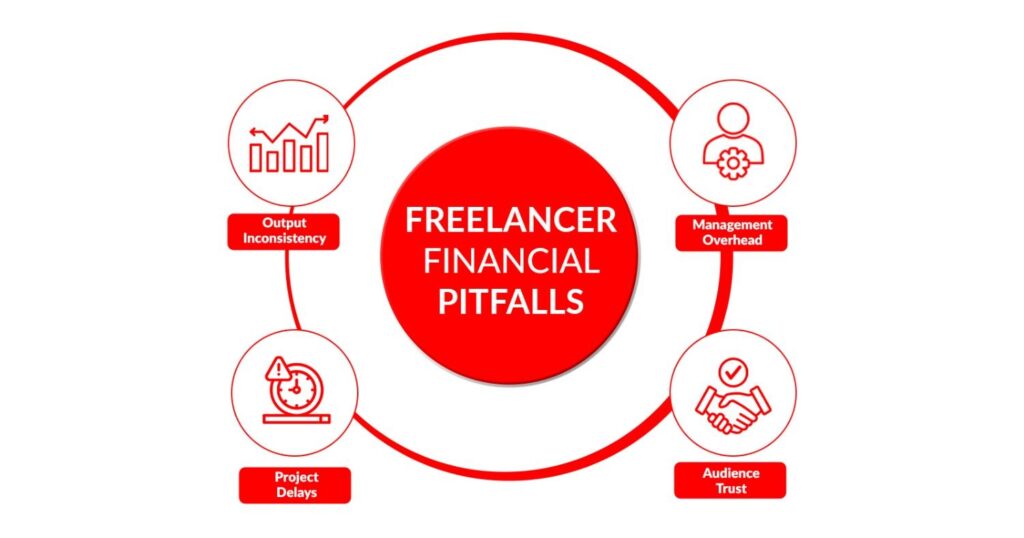
1. Quality Variability = Real Financial Risk
At budget rates, you’re rolling the dice. Some freelancers over-deliver; many under-deliver or disappear. The result:
- Inconsistent tone
- Pacing
- Visual
- Messaging across your content.
2. Internal Overhead Is the Silent Budget-Killer
Cheap gigs still require expensive internal time: detailed briefs, multiple review rounds, chasing late deliverables, and final polishing. Most teams under-track this, but 3–8 hours of staff time at $60–$100/hr per project is common. In practice, the “$99 edit” routinely costs $500–$1,000 once your own payroll is included.
3. Delays Create Direct Revenue Loss
Freelancers juggling dozens of clients frequently miss deadlines. A single late video for a launch, trend, or seasonal campaign can cost thousands to tens of thousands in lost sales and reach, far exceeding the original fee you tried to save.
4. Brand Damage Compounds Over Time
One low-energy or mismatched video weakens audience trust, tanks engagement, and hurts algorithmic performance. The damage isn’t always dramatic, but it’s cumulative and measurable in lower lifetime customer value and slower growth.
When you add up internal time, rework, delays, and eroded brand equity, the cheapest freelancer is almost never the lowest-cost option. The hidden bill always arrives; it’s just paid in lost revenue and wasted hours instead of the original invoice.
A 2018 Upwork case study on the gig economy supports these findings. It highlights that even skilled freelancers often face inconsistent availability, quality variation, and communication gaps, challenges that significantly increase hidden costs for businesses relying on freelance talent. This reinforces why structured teams like ShortVids are a safer, more predictable alternative.”
Practical Tips to Avoid Freelancer Pitfalls
Here are actionable tips to minimize risks when working with freelancers:
1. Always Check Portfolios Thoroughly
Don’t hire based on price alone. Spend 10–15 minutes reviewing past work for style consistency, relevant experience, and polish.
2. Define Clear Briefs and Expectations
Specify deliverables, formats, brand guidelines, tone, deadlines, and revision rules. Clear briefs can cut revision rounds by 50% and prevent miscommunication.
3. Limit Multiple Freelancers for Single Projects
Assign one freelancer or a cohesive team per project. Splitting tasks across multiple freelancers often leads to mismatched styles, 3–5 revision cycles, and 10–15 hours of internal coordination.
4. Track Progress Closely
Weekly updates and milestone checks prevent delays and ensure accountability. Tools like Trello or Asana can streamline monitoring.
5. Consider Predictable Teams
For businesses producing 8+ videos per month, ad hoc freelancers become a liability. Structured teams like ShortVids offer:
- Consistent branding
- 24–48 hour turnarounds
- One included revision
- 60–80% less internal oversight
Often, investing in a predictable team costs less overall than managing multiple cheap freelancers.
Treat freelance hiring like any high-stakes investment. A few disciplined habits (or moving to a reliable team) turn a risky expense into a predictable, high-ROI content engine.
How Predictable Teams Increase ROI
Predictable, structured teams maximize ROI by reducing hidden costs and ensuring consistent, high-quality output. Unlike freelancers, they deliver polished content on the first draft, cut revisions, and prevent missed deadlines.
Benefits:
- Consistent Quality: Brands with uniform messaging see 23% higher trust and 30% higher engagement.
- Faster Turnarounds: Timely campaigns capture peak opportunities, avoiding lost revenue.
- Scalability: Repeatable workflows allow growth without extra management hours.
- Reduced Hidden Costs: Fewer revisions, less internal coordination, and minimized brand risk.
Final Verdict
Freelancers from Fiverr or Upwork may seem affordable upfront. But the hidden costs, unreliable delivery, inconsistent quality, revision fatigue, and brand disruption end up costing far more in the long run. If you want predictable output, faster turnaround, and a partner that actually understands your brand, ShortVids gives you dedicated, agency-level editing services without the chaos of marketplaces. Ready to stop gambling on freelancers? Join ShortVids today and get the creative team your brand actually deserves.
Frequently Asked Questions
Only for non-critical, low-stakes tasks where brand consistency and quality aren’t major concerns. For projects that impact audience perception or revenue, experienced teams are a safer choice.
Hidden costs can quickly double or even triple the initial budget. Revisions, miscommunication, and internal management time often outweigh the freelancer’s upfront fee.
Structured teams, standardized workflows, guaranteed turnaround times, and brand-focused editing eliminate the unpredictability common with ad-hoc freelancers.
While freelance rates are generally higher than full-time employee salaries, the cost gap is smaller for certain roles where freelance and employee rates are more comparable.
Start by outsourcing high-priority or complex projects to a structured team like ShortVids. gradually replacing critical workflows while monitoring quality, consistency, and efficiency improvements.
Book a Call Today
- Fixed monthly plans starting at $999
- 24-hour turnaround time (or less) on all short-form edits
- 3-layer quality check system on every video
- No more chasing freelancers or managing editors
- Scale up to 50+ videos/month without hiring in-house
- Content team trained on platform trends, scroll-stopping hooks & storytelling
- Fully managed by professionals – you just upload & approve
- Response time: Under 1 hour (US & GCC time zones)
Cut your production costs, not your standards.