

Short answer: A creative concept is a different idea about why someone should buy: a new angle, audience or story. A variation keeps that idea and changes the execution, like the hook, headline or format. Test concepts first to find direction, then use variations to refine the winner. Most teams do it the other way round.
Quick Summary
TL;DR: Motion’s 2026 benchmark dataset covers 578,750 creatives across 6,015 advertiser accounts, and only about 5 percent of them qualified as winners. Meta’s own engineers say the retrieval stage now works through every eligible ad at over one billion ads per second. So a lot of ads compete for a few winning slots, and ten near-identical edits of one idea give you ten chances at the same bet. Test different ideas first. Polish the winner second.
One scope note before we start. ShortVids is a creative production partner. We make the ads. Your own team or media buyer runs the campaigns, sets the budgets and owns the account.
Want a steady flow of genuinely different ad concepts, not ten copies of one? See how ShortVids ads as a service works
What is a creative concept?
A creative concept is the core idea of an ad. It answers one question: why should this person care, and what story do we tell to get there?
Change the concept and you change the reason to buy, the person being spoken to, or the story being told. A founder explaining why they built the product is one concept. A side-by-side comparison against the old way of doing it is another. A customer complaint read aloud and answered is a third. Each one would survive being described in a single sentence that has nothing in common with the others.
What is a creative variation?
A creative variation is the same concept with a different execution. The idea stays put. The surface moves.
Swap the opening line. Cut the first three seconds differently. Try a different thumbnail, a different caption, a different length, a different voiceover. The founder is still explaining why they built the product. You have just tested whether they do it better in a kitchen or at a desk.
Concept vs variation at a glance
| Concept test | Variation test | |
|---|---|---|
| What changes | The angle, audience or story | The hook, format, length, copy or visual treatment |
| What stays | The product and the offer | The idea itself |
| Question it answers | Which reason to buy lands? | Which way of saying it lands best? |
| When to run it | Early, and again when a winner fades | After a concept shows promise |
| Production effort | Higher. New scripts, new footage. | Lower. Mostly editing. |
| Typical size of the gap | Large. Often several times between best and worst. | Smaller. Often a polish. |
The last row is a working expectation from how tests tend to read, not a published benchmark.
Why the difference matters more now
Meta describes Andromeda as its machine learning system for ads retrieval. The December 2024 engineering post says so directly, and the October 2026 follow-up describes a next generation that surfaces top candidates from every eligible ad. It also notes that generative AI tools have helped advertisers create hundreds of millions of new ads.
That is the official part. It is about how ads get retrieved, not about how you should brief a designer.
The advice on creative diversity comes from practitioners. Here is what they say, and how much weight it can bear.
- Hunch describes diversification as building ads that draw different engagement patterns, not just different-looking versions of one idea.
- Motion argues that diversity is about intent, not volume, and that much of what gets called testing is recycling.
- Dentsu advises building distinct concepts rather than duplicating ads with small edits.
- Jon Loomer notes you do not necessarily need to create a pile of ads to satisfy creative diversification.
- Excite Media suggests roughly 70 percent of a creative should look distinct for Meta to treat it as new, and that three to five genuinely different creatives is usually enough for a small business. That is a vendor heuristic. Meta has not published a threshold.
Not everyone agrees the change is big. PPC Land points out that many changes blamed on Andromeda also involve other systems and Advantage+ defaults, so pinning a performance swing on Andromeda alone is not well supported.
Two claims you will see repeated are unconfirmed: that Meta groups lookalike ads under a single internal entity ID, and that a similarity score above 60 percent suppresses delivery. We could not find either in a Meta source, so we are not building advice on them.
What survives all of that is simple. Ads that say the same thing in the same way give the system, and your audience, little new to react to. Ads built on different ideas do.
Meta now shows creative diversity in Ads Manager
Ads Manager now carries a “Creative diversity” column, and it rates ads Low or High. Coverage from Search Engine Land, Common Thread and Oakgen treats it as a new, Meta-supplied rating. Some of that coverage describes it as an estimate that is still in development, and we could not find published thresholds for what counts as Low or High.
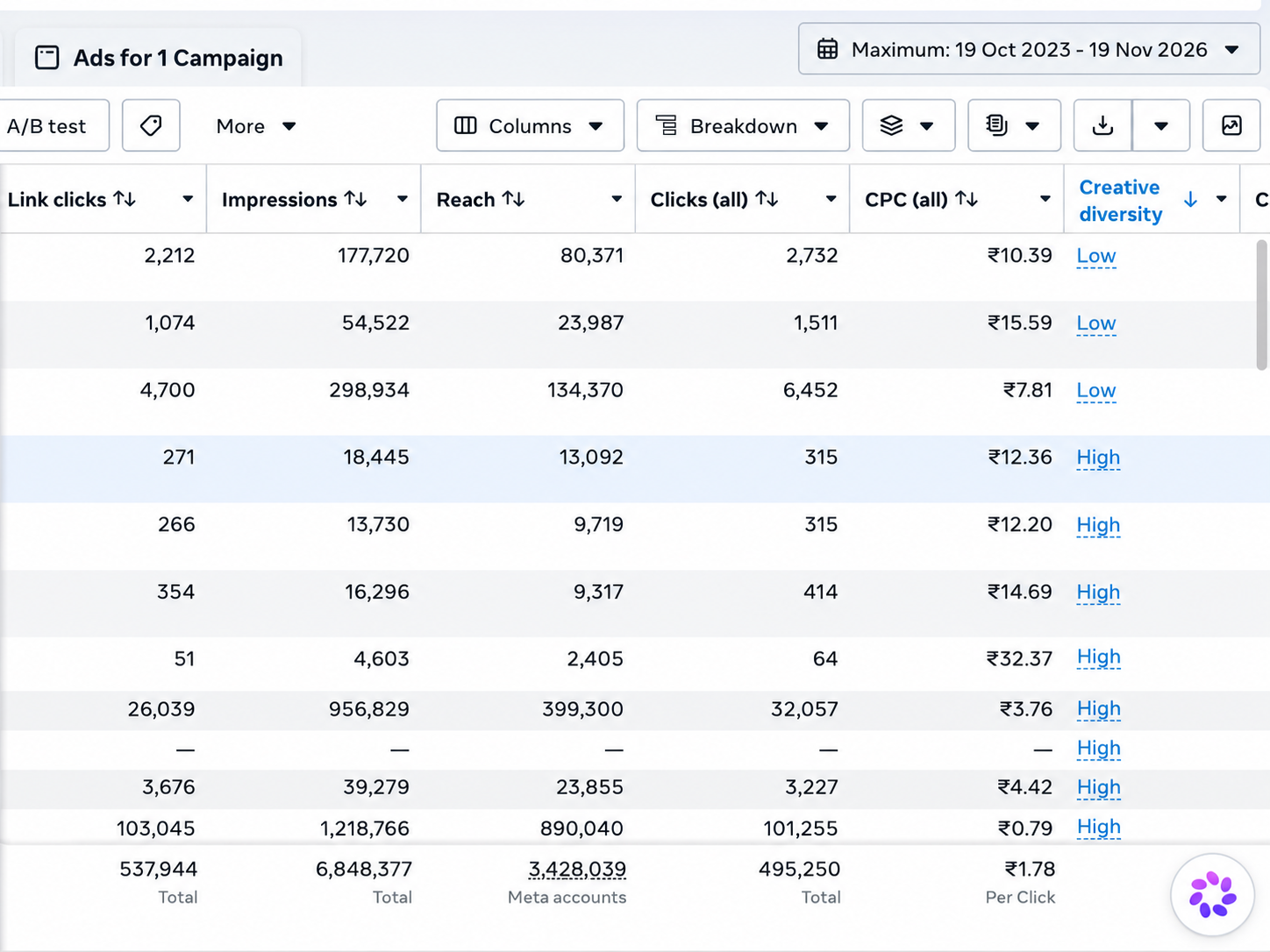
Here is what the table actually shows. The three rows rated Low delivered roughly 55,000 to 299,000 impressions each, at ₹7.81 to ₹15.59 per click. The two biggest rows by delivery, around 957,000 and 1.2 million impressions, are rated High, at ₹3.76 and ₹0.79 per click. The High group also holds the most expensive click in the table, ₹32.37, on 4,603 impressions.
So the picture is mixed. It is one campaign over a date range that runs back to 2023, so ads of very different ages sit side by side. The screenshot shows that the column exists and how it reads. It does not show that a High rating causes better results.
The practical point is that creative testing is now a visible part of the process, with a column of its own. Use it as a prompt, not a target. If a set of ads reads Low, run the swap test below on those ads and ask whether they are really different concepts. Do not chase the label. Without published thresholds you cannot tell how a rating was reached or how to move it.
The swap test: is it a concept or a variation?
You need a fast way to sort a batch of ads before you spend on them. Try this. Describe each ad in one sentence, leaving out the visual style. If two ads produce the same sentence, they are variations of one concept.
An illustration. Take an online course for freelance editors.
| Ad | One-sentence description | Verdict |
|---|---|---|
| A | A student shows the first client they landed within 60 days | Concept 1: proof of result |
| B | Same student, shot in a car, with a different opening line | Variation of Concept 1 |
| C | An editor explains why most beginners never get paid | Concept 2: mistake and fix |
| D | A split screen of hours spent editing versus hours spent earning | Concept 3: time and money comparison |
Four ads, three concepts. If you had budgeted for four ideas, you would have found out the hard way.
Free swipe file
Steal 150+ proven Meta ads that generated millions for the world’s top brands and agencies.
How to run a concept test, then a variation test
Here is a sequence that keeps the two jobs separate.
- List the reasons to buy. Write down every reason a customer has given you, in their words. Sales calls, reviews and support tickets are better sources than a brainstorm.
- Turn the strongest reasons into concepts. Aim for three to five that pass the swap test. Meta’s own guidance, as quoted by Jon Loomer, is to use six or fewer ads per ad set, so a small number of distinct concepts also fits how ad sets work.
- Make one clean version of each. Do not polish yet. A concept test is a question about the idea, so keep execution quality even across all of them.
- Run them against the same audience and offer. Change one thing, the concept, and let the results tell you which direction has pull.
- Pick one or two directions. Not the highest-clicking ad. The ones that bring the people you actually want, judged on the metric your business runs on.
- Now make variations. Take the winning concept and change one execution element at a time: the first three seconds, the headline, the length, the format, the person on screen.
- Keep a log. Record the concept, what changed and what happened. A year of notes is worth more than any single result.
- Return to concepts when the winner fades. Variations extend a good idea. They cannot replace one that has run its course.
The maths of finding a winner
Motion’s benchmark gives tier-average hit rates from 4.0 percent for micro-spend accounts to 8.8 percent for enterprise accounts. Across the whole dataset it is roughly 5 percent.
If one in twenty creatives wins, you need to launch around twenty to expect one winner. That is our arithmetic on Motion’s figure, not a promise about your account.
Motion adds a point worth keeping. Hit rate alone misleads. In its example, a team launching 5 ads with 1 winner has a 20 percent hit rate. A team launching 50 ads with 5 winners has a 10 percent rate but five times as many winners. Motion treats winners per month as the number to watch.
This is where concepts and variations split the work. Concepts raise the chance that a launch is a real swing. Variations raise the volume you can launch without starting from nothing each time.
Common mistakes
- Calling ten edits of one idea a test of ten ideas.
- Polishing a concept before knowing whether it works.
- Changing the concept, the hook and the audience in one go, then not knowing what moved the result.
- Judging concepts on click-through rate alone.
- Killing a concept after one weak variation. The idea may be fine and the execution poor.
- Never going back to concepts.
- Skipping the log.
What this does not prove
This article draws on benchmark data and practitioner opinion. It is not a controlled study. We did not find an independent experiment comparing concept testing with variation testing on Meta, and the figures from vendors are directional. Hit rates in Motion’s report come from accounts that choose to use Motion, so they may not match a small brand’s results. Your category, offer and audience will move all of this.
Related: Meta Andromeda creative testing: ads, buyers and the KPIs that matter. Also see our guide to Facebook ad creative and what a creative subscription includes.
Where ShortVids fits
Concept testing is expensive in production time. New scripts, new footage, new edits, every round. That is the part most small teams run out of capacity for, so they fall back on variations of whatever worked last quarter.
ShortVids is the production side of that loop. You bring the reasons to buy and the data. We turn them into distinct ad concepts and the variations that follow, on a monthly subscription, so the supply of new ideas does not depend on one overworked editor. We do not buy media or manage your ad account. For the commercial overview, see our ads as a service page.
Ready to feed your testing with real concepts? See how ShortVids ads as a service works
Frequently asked questions
What is the difference between a creative concept and a creative variation?
A concept is the core idea: the angle, audience or story. A variation keeps the idea and changes how it is shown, such as the hook, headline, format or length.
Should I test concepts or variations first?
Concepts first. A concept test tells you which direction has pull. Variations then refine a direction that already works. Reversing the order optimises an idea you have not yet confirmed.
How many concepts should I test at once?
Three to five distinct concepts is a practical range for most small and mid-size accounts. Meta’s guidance, as quoted by Jon Loomer, is six or fewer ads per ad set, and spreading a small budget across more makes each result noisier.
How do I know if two ads are really different concepts?
Describe each in one sentence without mentioning the visual style. If the sentences match, the ads are variations of one concept. Different sentences mean different concepts.
Does Meta penalise similar ads?
Meta has not published a rule on this. Practitioners report that near-duplicate ads add little, and some quote similarity thresholds, but we could not verify any of those figures in a Meta source. Treat them as rules of thumb.
What is a good hit rate for creative testing?
Motion’s 2026 benchmark reports roughly 5 percent across its dataset, from 4.0 percent for micro-spend accounts to 8.8 percent for enterprise accounts. Winners per month is a more useful number than hit rate on its own.
What should I change in a variation test?
One execution element at a time. The first three seconds, the headline, the length, the format and the person on screen are the usual candidates. Changing several at once hides which one worked.
How often should I go back to testing new concepts?
Whenever performance on your winners fades, and on a regular schedule even when it does not. Variations extend a good idea. They do not replace one that has run its course.
Where is the creative diversity column in Ads Manager?
Open the Columns menu in Ads Manager and search for Creative diversity. One source describes it at the ad set level, and the screenshot above shows it in the ads table. Meta changes its layout often, so check your own account.
What does a Low creative diversity rating mean?
Sources describe it as a rating of how visually similar your images and videos are to each other. Meta has not published thresholds and early coverage calls the metric an estimate, so treat Low as a prompt to check whether your ads are really different concepts.
Can ShortVids run my ad campaigns?
No. ShortVids is a creative production partner. We make the ads. Your team or your media buyer runs the campaigns and owns the ad account.