

Quick Summary
TL;DR: Meta Andromeda is an ad-retrieval engine. It helps Meta pull potentially relevant ads out of a much larger pool before ranking and auction decisions happen. Targeting did not disappear — more of it moved into the creative. The advertisers who adapt well are not the ones producing the most files. They are the ones testing genuinely different customer problems, promises, proof and formats, then judging the results with business outcomes, conversion data and creative diagnostics together.
Related: why creative diversity is the benchmark that matters in 2026, with the mortality and spend-concentration data behind it.
Your ads are the targeting now. Make sure they are saying more than one thing.
Get an Andromeda Creative Readiness Audit
If your Meta performance changed and nobody can explain why, you are probably looking at the wrong layer of the account. The audiences did not break. The creative pool did.
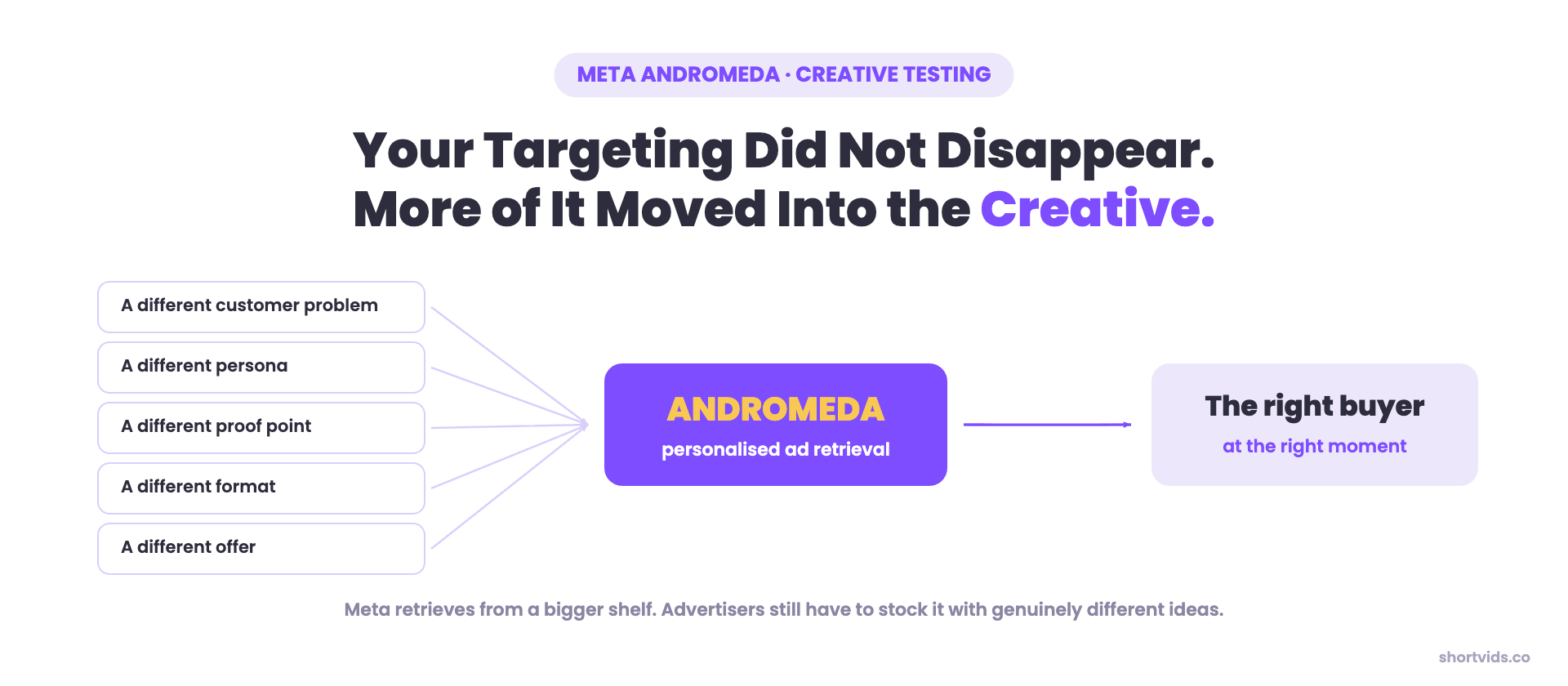
Meta Andromeda is a personalised ads-retrieval engine, and the practical change for advertisers is straightforward: Meta can now use a much wider range of creative options to find matches between people, products, messages and offers. A business that supplies one message repeated across 30 cosmetic variations is still giving the system a single idea. A business that tests different customer problems, desired outcomes, use cases, proof points and formats is giving it something to work with.
The response is not to produce random ads at industrial speed. It is to build a system that can research, develop, launch and learn from genuinely different concepts. This guide explains what Meta has disclosed, what advertisers are observing, where the evidence is still thin, and how to rebuild your creative testing so it works in this environment.
What Is Meta Andromeda?
Meta Andromeda is a personalised ads-retrieval engine. Retrieval is the stage at which Meta reduces a very large collection of eligible ads down to a smaller group that may be relevant to a particular person and request.
Meta’s own engineering team says Andromeda was built to improve ad retrieval as the number of eligible creatives expands. The company reports a substantial increase in model capacity along with improvements in retrieval recall and ad quality in selected segments. Those are system-level results reported by Meta. They are not a promise that any individual advertiser will see the same improvement. You can read Meta’s engineering explanation of Andromeda directly.
In plain terms: Andromeda helps Meta search a much bigger advertising shelf more intelligently.
That shelf keeps growing. Advertisers can produce more assets than ever, Meta can generate or adapt more combinations through its own automated tools, and catalogue-based advertising can represent thousands of products. A retrieval system designed for a smaller creative pool would struggle to evaluate that growth fast enough to serve an ad in the time a feed takes to load.
Andromeda is Meta’s answer to that retrieval problem.
Where Does Andromeda Sit Inside Meta Ad Delivery?
Andromeda matters, but it is not the entire advertising system. A lot of the commentary treats it as though it replaced everything. It did not.
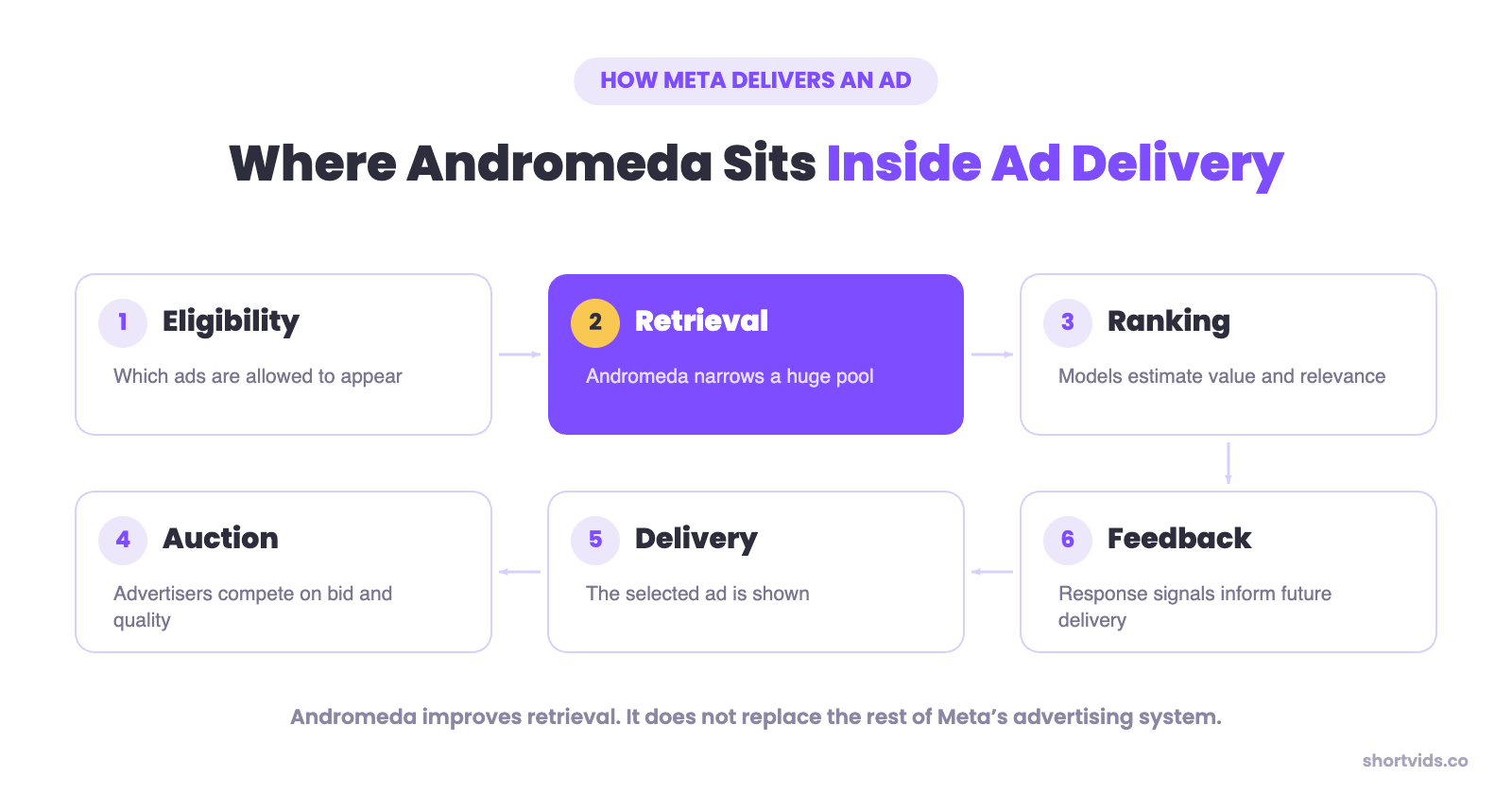
A simplified version of the delivery process looks like this:
- Eligibility: Meta identifies which advertisements are allowed and eligible to appear for a particular request.
- Retrieval: Andromeda helps retrieve a smaller set of potentially relevant advertisements.
- Ranking: Additional models estimate the value and relevance of the retrieved ads.
- Auction: Eligible advertisers compete based on Meta’s auction system, predicted action rates, ad quality and bids or budgets.
- Delivery: The selected advertisement is shown.
- Feedback: Engagement, conversion and other signals influence future optimisation.
This distinction is worth holding onto, because many explanations give Andromeda credit for every part of delivery. That is inaccurate. It is best understood as a major improvement to one stage — retrieval — inside a much broader recommendation and auction system.
Why Did Meta Need a New Retrieval System?
The advertising pool is no longer a handful of fixed images and headlines.
A single advertiser may now supply static images, videos, carousels, catalogue products, several primary-text options, multiple headlines, placement-specific assets, AI-generated backgrounds, cropped and resized versions, and a range of creator-led executions.
Multiply that across millions of advertisers and the number of possible ads becomes extremely large.
Meta says earlier retrieval systems had limited personalisation and leaned more heavily on isolated stages and rule-based processes. Andromeda uses more advanced models and indexing to process a much larger collection of creatives while holding the speed required to actually serve an ad. That is the technical reason creative diversification and Andromeda are almost always discussed together: Meta can now retrieve from a larger, more varied pool, but advertisers still have to supply the variety.
Is Andromeda a Targeting Update?
Partly. But calling it only a targeting update misses the point.
Andromeda improves Meta’s ability to retrieve ads that may be relevant to a person. Meta says the system can capture more complex relationships between people’s interests and the products or services represented by advertisements. What it does not do is make every other targeting and delivery input disappear.
All of the following still matter:
- Campaign objective
- Optimisation event
- Geographic and age restrictions
- Customer lists and exclusions
- Conversion history
- Pixel and Conversions API data
- Offer and pricing
- Landing-page experience
- Budget and bid strategy
- Account history
- Legal or category restrictions
So the useful conclusion is not “targeting is dead.” The useful conclusion is this: Meta is doing more of the matching automatically, which means advertisers have to express more of their customer strategy through the ad itself.
Related: what actually works in Facebook ad creative in 2026, with benchmarks.
Is Creative Really the New Targeting?
“Creative is the new targeting” is a helpful shortcut. It should not be treated as a literal description of the whole system.
The phrase is useful because the creative communicates who the message is for, which problem is being addressed, which outcome is being promised, which product or use case is relevant, what level of awareness the person may have, what evidence supports the claim, and which emotional or rational motivation is being used.
Take a company selling the same project-management platform to three groups:
- An agency owner worried about missed client deadlines
- A marketing director worried about campaign visibility
- An operations leader worried about handoff errors
The product is identical. The reason to care is not.
If all three people receive one generic “manage your projects in one place” ad, Meta has a single broad message to work with. If each problem is expressed through a distinct concept, Meta has three meaningful options to match against three different people.
Creative therefore becomes part of how the system identifies relevance. It does not become the only input.
How Does Andromeda Help an Ad Reach the Right Buyer?
Andromeda does not read your creative brief and assign the ad to a tidy audience label such as “busy agency owners.” It works inside Meta’s delivery system, using whatever information is available to retrieve ads that may be relevant to a person at a particular moment.
Advertisers do not control that decision directly. They influence it through the information they supply. That information comes from five practical areas.
1. The creative
The words, visuals, product, speaker, situation, problem and promise all help describe what the advertisement is about. A video showing an agency owner reviewing delayed client work carries a far more specific signal than a generic montage with “grow faster” on screen.
This is why a clear ad often gives Meta more useful information than a clever but vague one.
2. The conversion goal
Meta also needs to know what outcome the business actually wants. A campaign optimised for video views is not asking the system to find the same behaviour as a campaign optimised for purchases or qualified leads.
The optimisation event should be as close as practical to the real business result. Cheap clicks are a poor substitute for sales. A large volume of unqualified leads is a poor substitute for booked and attended calls.
3. First-party and conversion data
Pixel events, Conversions API signals, customer lists and prior conversion history help Meta understand which outcomes occurred after delivery. These signals will not rescue a weak offer, but missing or unreliable conversion data makes learning much harder for everyone.
The creative team and the technical team should not be working in isolation here. If the creative promises one action but the account records a different or incomplete event, the business is reading misleading feedback and briefing the next batch on top of it.
4. Eligibility and business controls
Location, age, exclusions, legal requirements, budget and bid controls still define where Meta is allowed to operate. Broad delivery does not mean abandoning sensible restrictions.
A local clinic should not pay to reach people outside its service area. A B2B company may still need customer exclusions. A regulated advertiser may need tighter controls than a general ecommerce store.
5. The response people produce
Delivery creates new information. People stop, watch, click, buy, ignore, hide or report an ad. Meta uses those response signals inside its wider optimisation system, and the advertiser uses them to decide what to create next.
That produces a simple cycle. The business supplies distinct messages. Meta retrieves and delivers potentially relevant ads. Buyers respond or they do not. The business reads business, conversion and creative signals together. The next creative batch tests a better question.
The goal is not to guess the hidden algorithm. It is to give the system clear options and give the business a disciplined way to learn.
A Buyer-First Way to Plan Creative
Before anyone writes a hook, build a small buyer map. For every meaningful customer type, answer six questions:
- Who is the buyer?
- What problem is expensive or urgent for them?
- What outcome are they trying to reach?
- What have they already tried?
- What objection stops them from acting?
- What proof would make the claim believable?
For a business like ShortVids, “businesses that need ads” is far too broad to guide useful creative. More useful buyer situations look like this:
- An agency owner whose media buyer is sitting idle waiting for client creatives
- A head of growth watching CPA climb as the winning ads fatigue
- A creative director who needs more output without losing brand control
- A SaaS founder who needs ads for demos, lead magnets and webinars
- An ecommerce team with plenty of products and too few distinct selling angles
Each situation produces a different ad concept, because the problem, the promise and the evidence all change. That makes the creative easier for a buyer to recognise, and it gives Meta a more varied pool to retrieve from.
The first sentence should make the intended situation obvious. The body should explain the problem and the mechanism. The proof should reduce doubt. The call to action should match the buyer’s level of readiness. That is human communication first. Any targeting benefit is a consequence of making the message clearer.
What Changed From the Older Meta Advertising Model?
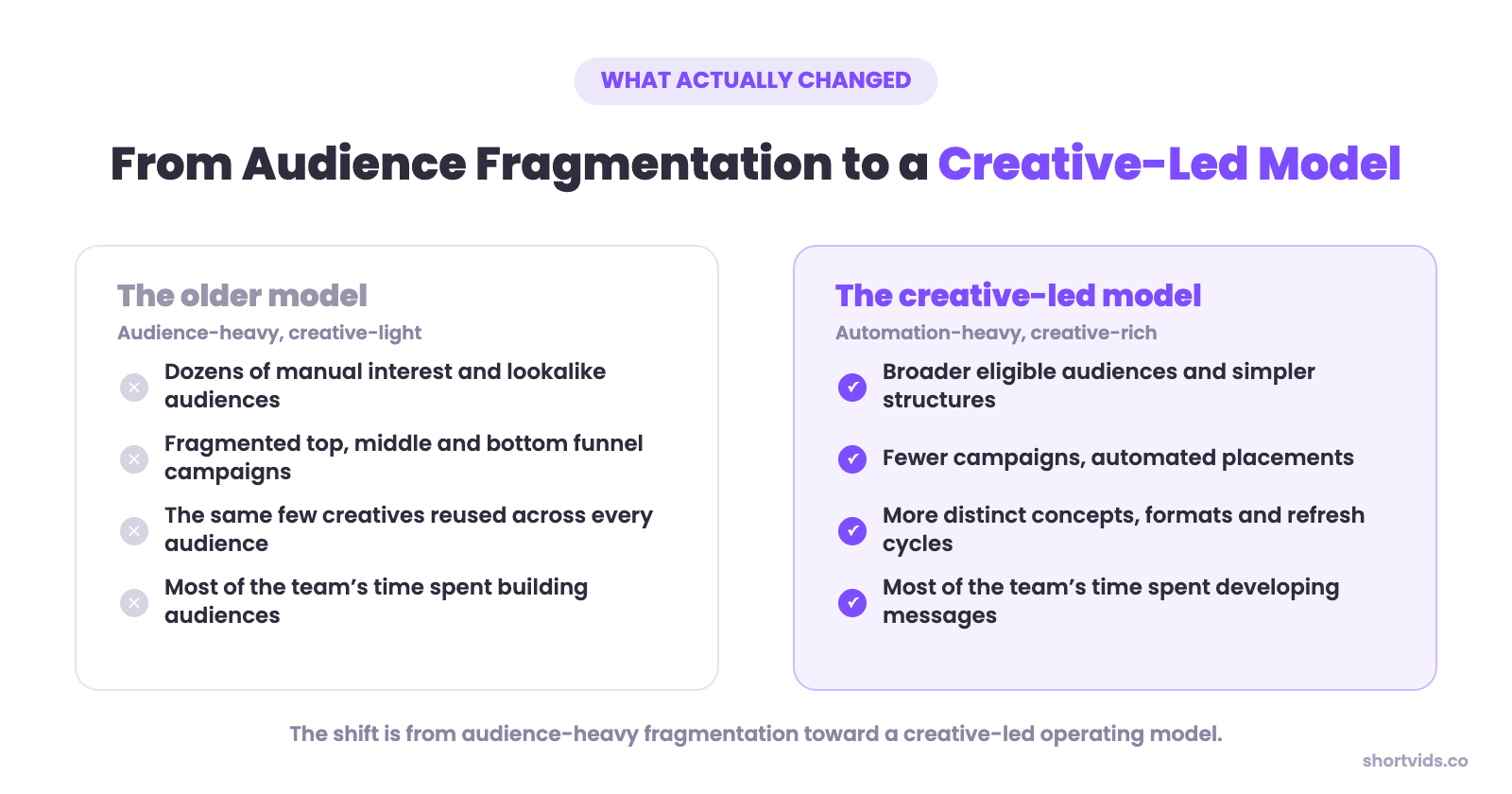
For years, advertisers were trained to build audiences by hand. A typical account contained cold interest audiences, lookalikes, website visitors, video viewers, cart abandoners, existing customers and separate top-, middle- and bottom-funnel campaigns. The same small set of creatives was then distributed across all of them.
Under Meta’s increasingly automated system, many advertisers are moving toward broader eligible audiences, fewer fragmented campaigns, automated placements, simplified account structures, better conversion data, more creative concepts and more frequent creative refresh.
This does not mean every account should collapse into one campaign or strip out every audience control. Regulated products, geographic limits, customer exclusions, low conversion volume and different business models all justify different structures.
The broad transformation is that advertisers now spend less time constructing dozens of audiences and more time developing the messages Meta can actually use inside automated delivery.
What Does Creative Diversification Actually Mean?
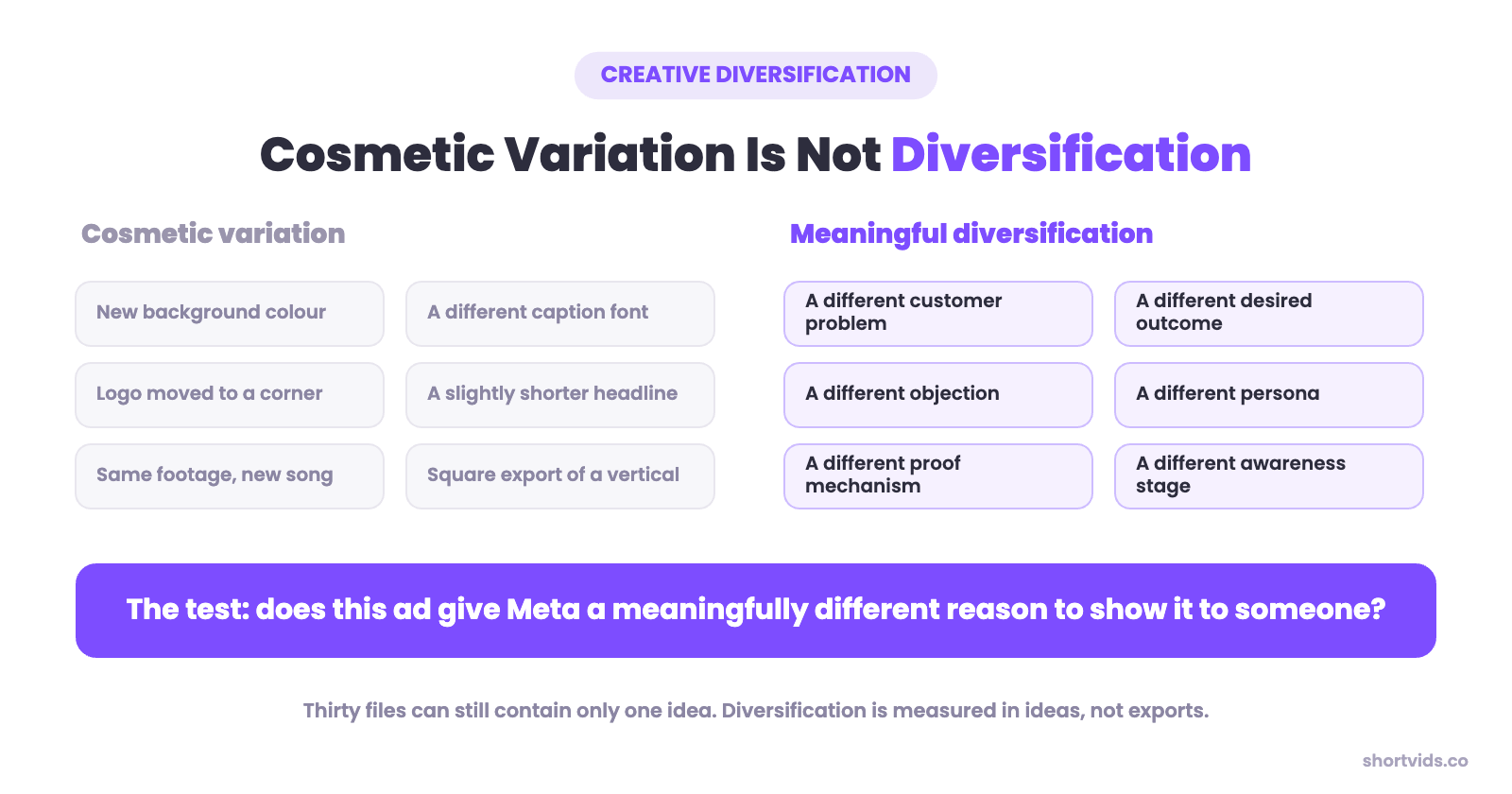
Meta describes creative diversification as developing unique campaign assets for different personas, needs or use cases. It is not changing the colour, the caption or the crop of the same advertisement. Meta’s own creative-diversification guidance is worth reading in full.
Cosmetic variation
- A new background colour
- A different caption font
- The logo moved to another corner
- A slightly shorter headline
- The same footage with another song
- A square export of a vertical video
These changes can be useful for production or placement. They do not necessarily create a new reason for anyone to care.
Meaningful diversification
- A different customer problem
- A different desired outcome
- A different use case
- A different objection
- A different persona
- A different proof mechanism
- A different product benefit
- A different awareness stage
- A different offer
- A different storytelling format
The practical test is one question: does this advertisement give Meta a meaningfully different reason to show it to someone?
Concepts, Variations and Adaptations Are Different Units of Work
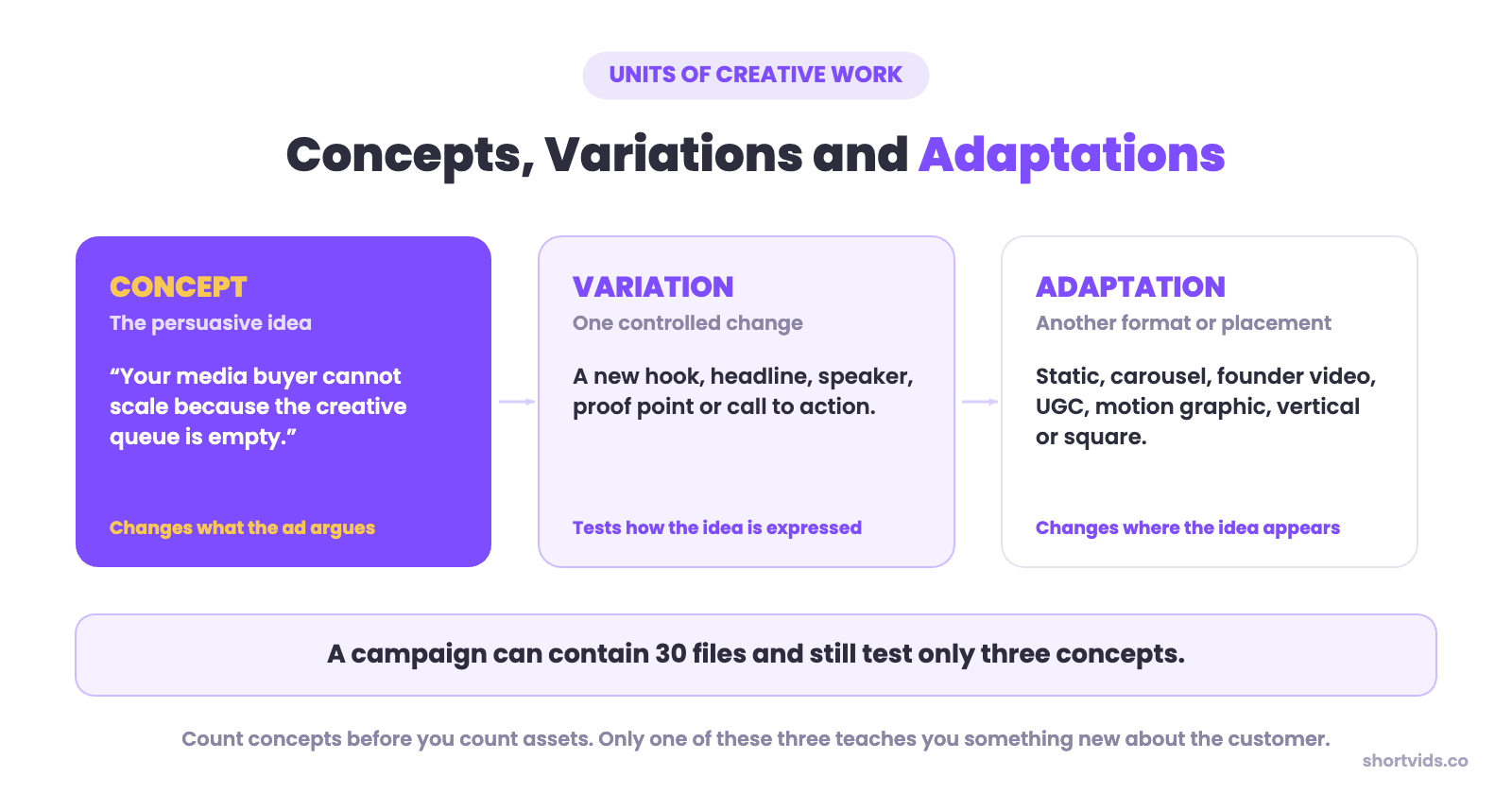
A lot of creative reporting inflates production by quietly combining three different things.
Concept
A concept is the underlying persuasive idea. For example: your media buyer cannot scale because the creative queue is empty. That connects a problem, a consequence and a commercial outcome.
Variation
A variation changes one controlled element inside the concept — a different opening hook, a different headline, a founder voice instead of a media-buyer voice, a new proof point, a different call to action.
Adaptation
An adaptation expresses an approved concept in another format or placement: static, carousel, founder-led video, UGC-style video, motion graphic, vertical, square.
A campaign can contain 30 files and still test only three concepts. That distinction sits at the centre of an Andromeda-ready creative system, and it is the first thing worth auditing in any account.
How Have Brands Changed Their Advertising Approach?
Public case studies can show patterns, but they need to be read carefully. Most of these brands changed more than one variable at a time. They may have adopted Advantage+ campaigns, catalogue tools, broader audiences and diversified creative simultaneously.
Read the results below as outcomes from combined strategies, not as isolated proof of Andromeda’s effect.
Ben & Jerry’s: more product and creative combinations
Ben & Jerry’s worked with its agency and Meta to diversify advertising through Advantage+ catalogue ads. Meta reports the approach produced 7% more link clicks and a 6.5% lower cost per link click, as covered in Meta’s reporting on the campaign.
The relevant change was not “make more ads.” The brand expanded the number of product and creative combinations available to Meta’s automated system. What that suggests: product-level diversity can be valuable, automation needs enough useful inputs, and catalogue creative can support personalisation at scale. What it does not prove: that every catalogue campaign will improve, that more products automatically create better performance, or that Andromeda alone caused the result.
Osprey: diversified creative inside an automated campaign
Osprey used Advantage+ shopping campaigns with a larger number of diversified advertising assets. Meta reports a 14% increase in purchases in the Osprey case study.
The useful lesson is that automated delivery and creative variety work together. A broader system still needs different products, situations, messages or formats to choose between. This is not an instruction to upload as many assets as possible — the more important question is whether those assets represent different commercial ideas.
TELETIES: combining diversified creative and automation
TELETIES paired diversified creative with Meta’s Advantage+ features. Meta reports 7% more purchases in the TELETIES case study.
The lesson is not that one format won. It is that the brand gave Meta a broader set of creative inputs and let automated delivery find the opportunities.
bonprix: adding format diversity
Fashion retailer bonprix added product video to Advantage+ catalogue advertising instead of relying on existing catalogue presentations alone. Meta reports an 18% lift in purchases in the bonprix case study.
This introduces another kind of diversity: format. Two ads can promote the same product and still do different communication jobs. A static image establishes the offer quickly. A product video demonstrates movement, fit, texture or use. A carousel helps someone compare several products. Format should follow what the idea needs to communicate.
FULLBEAUTY Brands: expanding automated product presentation
FULLBEAUTY Brands used Advantage+ catalogue ads together with Advantage+ creative. Meta reports a 45% higher return on ad spend in the FULLBEAUTY case study.
That is a strong reported result, and it should be handled carefully. The campaign involved automated catalogue delivery and creative features together, so it cannot responsibly be attributed to Andromeda alone. The operational lesson is more useful than the headline number: brands need product information, creative variety, conversion data and a campaign structure that lets the system use those inputs.
OLLY: starting with consumer motivations
OLLY’s creative-diversification approach began by identifying different consumer motivators and hook trends before producing any campaign concepts, as described in the OLLY case study.
This is probably the most important example for creative teams. Diversification did not begin in the editing timeline. It began with understanding why different people might buy. For the same wellness product, the motivations might be convenience, taste, routine, sleep quality, energy, stress or a specific life stage. The editing comes after the motivation, not before it.
What Do These Brand Transformations Have in Common?
The brands and campaigns differ, but a few patterns keep showing up: more than one creative format, more product or message options, increased use of automated delivery, fewer assumptions about one universal winning ad, creative built around different motivations, a larger pool of eligible inputs, and a stronger connection between product data and creative.
The common thread is not volume on its own. It is useful choice.
What Do the Case Studies Not Prove?
Case studies are selected success stories. They are not controlled evidence that every advertiser should copy the same setup.
- Multiple campaign variables frequently changed at once.
- Meta publishes successful examples, not a random sample of all advertisers.
- Category, margin, audience size and conversion volume all affect results.
- A catalogue strategy built for fashion may not transfer to B2B SaaS.
- More assets can waste money when the ideas underneath are repetitive.
- Automation cannot repair a weak offer or unreliable tracking.
A guide worth trusting contains both the result and the limitation.
What Are Advertisers Seeing Outside Meta’s Case Studies?
Official guidance explains the intended system. Practitioner evidence shows how it behaves inside real accounts.
Common Thread Collective
Common Thread Collective published an analysis covering roughly 53,000 ads, 147 brands and $14.5 million in BFCM spending, examining creative formats, catalogue advertising, bidding and diversity in Meta’s newer delivery environment. Their 53,000-ad analysis is useful because it moves the conversation past individual case studies and shows patterns across brands.
It still has limits. The sample is weighted toward CTC’s clients and an ecommerce context, correlation does not prove that one creative practice caused the outcome, and seasonal BFCM behaviour may not represent the rest of the year. The right use of practitioner data is to form better hypotheses, not to declare universal laws.
Motion
Creative-analytics platform Motion has documented how strategists and growth teams are responding to Andromeda through persona testing, creative-diversity measurement, fatigue analysis and higher-volume production systems. Their practitioner discussion highlights an operational change more than a tactical one: teams need a shared language connecting creative work with performance.
Instead of saying “the video failed,” a team needs to be able to ask whether the concept was weak, the opening was weak, the offer was unclear, the ad attracted the wrong kind of curiosity, the format was unsuitable, the landing page continued the promise, or the audience was large enough in the first place.
Jon Loomer
Meta advertising educator Jon Loomer has documented Meta’s native creative-testing feature and his own experience using it. The feature can place controlled spending behind several new ads, which reduces the delivery imbalance that makes normal ad-set comparisons so difficult to read. In his creative-testing walkthrough, he recommends testing meaningfully different formats, themes, customer profiles and message angles rather than subtle changes.
His experiment found that a flexible image format produced the lowest registration cost among the formats he tested. That is a result from one test, not evidence that image ads universally beat video. The more important lesson is methodological: test differences large enough to teach you something.
Why Normal Meta Creative Testing Can Be Misleading
Most advertisers put several ads in one ad set and compare the final columns. That is useful for observing delivery. It is not always a controlled experiment.
Meta may allocate more spend to one advertisement early. Different ads may reach different people. One asset may receive too little spend to produce a reliable result. The same person may see more than one of your ads.
Which produces a familiar set of mistakes:
- Declaring the highest-spend ad the best concept
- Declaring a low-spend ad a failure
- Comparing ads that carry different offers
- Testing several variables at once
- Pausing after a small number of conversions
- Treating random movement as a durable winner
Creative testing in this environment needs two modes of learning.
Delivery-led learning
Place several distinct ads in the normal campaign and let Meta optimise. This answers which ads the system finds easiest to deliver, where spend is concentrating, which concepts hold up at scale, and which formats produce business results.
Controlled learning
Use Meta’s creative-testing or experiment tools when the business needs a cleaner comparison. This answers whether concept A outperforms concept B under more balanced delivery, whether a founder explanation beats a product demonstration, and whether one offer produces more qualified customers.
The first approach is closer to normal operation. The second is better for isolating a single decision. Mature accounts use both, and they know which question they are asking before they launch.
The Creative Testing Hierarchy
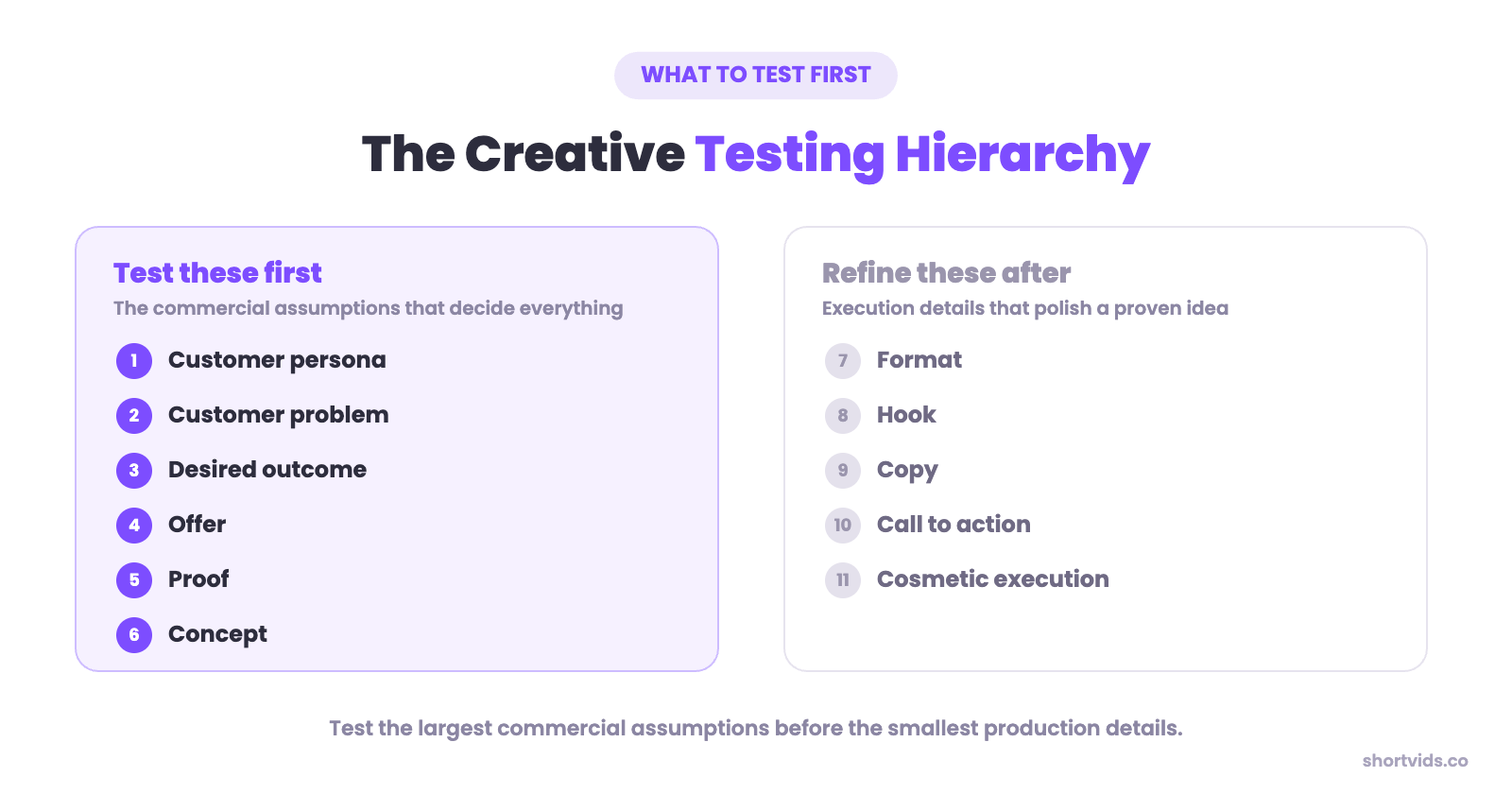
Most creative teams test at the bottom of the hierarchy, because those changes are the easiest to produce.
The more useful order runs from the largest commercial assumption down to the smallest execution detail: customer persona, customer problem, desired outcome, offer, proof, concept, format, hook, copy, call to action, and only then cosmetic execution.
Changing a button colour is quick. It rarely teaches as much as discovering that your customers respond more strongly to implementation speed than to lower cost. An Andromeda-ready system tests the biggest commercial assumptions before it polishes the smallest production details.
A Practical Creative Testing Matrix
Take ShortVids itself as the worked example. Each row below is a concept direction, not an ad. Hooks and executions get developed inside it.
| Concept | Audience | Problem | Promise | Proof | Formats |
|---|---|---|---|---|---|
| Empty creative queue | Agency owner | Media buyer has no ads to run | Fresh concepts every week | Workflow demonstration | Static, Slack-style ad, video |
| Creative fatigue | Ecommerce CMO | CPA is rising | Replace declining ads before they collapse | Account pattern and refresh plan | Carousel, motion, founder video |
| Hiring cost | SaaS founder | An internal team is expensive | An external creative department | Role and cost comparison | Static, founder video |
| Brand control | Creative director | Outsourcing may dilute the brand | Keep approvals while expanding production | The CONTROL workflow | Carousel, motion graphic |
| Missing learning | Head of growth | Production and performance are disconnected | Every batch informs the next | Testing dashboard | Product demo, static |
How Many Creative Concepts Should a Business Test?
There is no universal number, and anyone quoting one is selling something.
The appropriate volume depends on monthly advertising spend, expected cost per result, conversion volume, audience size, number of products, number of markets, sales-cycle length, the evidence you need to make a decision, and your production capacity.
A lower-spend account will usually learn more from three genuinely different concepts than from 20 lightly edited files. A high-spend ecommerce account may need continuous weekly production, because winners fatigue faster and more products and audiences are active at once.
The right question is not how many ads should we make? It is how many distinct decisions can our budget actually support?
A Directional Testing-Budget Formula
A simple starting calculation:
Testing budget = expected cost per result × desired results per concept × number of concepts
Suppose your expected cost per qualified lead is $100, you want 10 qualified leads per concept before you will believe anything, and you are testing 4 concepts. The directional requirement is $100 × 10 × 4 = $4,000.
This does not make the test scientifically conclusive. It stops a business planning more concepts than its budget can evaluate — which is the more common failure. The required evidence differs by objective: a low-cost ecommerce purchase accumulates data far faster than an enterprise sales opportunity.
Did Andromeda Introduce New KPIs?
No. Meta has not introduced a separate official set of “Andromeda KPIs.”
What changed is the operating environment. As creative takes a larger role in automated matching, teams need to connect business performance with creative diagnosis and production capacity. The cleanest way to do that is to organise your KPIs into five levels.
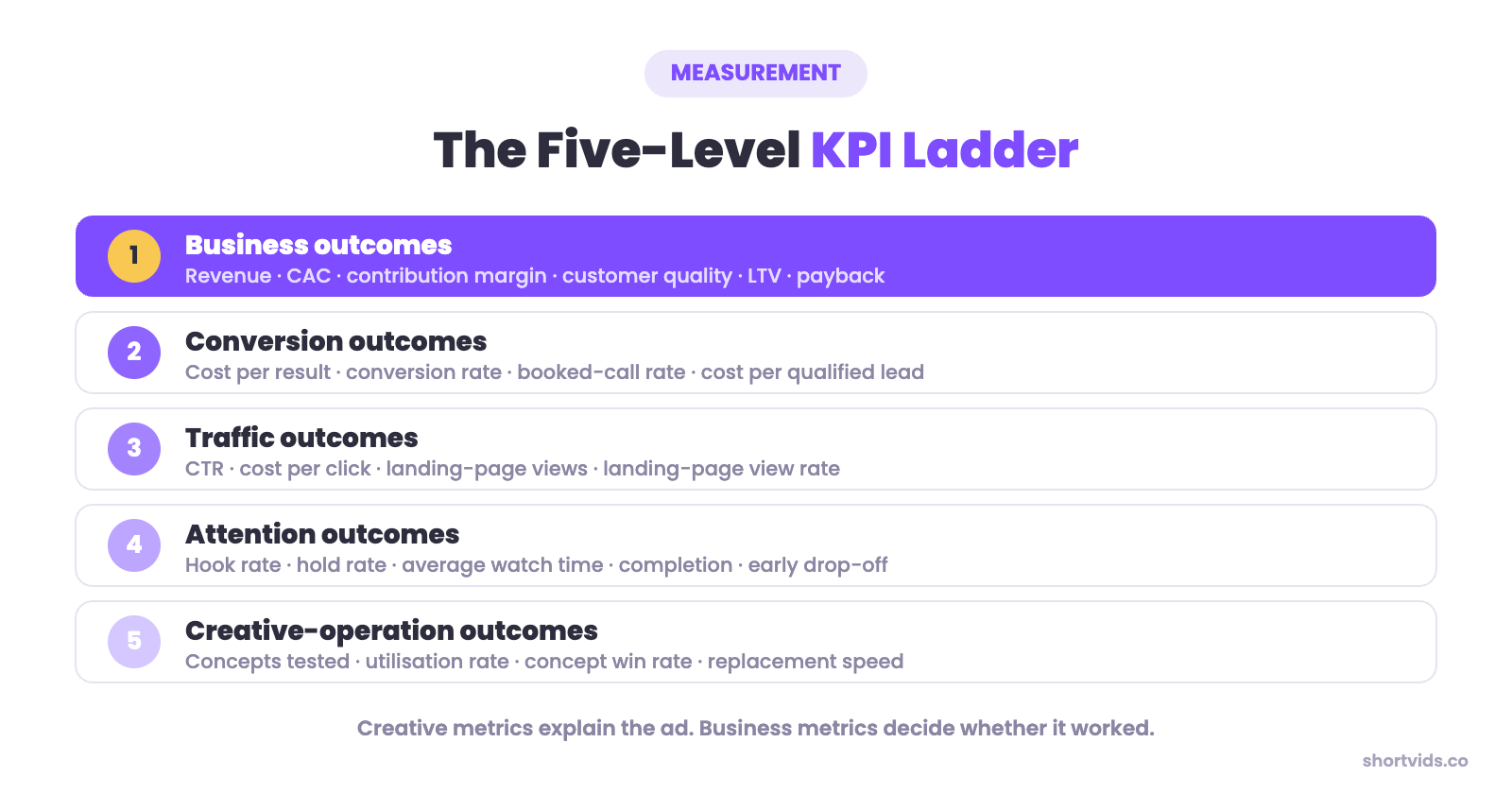
Level 1: Business outcomes
These determine whether advertising is creating economic value: revenue, customer-acquisition cost, contribution margin, qualified opportunity cost, customer quality, lifetime value and payback period.
ROAS can be useful, but it should not be your only business measure. A campaign can show an attractive platform ROAS while producing low-margin orders or customers who cancel within a month.
Level 2: Conversion outcomes
These measure the action the campaign was designed to produce: cost per result, conversion rate, purchase rate, lead-to-opportunity rate, booked-call rate, trial-to-paid conversion and cost per qualified lead.
The conversion event has to match the business goal. Optimising for cheap leads is not helpful when the sales team cannot qualify a single one of them.
Level 3: Traffic outcomes
These explain whether the advertisement created enough interest to move someone to the next step: click-through rate, cost per click, landing-page views and landing-page-view rate.
A high CTR is not automatically a good result. It can indicate strong relevance. It can also indicate curiosity, sensationalism or a promise the landing page cannot keep.
Level 4: Attention outcomes
These help diagnose the opening and the viewing experience: three-second video views, hook rate, hold rate, average watch time, completion rate and early drop-off.
Teams calculate hook and hold rates differently, so document your formula before comparing accounts or periods. Attention is diagnostic — a heavily watched advertisement can still fail to sell anything.
Level 5: Creative-operation outcomes
This is the missing measurement layer in most businesses: original concepts tested, variations per concept, percentage of delivered assets actually launched, creative utilisation rate, cost per usable concept, time required to reach a decision, concept win rate, learning yield, replacement speed and percentage of spend allocated to new creative.
These are the numbers that reveal whether the creative team is genuinely supporting the media account or just filling a folder.
KPI Combinations and What They May Mean
No single metric should be interpreted alone. These are diagnostic possibilities, not automatic conclusions.
| Pattern | Possible interpretation | Next question |
|---|---|---|
| High hook rate, low CTR | Strong opening, weak transition or offer | Does the body explain a reason to act? |
| High CTR, low conversion | Message and landing page may not match | Does the page continue the ad promise? |
| Low CTR, strong conversion | Smaller but more qualified response | Is the result scalable at the target CAC? |
| Strong engagement, weak sales | Entertaining creative without commercial clarity | Is the product and offer understood? |
| Strong early CPA, rapid decline | Fatigue or limited audience depth | Is the next concept ready? |
| Many delivered ads, few launched | Production is disconnected from media buying | Why are assets not entering the account? |
| High file count, low concept count | Variations are being mistaken for ideas | Which customer assumptions were actually tested? |
How Should Creative Fatigue Be Handled?
Creative fatigue happens when an asset loses effectiveness after repeated delivery or as audience response shifts. Meta surfaces creative-fatigue recommendations inside Ads Manager for eligible situations.
Warning signs can include rising frequency, declining CTR, rising cost per result, falling conversion rate, reduced incremental spend, negative comments, and a winner absorbing spend without holding its efficiency.
There is no fixed refresh calendar that applies to every account. An advertisement spending $50 a day against a large national audience behaves very differently from one spending $5,000 a day in a narrow category.
The practical rule is short: build the replacement before the current winner collapses. That requires continuous concept development, not emergency production after performance has already declined.
The 30-Day Andromeda Adaptation Plan
Understanding the update is not enough. A business needs an operating change, and 30 days is enough to make one.
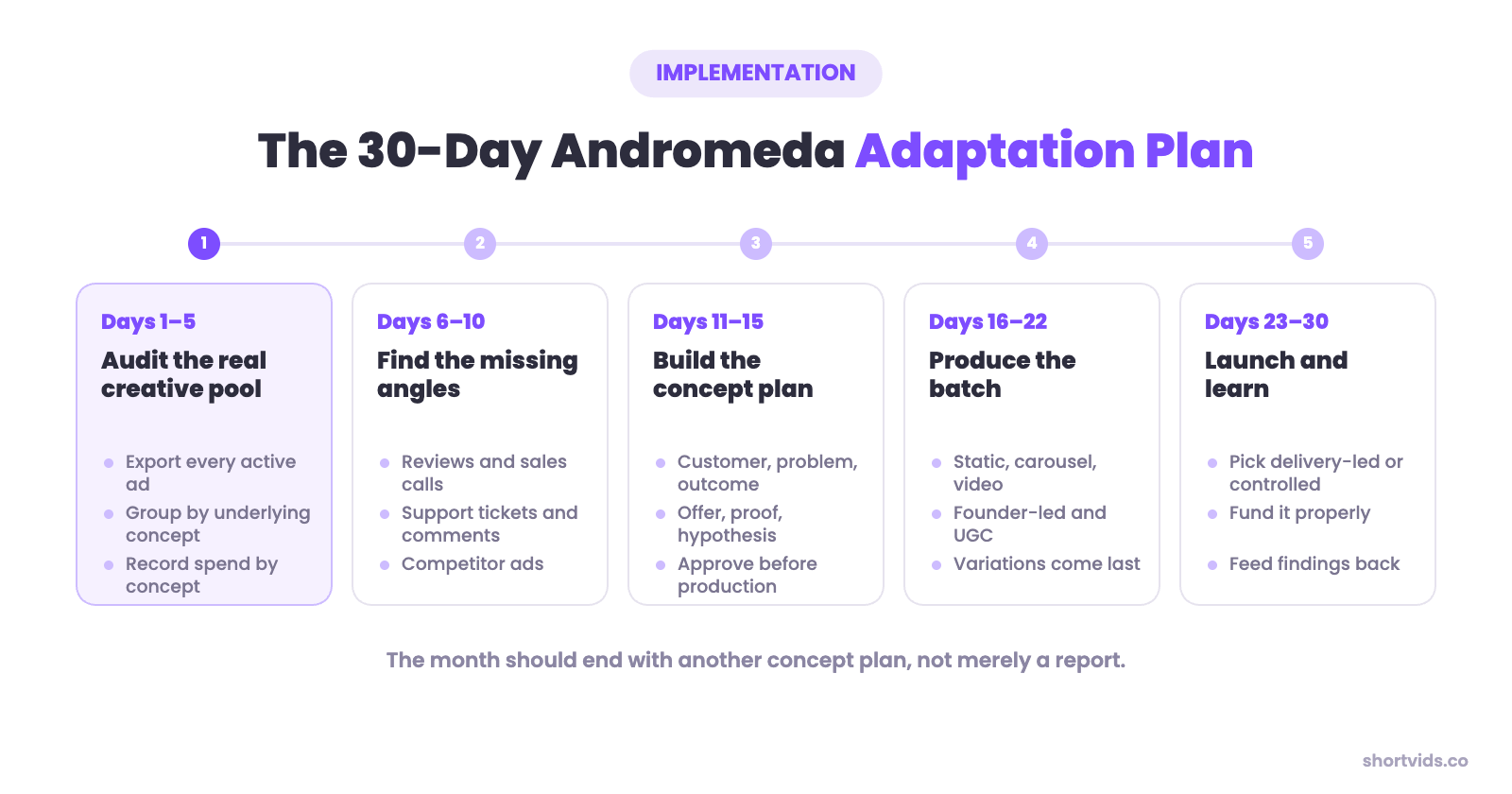
Days 1–5: Audit the real creative pool
- Export every active ad.
- Group ads by underlying concept.
- Separate concepts, variations and adaptations.
- Record spend and results by concept.
- Identify concepts receiving no meaningful delivery.
- Calculate the percentage of delivered assets that actually launched.
- Document the top customer problems currently represented.
The objective is to find out how much real diversity exists, as opposed to how many files exist.
Days 6–10: Find the missing customer angles
- Customer reviews
- Sales-call recordings
- Support tickets
- Product questions
- Competitor ads
- Comments on winning ads
- Landing-page objections
- Reasons customers said they chose you
Turn all of it into customer problems, motivations, use cases and proof points.
Days 11–15: Build the concept plan
Every concept should carry an intended customer, a problem, a desired outcome, an offer, proof, a hypothesis, a primary format and a success measure. Approve the concept before anyone starts full production.
Days 16–22: Produce the first diversified batch
Create the appropriate mix of static ads, carousels, product videos, founder-led videos, UGC-style videos, demonstrations and motion graphics. Develop controlled variations only once the core concepts are genuinely distinct from each other.
Days 23–30: Launch and learn
- Select delivery-led or controlled testing.
- Define the primary business metric.
- Define the diagnostic metrics.
- Launch with sufficient budget.
- Record what happened.
- Avoid conclusions before enough evidence exists.
- Return the findings to the creative team.
- Approve the next testing cycle.
The month should end with another concept plan, not merely a report.
The ShortVids Andromeda Readiness Score
Score each area from 0 to 2, where 0 means missing or undocumented, 1 means partially implemented and 2 means consistently implemented.
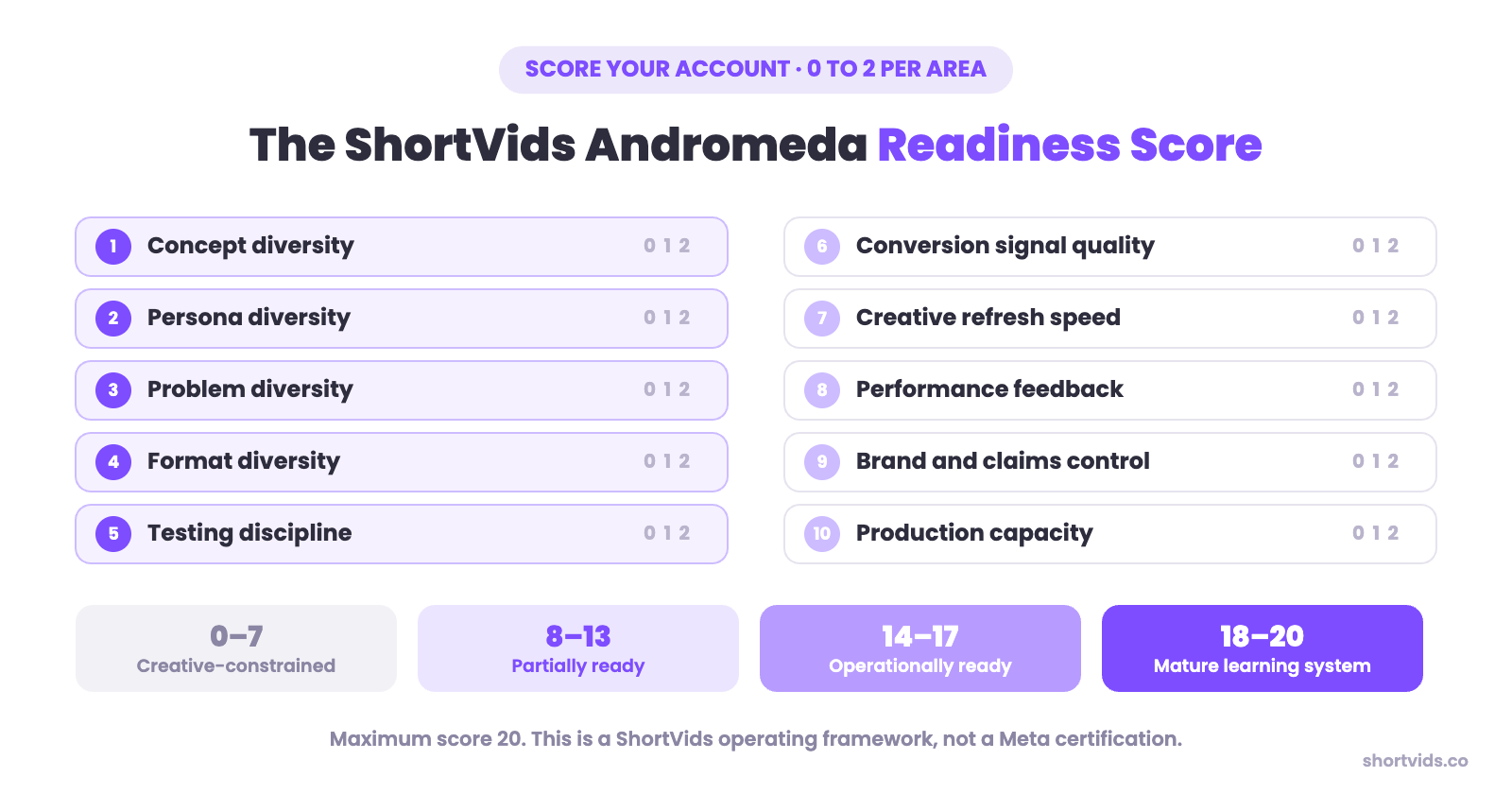
- Concept diversity. Are the ads testing different persuasive ideas?
- Persona diversity. Do the concepts represent different customer types or contexts?
- Problem diversity. Are multiple customer problems and desired outcomes represented?
- Format diversity. Does the account use formats that suit the idea, rather than repeating one production style?
- Testing discipline. Does every major concept have a hypothesis and a decision rule?
- Conversion signal quality. Is Meta receiving reliable information about the business outcome?
- Creative refresh speed. Can the team replace declining assets before performance collapses?
- Performance feedback. Does the creative team receive useful performance information?
- Brand and claims control. Are positioning, claims, disclaimers and final approvals documented?
- Production capacity. Can the team produce the required concepts and formats consistently?
Maximum score is 20. A score of 0–7 means creative-constrained, 8–13 partially ready, 14–17 operationally ready, and 18–20 a mature creative learning system. This is a ShortVids operating framework, not a Meta certification.
What We See Inside Real Accounts
Across Meta ad accounts representing more than $10 million in spend over an eight-month period, the same pattern shows up more often than any other: the creative library is large and the concept count is small.
Accounts arrive with hundreds of files. Grouped by underlying persuasive idea, they frequently collapse into a handful of concepts, most of them built around the same customer problem with different music, captions and crops layered on top. The account is not short of assets. It is short of arguments.
Two related patterns turn up alongside it. Delivered creative often never launches, because production and media buying run on separate calendars and nobody owns the handover. And when a winner starts to decay, there is usually no replacement ready, so the team produces the next batch under pressure — which is exactly when it reaches for a safe variation of the ad that is already dying.
None of that is an algorithm problem. It is an operating problem, and it was a problem before Andromeda. Andromeda just made it more expensive.
How to Publish a Guide Like This for SEO, AEO and AI Search
If you are producing this kind of cornerstone content yourself, the publishing model matters as much as the writing. A founder searching “how to test Meta ads after Andromeda” needs a usable testing system. A marketing leader searching “Meta creative testing agency” needs enough information to decide whether to build internally or hire a partner. One page can serve both without spawning a thin post for every phrase.
Google’s current position is straightforward: AEO and GEO are industry terms, but generative search in Google remains rooted in its core Search ranking and quality systems. There is no separate trick that replaces SEO. Google recommends original, useful, non-commodity information, clear organisation, crawlable pages and strong images or video, as set out in its guide to generative AI features in Search.
Lead with a direct answer
The opening should answer the primary question in a few plain sentences, then earn attention by explaining the mechanism, the evidence, the limitations and the implementation.
Use question-led headings where the reader has a real question
Headings like “Is creative really the new targeting?” work because people genuinely ask them, and the answer should appear immediately below the heading. Not every heading needs to be a question — forced question headings make a page repetitive. Processes, frameworks and plans read better under descriptive headings.
Keep entities and terms unambiguous
Define a term the first time you use it. Andromeda is an ads-retrieval engine. Retrieval is the stage that narrows a large eligible pool before ranking and auction. Creative diversification means genuinely different assets for different personas, needs, messages or use cases. Clear definitions help readers and reduce the risk that a sentence gets quoted without its context.
Separate facts, observations and recommendations
Every major claim belongs to one of three groups: platform disclosure (what Meta or Google officially says), observed evidence (what case studies or practitioner datasets report), and operating recommendation (what you believe advertisers should do). Blending them is how a useful article turns into an unreliable one. Meta reporting retrieval improvements in selected segments does not prove every advertiser will improve, and a sensible testing framework is not an official Meta requirement.
Add first-party experience
The page becomes far more valuable when it carries evidence that could not be copied from another summary: the number of accounts or creatives reviewed, the period covered, the percentage of files that were cosmetic variations, the common creative gaps, an anonymised before-and-after concept map, a screenshot of a real testing tracker with client data removed. Precision is more persuasive than a large but poorly explained number.
Embed evidence beside the claim
A reader should not have to scroll to a reference list to work out why a statement is credible. Link the engineering explanation where you define Andromeda. Link the diversification guidance where you explain distinct concepts. Link each case study beside its reported result.
Use original visuals that explain rather than decorate
Diagrams should carry the delivery flow, the old model against the creative-led model, the testing hierarchy, the KPI ladder and a worked testing matrix. Each image needs a descriptive filename, useful alternative text and a caption that states the lesson — and the surrounding text should still explain the point, so nothing essential lives only inside an image.
Build internal links around business decisions
A page like this should sit at the centre of a small number of strong related pages, not a large collection of thin keyword posts. Useful destinations are the service page, relevant case studies, pricing and deliverables, creative-fatigue diagnosis, format-specific production pages and the booking page. Use descriptive anchor text — “see how ShortVids produces weekly Meta ad concepts” beats “click here.”
Add structured data carefully
Article or BlogPosting markup can describe the headline, author, reviewer, publish date, modified date, images and publisher. Breadcrumb markup clarifies the page’s position on the site. Structured data must match what the reader can actually see: no FAQ markup for hidden questions, no invented review ratings. Google is also explicit that no special structured data is required to appear in generative AI search.
Keep the page technically accessible
Before publishing, confirm the URL returns a 200, the page is indexable, the canonical points at the preferred version, the title and meta description are unique, one visible H1 matches the topic, headings follow a logical order, important content appears in the rendered HTML, images are compressed without going blurry, the mobile layout is readable, buttons and links are clearly labelled, Core Web Vitals are reasonable, the article is in the XML sitemap, and the page has been inspected in Search Console.
Google has also said websites do not need an llms.txt file, artificial chunking or rewritten AI-only text to appear in its generative Search features. Those tactics distract from the thing that actually works: a clear, useful and technically healthy page.
Measure search performance as a business funnel
Search visibility is not the result. Measure in four layers: discovery (impressions, indexed status, query coverage), engagement (click-through rate, engaged time, scroll depth), commercial interest (visits to pricing, case studies, service pages and the audit CTA), and revenue contribution (qualified enquiries, booked calls, opportunities and closed revenue). A page can earn a great many impressions for broad Andromeda questions and still fail commercially. It can also attract fewer clicks and influence high-intent buyers who return later through branded search.
A Publishing Checklist for Cornerstone Content
- The title promises the exact problem the article solves.
- The opening gives a complete short answer.
- Every technical term is defined simply.
- Every platform claim has a nearby official link.
- Every case-study number identifies the company and the context.
- Limitations are stated beside results.
- Internal frameworks are labelled as internal frameworks.
- First-party observations have documented evidence and approval.
- Original visuals exist, with alt text and a useful caption.
- Relevant service, case-study, pricing and booking pages are linked.
- The author, reviewer and last-updated date are visible.
- Article and breadcrumb structured data match the page.
- The page is indexable, canonical and mobile-friendly.
- The CTA offers a useful next step without promising results.
That is what “AI-friendly” should mean in practice: a page that gives reliable answers, shows how it knows, offers original experience and stays easy for a person to use.
The Production Problem Most Advertisers Discover
The strategic recommendation sounds simple: create more meaningful diversity. Executing it is where most teams stall.
Doing it properly can require a customer researcher, a creative strategist, a copywriter, a scriptwriter, a static designer, a video editor, a motion designer, a UGC coordinator, a project manager, a quality reviewer and a performance analyst.
Most businesses have no appetite for recruiting and managing all of those roles simply to keep a Meta account supplied with fresh concepts. And partial hiring does not fix it — hiring one editor does not solve research, hiring one designer does not solve scripts, and hiring one strategist does not create production capacity.
What the work actually requires is a connected team.
How ShortVids Supports an Andromeda-Ready Creative System
ShortVids works as a done-for-you performance creative team for brands and agencies, and the team does more than wait for an editing brief.
That covers customer and competitor research, creative-library analysis, creative-gap identification, persona and use-case development, concept development, testing hypotheses, hooks and scripts, static ads, carousels, video ads, UGC-style execution, founder-led ads, motion graphics, controlled variations, placement adaptations, quality assurance, weekly creative delivery, performance review and next-cycle recommendations.
The positioning is simple: ShortVids is marketing-first and production-led. The team understands customer problems, offers, concepts, hooks, CTR, conversion rate, CPA, fatigue and testing — and it has the production capacity to turn that strategy into ad-ready assets. Plans start from $999 per month.
What the Client Continues to Control
ShortVids does not take ownership away from the business. The client keeps control of product truth, approved claims, offer and pricing, customer data, the advertising account, the budget, legal approval, final creative approval, and every launch and scaling decision.
Media buying is treated as a separate responsibility unless it is specifically included in the engagement.
A business can spend months recruiting a strategist, a copywriter, a designer, an editor and a project manager, then spend more months building briefs, review systems and performance reporting. The point of the service model is to provide connected creative capacity without forcing the client to assemble that department role by role. It does not mean the client stops thinking — the client supplies the product truth, the commercial context and the approvals, and ShortVids handles the specialised research, concept and production work.
Get an Andromeda Creative Readiness Audit
Share your current ads, your offer, your audience and the performance challenge you are trying to solve. The ShortVids team will separate concepts from cosmetic variations, identify missing customer problems and use cases, review format diversity, highlight production bottlenecks and recommend the next creative directions.
Get My Andromeda Creative Readiness Audit
Or, if you would rather start with the work itself: ShortVids will identify three genuinely different creative directions for your business, built around customer problems, use cases and proof rather than colour changes and repeated hooks.
Frequently Asked Questions
What is Meta Andromeda?
Meta Andromeda is an ad-retrieval engine that helps Meta select potentially relevant ads from a large pool before the later ranking and auction stages.
Is Andromeda the same as Meta Advantage+?
No. Andromeda is part of Meta’s underlying ad-retrieval technology. Advantage+ is a suite of advertiser-facing automation products covering areas such as audience, campaign and creative optimisation.
Did Andromeda remove audience targeting?
No. Audience controls, eligibility, geography, conversion signals and restrictions all still matter. Andromeda increases Meta’s ability to retrieve relevant ads within its automated delivery system.
Is creative the new targeting?
Creative now carries more information about the customer problem, use case, product and promise, so it contributes to matching. It is not the only targeting or delivery input.
What is creative diversification?
Creative diversification means developing genuinely different assets for different customer personas, needs, motivations or use cases. It is more substantial than changing colours, captions or crops.
How many creative concepts should I test?
The number depends on budget, conversion volume, audience size, expected cost per result and production capacity. Start with fewer meaningful concepts rather than many cosmetic variations.
Are hooks separate concepts?
Usually not. A hook is generally a variation within a concept, unless it changes the underlying customer problem, promise or persuasive idea.
Should every concept be produced as a video?
No. The format should fit the idea. Some concepts communicate more clearly through static images, carousels, demonstrations or motion graphics.
Did Andromeda introduce new KPIs?
No separate official Andromeda KPI set exists. Advertisers should keep measuring business, conversion, traffic and attention outcomes, and add creative-operation measures.
Is CTR still important?
CTR is useful for diagnosing interest, but it does not prove business performance. Read it alongside conversion rate, CPA, customer quality and the landing-page experience.
How do I know whether an ad is fatigued?
Possible signs include rising frequency, declining CTR, rising CPA, a lower conversion rate and reduced ability to spend efficiently. Interpret the pattern in the context of the account.
What does Andromeda-ready creative mean?
It refers to a creative system that supplies Meta with meaningfully different concepts, messages, products and formats. It is a ShortVids working term, not an official Meta certification.
Can ShortVids work with my existing media buyer?
Yes. ShortVids can supply the research, concepts and creative production while your existing media buyer keeps campaign, budget and scaling responsibility.
Does ShortVids guarantee improved ROAS?
No responsible creative provider can guarantee ROAS. Performance also depends on the offer, product, pricing, audience, media buying, landing page, measurement and market conditions.
What does ShortVids need from my business?
The team needs the offer, the audience, brand rules, approved claims, existing ads, any available customer research and enough performance information to understand what has already happened.
What happens during the readiness audit?
ShortVids reviews the existing creative pool, separates concepts from variations, identifies missing customer angles and recommends the next testing directions.