

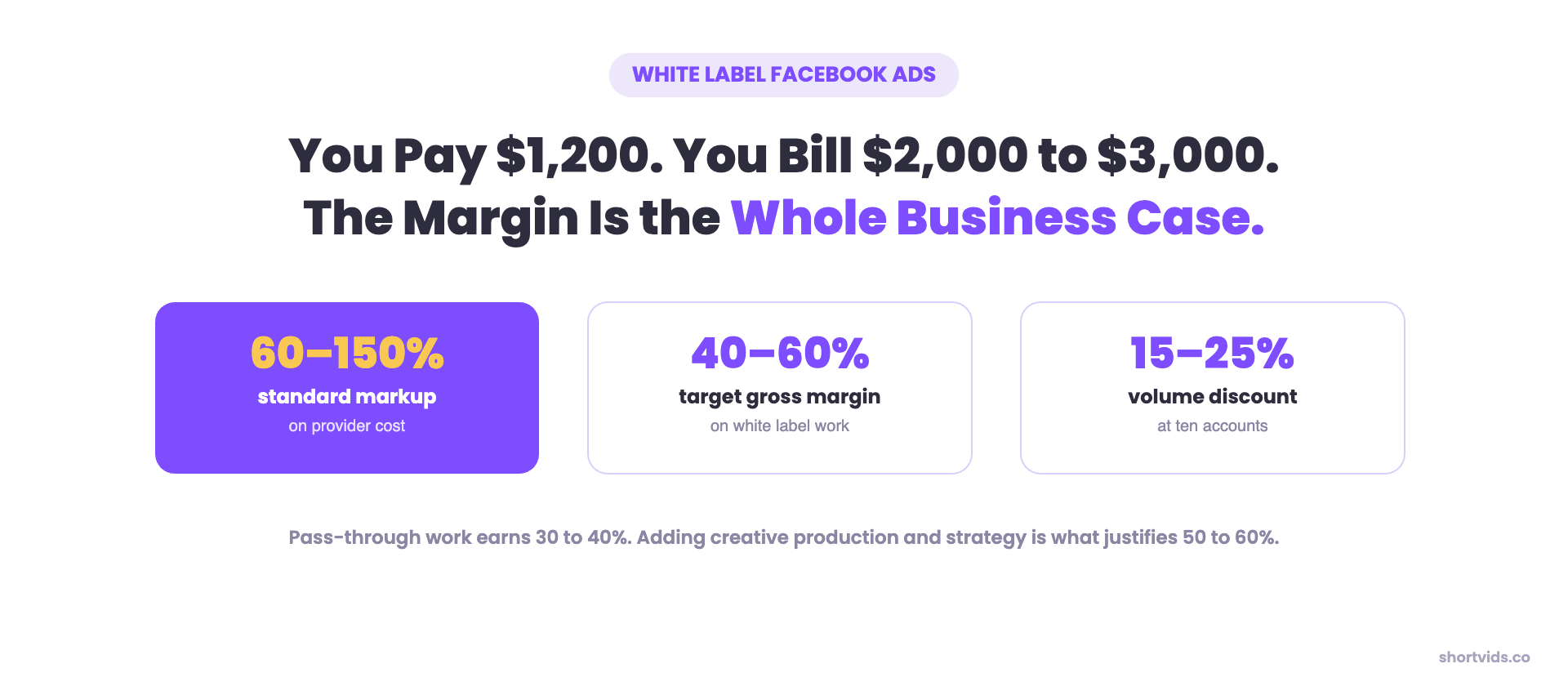
Short answer: White label Facebook ads means a provider does the work and your agency bills the client under its own brand. Typical markup is 60 to 150 percent on provider cost, with agencies targeting 40 to 60 percent gross margin. Pure pass-through earns 30 to 40 percent. Owning the creative brief is what moves you up that range.
Quick Summary
ShortVids is a white label creative production partner, not a white label media buyer. We produce the ad creative under your brand, meaning research, concepts, scripts, static, video and UGC, and your team or your client’s buyer runs the campaigns. That distinction matters on this page because most white label Facebook ads providers sell account management, and the two are priced and resold very differently.
TL;DR: The economics are simple and rarely stated plainly. Pay a provider $1,200 a month per client, bill $2,000 to $3,000, keep the difference for owning the relationship. What decides whether you sit at the bottom or top of that range is how much of the thinking you do, not how well you hide the provider.
Want to see the work before you resell it?
Get three white label ad concepts for one of your clients
What Are White Label Facebook Ads?
White label Facebook ads is an arrangement where an external provider performs the work and the agency delivers it to the end client under its own brand. The client sees your logo on the reports, your name in the calendar invite, and your account manager on the call. The provider stays invisible by design.
It splits into two very different services that get sold under the same phrase:
- White label media buying. The provider runs campaigns, sets budgets, manages bids and reports on spend. This is the version most providers in this category sell.
- White label creative production. The provider builds what goes inside the ad, meaning concepts, scripts, static design, video and UGC, while the agency or its client keeps the account and the buying decisions.
Getting this wrong is the most common cause of a failed white label relationship. An agency that already has a competent buyer and a creative bottleneck does not need another buyer. An agency with neither needs full service and should say so.
Scope varies by provider. Toptal’s guide to the category lists the usual inclusions as campaign planning, A/B testing and optimisation, campaign management, bidding and scheduling, and reporting under your branding.
What Does White Label Facebook Ads Cost?
Two pricing shapes dominate, per ClicksGeek’s 2026 white label cost analysis.
| Model | Typical range | Note |
|---|---|---|
| Percentage of ad spend | 15 to 25% of monthly budget | Varies by budget size and scope |
| Flat monthly fee | Fixed per tier or workload | Easier to resell predictably |
| Volume discount | 15 to 25% at around ten accounts | A further 10% is common on annual commitment |
Flat fees are generally easier to build a resale price on, because you can quote the client a fixed number without exposing how the underlying cost moves with their spend.
The Margin Maths Nobody Publishes
This is the part agencies actually want and most provider pages avoid.
Standard markup on white label services runs 60 to 150 percent of your cost. In practice that means paying a provider $1,200 a month for a client and billing $2,000 to $3,000 for the same work under your brand. The $800 to $1,300 you keep is compensation for owning the client relationship, the strategic oversight and the churn risk, which are real costs even though they are not invoiced.
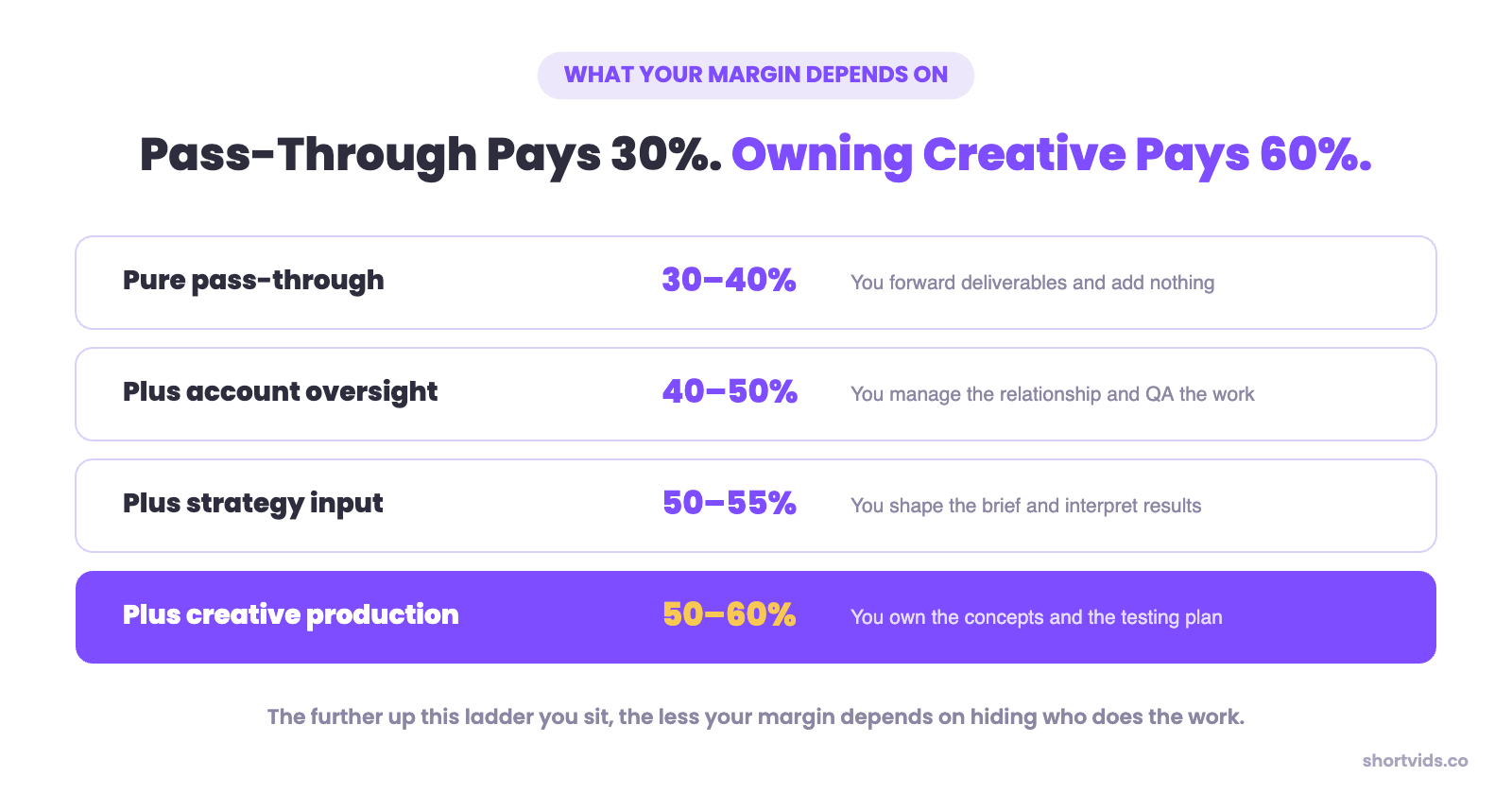
Where you land inside that range is not arbitrary. It tracks how much of the thinking you do:
- Pure pass-through: 30 to 40 percent. You forward deliverables with minimal oversight. Defensible, but fragile, because the client is paying for something they could buy directly.
- Plus strategic consultation, creative production or integration with your other services: 50 to 60 percent. You are shaping the brief, interpreting results and connecting the work to everything else the client buys from you.
Most successful agencies target 40 to 60 percent gross margin on white label work. If you are sitting at 30 percent, the fix is usually not to squeeze the provider. It is to take on more of the layer the client is actually paying you for.
Free swipe file
Steal 150+ proven Meta ads that generated millions for the world’s top brands and agencies.
What the Search Results Tell You About This Market
Worth a short detour, because it says something useful about how agencies buy.
We pulled the US search results for “white label facebook ads” in September 2026. The top organic result is not a provider. It is a Reddit thread in r/FacebookAds titled “I run white label Facebook Ads for 30+ agencies”, taking an estimated 117 clicks a month. The next result, a provider service page, takes 15.
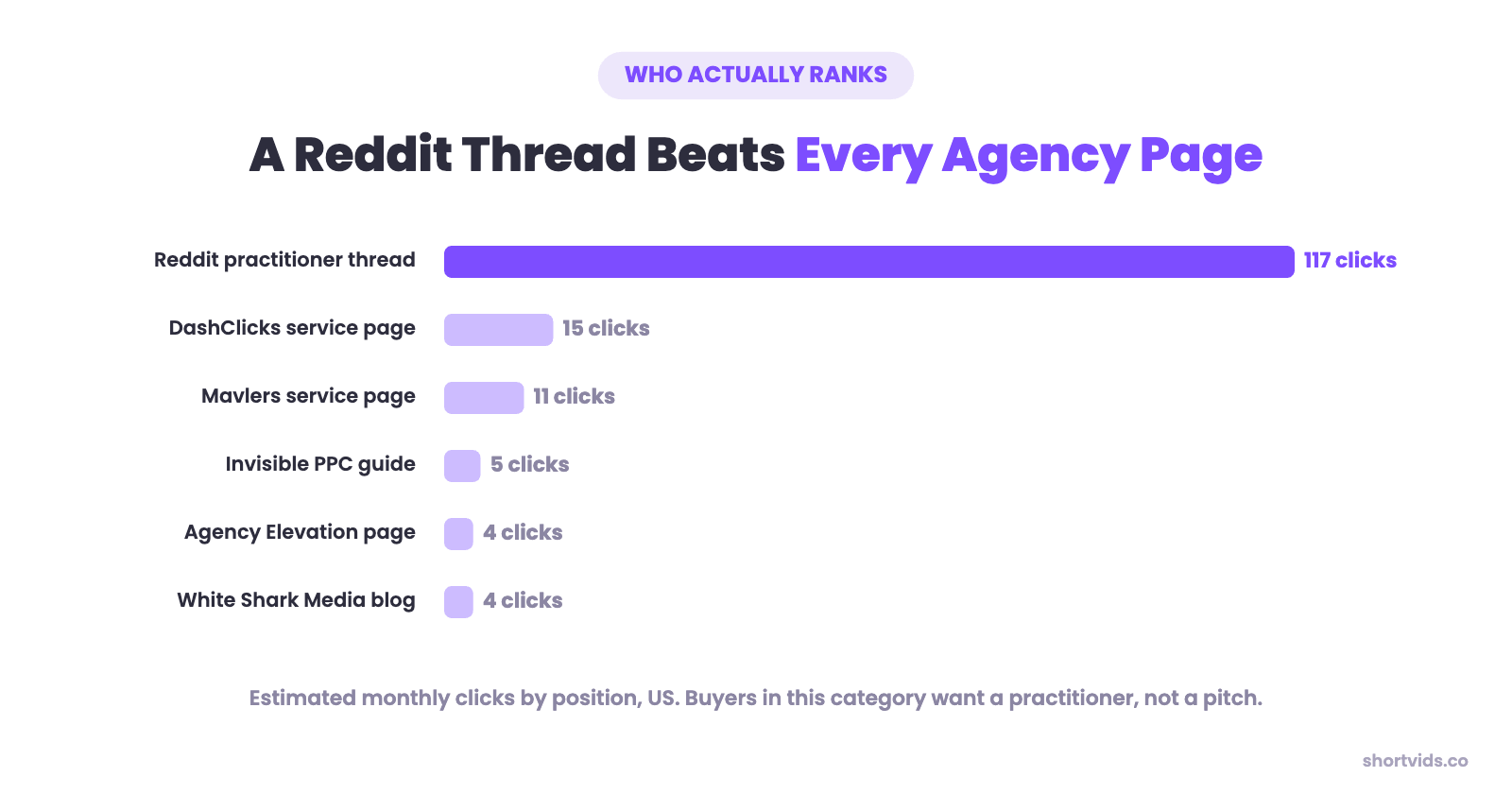
Add up the estimated clicks for every commercial provider page on that first page and you get 45. The single practitioner thread takes 117, more than twice the lot of them. Agencies shopping for a white label partner are not looking for a pitch. They are looking for someone who has done it and will say what actually happens.
That is also a fair warning about this page. Treat everything below as our position, and go read the practitioner threads too.
What to Ask a White Label Facebook Ads Provider
Six questions, in the order that matters. The first three will disqualify most providers on their own.
1. Who owns the ad account?
The client should, with your agency and the provider holding partner access. If the provider insists on running campaigns from its own Business Manager, your client’s pixel history, custom audiences and conversion data sit with a company your client has never heard of. When you switch provider, that all resets. We covered why this is the single clearest red flag in our guide to choosing a Facebook ads agency.
There is also a platform constraint here that catches agencies out. Meta does not let one partner pass partner access to another partner. DashClicks answers this directly in its published FAQ: “Facebook does not allow partners to give access to other partners,” and recommends adding your personal profile to the client’s Business Manager instead. If a provider has not raised this with you during onboarding, they have not done this often.
2. What happens when my client wants to talk to the person doing the work?
Ask directly. Positions vary widely and providers state them openly. Invisible PPC builds its whole proposition on never touching your client, described in Clicks Geek’s provider roundup as “no client-facing communication or materials from the provider, ever”. Agency Elevation goes the other way and joins your Slack channel, saying you will “view us no differently than you would an in-house employee”. Neither is wrong. You just need to know before you promise a client anything.
3. What is the actual creative output per month?
Get a number, and get the format. “Unlimited requests” means nothing without a throughput figure and a turnaround time. DashClicks publishes 5 to 7 business days to build and launch a campaign once assets are supplied, revisions within about one business day, and optimisation at minimum once a week. That is a useful benchmark to hold others to. Benchmarks in our Facebook ad creative guide put the working requirement at roughly one new ad per $3,000 of client spend, so check the provider can actually meet that for the accounts you plan to resell.
4. Is the work genuinely unbranded?
Check the file naming, the report templates, the shared drive structure and the metadata. Providers leak their own brand in small places, and a client noticing is a bad day.
5. What are the volume terms?
Discounts of 15 to 25 percent are standard at around ten accounts. Agency Elevation states plainly that its pricing “includes special volume discounts that get cheaper as you add more clients”. If you are planning to scale, negotiate the tier before you need it rather than after.
6. What happens to the work if we stop?
Who owns the finished creative files, the source projects and the account structure. Get it in writing.
Where This Goes Wrong
Four failure patterns show up repeatedly.
Buying media buying when the gap was creative. The agency already had a competent buyer. Adding a second one changed nothing, because the constraint was creative volume. This is the most expensive version of the mistake because it takes months to diagnose.
Reselling on price alone. At 30 percent margin with no added layer, the client eventually works out they are paying a middleman. The relationship ends when they find the provider, or someone cheaper.
Promising turnaround you have not tested. Quote the provider’s stated turnaround to a client before you have run a real cycle and you will discover the gap at the worst moment.
No creative testing process behind the output. A provider shipping volume without a testing framework produces a lot of files and very little learning. Ask what their kill criteria are and how findings feed the next batch.
The Gap Almost Every White Label Provider Has in Common
Here is something you can verify yourself in ten minutes. Go to the service lists that white label Facebook ads providers publish and look for video production.
Agency Elevation lists 22 deliverables on its white label Facebook ads page. Among them: ad copy creation, ad copy optimisation, custom audience creation, retargeting ads, audience testing, campaign build-outs, conversion tracking audits, landing page recommendations, and image creative production. Video production does not appear.
DashClicks describes its campaign setup step as putting together “campaigns, ad sets, ads, copy and graphics”. Copy and graphics. Not video.
Of the nine providers in Clicks Geek’s 2026 roundup, one is singled out for in-house video: Voy Media, where the roundup notes “ad design and video production handled internally” and observes that “creative quality is often the bottleneck in Facebook ad performance”. The others cluster around management and reporting. MixBloom, listed at around $399 a month, pairs organic social content with ad management. Vendasta sells Facebook ads as one resellable product inside a wider agency platform.
That is the shape of the market. White label media buying is a crowded, well-served category. White label video creative at volume is not.
It matters more than it used to. Meta’s Andromeda ranking system rewards creative variety directly, because the retrieval stage needs distinct assets to pull from. We wrote that up in detail in our Andromeda creative testing guide. An agency reselling media buying alone, on a static creative library its provider refreshes occasionally, is competing with one hand tied.
Creative Partner or Media Buying Partner: Which Gap Do You Actually Have?
Be honest about which of these describes your agency, because the two problems have different answers.
| Symptom | The real gap | What to buy |
|---|---|---|
| Nobody on the team can structure a campaign or read the data | Media buying | A white label media buyer |
| Campaigns are competent but performance decays after three or four weeks | Creative volume | A white label creative partner |
| You are shipping the same three statics to every client | Creative volume and variety | A white label creative partner |
| Results are fine, but reporting eats your account managers | Operations | Reporting tooling, not fulfilment |
| You win the pitch then cannot produce what you promised | Production capacity | A white label creative partner |
Creative decay is the one most often misdiagnosed as a media buying problem. The campaign structure has not changed and the buyer has not got worse. The audience has simply seen the ads. Hiring a second media buyer does not fix that, and it is the most expensive way to find out.
How ShortVids Fits
We are the creative half. ShortVids produces Facebook and Instagram ad creative under your brand: video edits, statics, hooks, variants and iterations on the winners, delivered unbranded for you to hand to your client or your media buyer. We do not run your ad accounts and we do not manage your client relationships.
That is a deliberate limit, not a gap we are hiding. If your problem is that nobody can run the account, a media buying provider from the list above is the right call and we will say so. If your problem is that you cannot feed the account fast enough, that is the thing we do.
Everything is unbranded by default. Files, folders and delivery carry no ShortVids marks, and we do not contact your clients. Pricing sits on our pricing page rather than behind a call, so you can work out your margin before you speak to anyone. Examples of the output are in the portfolio.
Want to see whether the numbers work for your client mix? Book a call and we will go through the margin maths on a real account of yours rather than a generic example.
Frequently Asked Questions
What are white label Facebook ads?
White label Facebook ads are campaigns built and run by a third party provider but delivered entirely under your agency’s brand. Your client sees your name on the strategy, the creative and the reporting, and never learns the provider exists. Agency Elevation describes the intent as work that is “indistinguishable from as if the work were done by in-house employees of yours”.
How much do white label Facebook ads cost?
Two common models. Percentage of ad spend, usually 15 to 25 percent, or a flat monthly fee per account. Published entry points in 2026 run from around $399 a month at the lower tiers, with most providers quoting custom pricing based on spend volume and account count.
What margin can an agency make reselling Facebook ads?
Standard markup runs 60 to 150 percent over provider cost. Pure pass-through media buying tends to land at 30 to 40 percent gross margin. Adding your own creative production, strategy or reporting layer typically moves that to 50 to 60 percent, because you are selling something the provider is not.
Is white labeling Facebook ads legal?
Yes. Reselling another company’s service under your own brand is a normal commercial arrangement. You need a written agreement covering ownership of the work, confidentiality and what happens on termination. We are not lawyers, so have yours look at the contract.
Will my client find out I am using a white label provider?
Not if the provider is genuinely unbranded and you check the details. The leaks are small and boring: file naming, report templates, shared drive structure, document metadata, and an email signature nobody thought about. Audit those before the first delivery.
Who should own the Facebook ad account?
Your client, with you and the provider holding partner access. Meta also does not permit one partner to grant partner access to another partner, so the practical route is usually adding individual profiles to the client’s Business Manager. If a provider wants to run everything from its own Business Manager, the pixel history and audiences you build are not yours to take with you.
How long does it take to launch a white label campaign?
DashClicks publishes 5 to 7 business days from the point all assets are supplied, and notes a 1 to 2 week gap between purchase and campaigns going live. Agency Elevation says new builds can be live “in a matter of a day or two”. Treat the faster figure as best case and quote your client the slower one.
What is the difference between white label creative and white label media buying?
Media buying is account structure, budgets, bidding, audiences and optimisation. Creative is the ads themselves: video, statics, copy, hooks and the variants you test. Most white label providers sell media buying with image creative attached. Fewer produce video at volume. Work out which half you are short of before you buy either.
Can I use a white label provider for just creative?
Yes, and it is increasingly the split agencies choose when they already have a competent buyer. You keep account control and client strategy, and outsource only production capacity. That is the arrangement ShortVids works in.
How many ads does a Facebook account need per month?
A working rule is roughly one new ad per $3,000 of monthly spend, rising when creative fatigue shows up early. A client spending $30,000 a month therefore needs about ten fresh assets a month, not four a quarter. Check any provider’s throughput against that before you commit.
What should I look for in a white label Facebook ads contract?
Ownership of finished creative and source files, the notice period, whether the provider may approach your clients directly, data and account access on termination, and volume tier thresholds. Toptal’s guide to the category, written by Rebekah Carter, flags the client-poaching risk specifically, warning against a partner who might “steal your customers by approaching them directly”.
Does creative volume actually affect Facebook ad performance?
Meta’s current ranking system, Andromeda, selects from a large pool of candidate ads at the retrieval stage, so accounts with more distinct creative give it more to work with. Clicks Geek’s roundup puts it plainly: creative quality is often the bottleneck in Facebook ad performance. Volume alone is not a strategy, but starving an account of new assets reliably caps it.