


Faceless YouTube channels are exploding, but so is the fear around AI-slop content, cheap fake videos, and looming AI YouTube crackdowns. If you’re using AI tools to scale content without showing your face, you’re probably asking one core question: Can I do this safely without ruining my credibility or my channel?
The short answer: Yes, but only if you understand the line between ethical automation and low-quality AI spam. YouTube is no longer tolerating reused AI content, synthetic misinformation, or low-effort videos designed purely for clicks. Channels built on shortcuts are quietly getting buried or demonetized.
Recent research indicates that over 20% of videos recommended to new YouTube users are of low quality, AI-generated “AI slop” clips. Anadolu Ajansı
This guide breaks down the real difference between AI slop vs smart automation, YouTube’s current stance on AI-generated content. And how faceless creators can stay profitable without becoming part of the cheapfake problem.
Quick Summary
TL;DR: Faceless YouTube channels scale best when AI handles repetitive tasks while humans oversee creativity, storytelling, and compliance. A structured AI-assisted workflow—covering scripting, voiceovers, editing, and Shorts repurposing- reduces time and cost without sacrificing quality. Services like ShortVids accelerate content repurposing and Shorts production, enabling higher output, better engagement, and sustainable growth. #tldr
- Core Components: Idea Generation → AI Script Drafting → Human Hook & CTA Edits → AI Voiceover → AI Video Assembly → Human Review → Shorts Creation → Scheduled Uploads → Performance Analysis
- Outcome: Efficient, scalable, and profitable faceless YouTube channels with consistent uploads, improved retention, stronger audience trust, and reduced creator burnout.
What Is AI Slop Content and How Is It Different from Smart Automation?
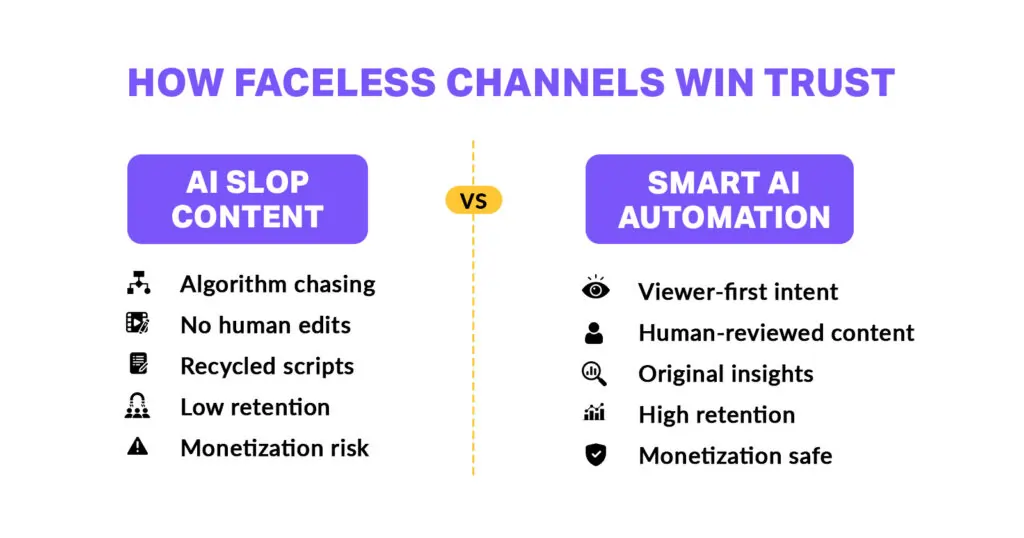
AI slop content refers to mass-produced, low-effort videos created with minimal or no human oversight. These videos are not designed to educate, entertain, or inform. Their sole purpose is to flood YouTube with uploads in the hope that something sticks. In practice, they exploit AI automation tools while ignoring viewer experience.
Most AI slop videos follow the same hollow formula: a recycled AI script, generic stock footage, and robotic narration stitched together in minutes. There’s no context, no originality, and no attempt to add insight. Viewers notice this immediately and so does the algorithm.
By contrast, smart AI automation uses AI as an assistant, not a replacement. The creator still controls narrative, accuracy, pacing, and intent. AI helps speed up research, outlines, or rough drafts, but the final output is shaped by human judgment.
The difference isn’t the tool; it’s how much thinking happens after the tool is used.
AI Slop vs Smart Automation (Quick Comparison)
The contrast becomes clearer when you compare AI slop content with smart automation across intent, execution, and long-term impact.
| Aspect | AI Slop Content | Smart AI Automation |
|---|---|---|
| Goal | Trigger algorithm | Serve real viewers |
| Editing | None or minimal | Human-reviewed |
| Originality | Reused or generic | Unique insights added |
| Viewer Value | Low | High |
| Long-Term Growth | Unsustainable | Scalable & safe |
Real-Life Example: A clear example of faceless content done right is Kurzgesagt, In a Nutshell. The channel never shows a human face, yet it maintains high credibility by combining automation with heavy human editing, original research, and clear educational value. This proves that AI-assisted workflows can scale content without becoming AI slop, as long as quality, accuracy, and viewer trust remain the priority.
Why Does Cheapfake Content Hurt Long-Term Growth on YouTube?
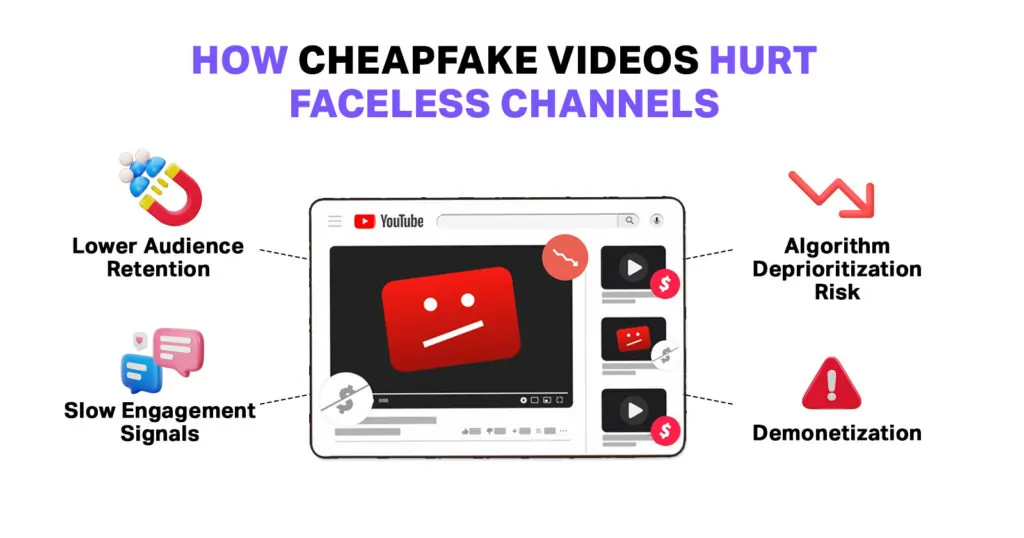
At first glance, cheapfake content, mass-produced, low-effort AI videos may seem like a shortcut to fast views. Many creators are tempted to rely on recycled scripts, robotic narration, or generic stock footage to flood the platform with uploads. While this strategy can generate early spikes in views or clicks, the long-term consequences are far more damaging.
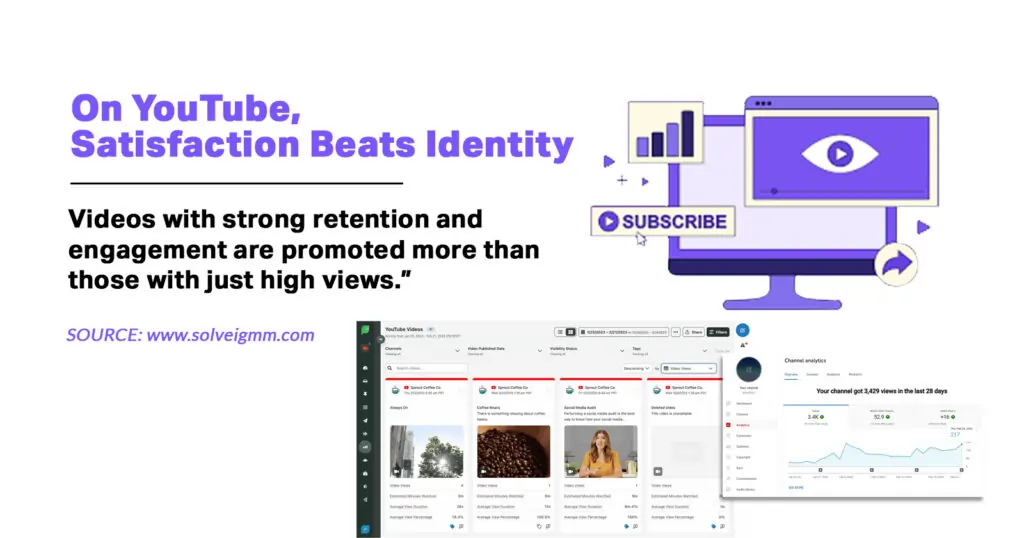
YouTube’s algorithm is now tuned to reward viewer satisfaction and watch time, meaning that low-quality, attention-farming content gets quietly deprioritized over time. Channels built on these shortcuts often see initial metrics rise, only to plateau or decline sharply, leaving creators with a hollow sense of growth.
Recent research from Search Engine Journal shows that YouTube’s algorithm prioritizes audience retention and engagement over simple view counts. Videos that fail to hold attention or generate likes, comments, and shares are less likely to appear in recommendations, regardless of upload frequency. This highlights why cheap fake content, even if it attracts short-term views, fails to sustain long-term growth.
Here’s What Actually Happens:
- Lower audience retention: viewers click away quickly when content feels generic
- Weak engagement signals: few likes, comments, or shares
- Algorithm deprioritization: repetitive or low-value uploads are shown less frequently
- Monetization risk: reused AI content or cheap fake videos may trigger strikes or demonetization
Cheapfake videos fail because they don’t build trust, loyalty, or repeat viewership. Even faceless channels rely on quality to maintain credibility; viewers may not see a creator’s face, but they immediately sense low effort.
YouTube’s Current Stance on AI-Generated Content
YouTube isn’t banning AI‑generated videos, but it is tightening the rules around how they’re used, labeled, and monetized. The platform’s core policy focus is on transparency, originality, and audience protection. Creators are encouraged to use AI video editing tools constructively, but they must avoid misleading or deceptive practices that harm viewer trust or platform integrity.
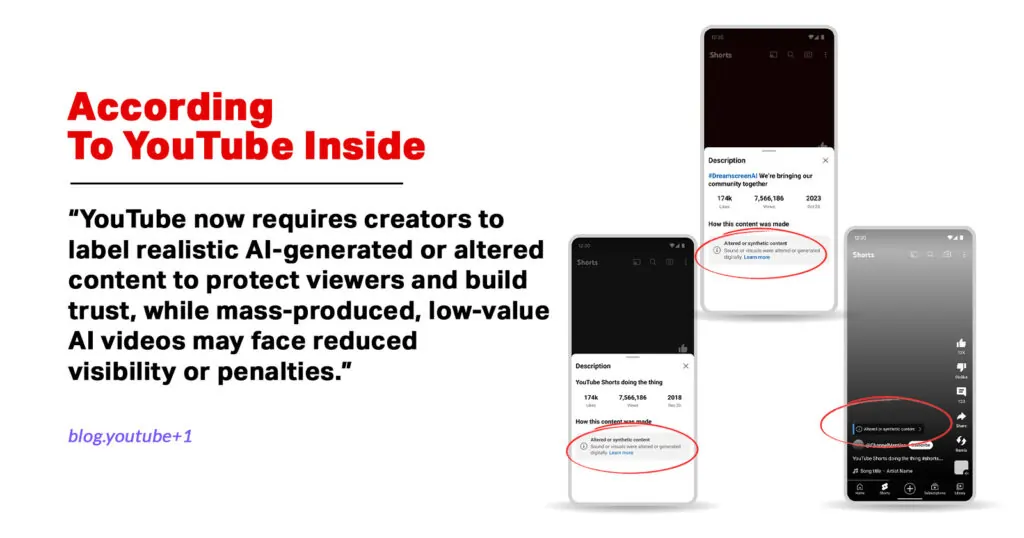
According to YouTube’s own help documentation, creators must disclose content that is meaningfully altered or synthetically generated if it could be mistaken for real footage or narration. This includes deepfakes, AI‑cloned voices, or realistic AI scenes.
When disclosure is required, YouTube will apply a label highlighting that the content includes altered or synthetic elements. Creators who repeatedly fail to disclose might face limited visibility, demonetization, or channel penalties for violating policies.
At the same time, YouTube’s updated Partner Program rules clarify that mass‑produced or repetitious content, especially low‑effort, AI‑driven content without added value, is considered “inauthentic”. Historically, such channels have been ineligible for monetization unless they demonstrate originality and human input.
YouTube AI Content Policy Snapshot
The table below summarizes YouTube’s AI content policies, showing what’s allowed versus what’s restricted.
| Policy Focus | What’s Allowed | What’s Restricted |
|---|---|---|
| AI Tools | Supportive use (research/drafts) | Replacing human judgment entirely |
| Disclosure | Required for realistic synthetic content | Not required for obvious animation or cosmetic edits |
| Monetization | Original content with value | Mass‑produced, repetitive, AI‑only content |
| Viewer Trust | Transparency labels | Misleading deepfakes or deception |
Can Faceless Channels Still Be Profitable Without Losing Trust?
Faceless channels are growing faster than ever, but many creators worry about credibility when using AI. The truth is, you can scale a faceless channel profitably, as long as ethics, quality, and audience trust guide every decision. Cutting corners may boost short-term views, but it risks alienating your audience and triggering algorithm penalties.
Successful faceless channels demonstrate that visibility requires value, consistency, and responsible AI use. Some of the most trusted faceless channels focus on education, tech, finance, or motivation, providing insight without ever showing a human face.
What Builds AI Content Trust in Faceless Channels?
For AI-assisted content to maintain credibility, creators must prioritize accuracy, logical structure, and clear sourcing.
- Accurate information
- Logical structure
- Clear sourcing
- Consistent quality
- Viewer-first intent
Trust is built through clarity and value, not personality. When your content genuinely answers questions better than competitors, viewers won’t mind if AI helped create it.
How Can Creators Stay Faceless and Still Maintain Credibility?
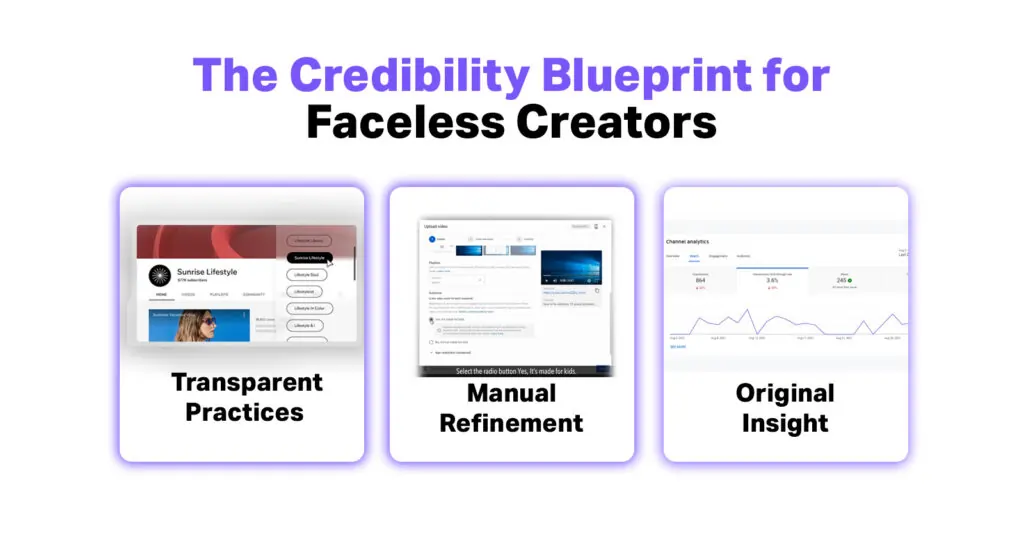
This is where many faceless creators stumble: they assume that hiding their identity allows shortcuts. The truth is, credibility depends on intentional, high-quality execution, not visibility. A successful faceless channel requires clear ethical practices and thoughtful AI use.
Credible Faceless Channels Do These Things
Trustworthy channels disclose when synthetic elements are used and never mislead viewers. AI-generated scripts are always manually edited to add nuance and clarity, and creators consistently include original examples or deeper analysis.
AI serves as a support tool, not a replacement for human judgment. These practices ensure the content delivers real value, maintains engagement, and builds long-term loyalty.
Low-Credibility Channels Do This
Channels with weak credibility often upload raw AI outputs with little or no editing. They reuse scripts across multiple niches, prioritize volume over value, and ignore audience feedback. This approach erodes trust and triggers algorithm penalties.
Faceless Ethics Checklist
Maintaining audience trust requires clear ethical practices and responsible AI use. These principles help ensure that every video provides value and builds long-term credibility:
- No misleading thumbnails that exaggerate content
- No fake authority claims or pretending to be an expert
- Clear educational or entertainment purpose guiding every video
- Human review before publishing to verify accuracy and quality
- AI as a support tool, not a replacement for original thinking
Following these ethics allows creators to remain faceless while producing trustworthy, audience-friendly content that stands out in the algorithm.
What Are the Best Practices for Ethical AI Use on YouTube?
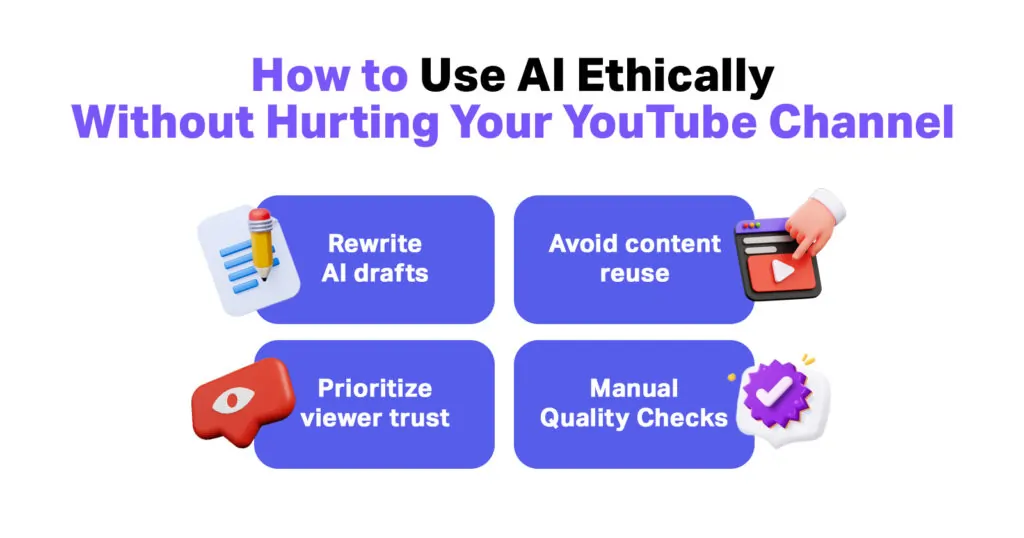
Ethical AI use is about creating with intention, transparency, and viewer-first thinking. AI can accelerate research, generate draft scripts, or suggest visuals, but creators must retain control to maintain quality and trust. Using AI responsibly ensures that your content is both scalable and credible, avoiding the pitfalls of low-quality automation.
Best Practices That Protect Your Channel
Always rewrite AI-generated scripts in your own voice, adding fresh perspectives, examples, or commentary. Avoid publishing repetitive formats or recycled outputs across multiple videos. Optimize every video for human viewers, not the algorithm, focusing on engagement metrics like watch time, retention, and audience satisfaction.
Human review before publishing is essential to catch errors, clarify intent, and maintain ethical standards. Unlike AI slop content, which exists primarily to exploit algorithms with minimal editing and high reuse, ethical AI automation prioritizes audience value, originality, and trust.
Human review, careful scripting, and adding commentary transform AI assistance into a sustainable growth strategy. This approach reduces faceless channel monetization risk and helps maintain credibility, proving that faceless channels can scale responsibly.
Is YouTube Really Cracking Down on Reused AI Content?
Yes, and quietly. YouTube’s system doesn’t always issue explicit warnings. Instead, creators notice sudden drops in impressions, reach, or monetization eligibility. Channels that repeatedly publish reused AI content may gradually lose favor in the algorithm, even if they initially see clicks or short-term engagement.
This is how AI content spam is handled algorithmically. The platform prioritizes trust signals, watch time, and engagement, so low-effort, repetitive content loses visibility over time. Creators relying heavily on reused AI content often think they’re “shadow-banned,” but in reality, the algorithm is deprioritizing videos that fail to deliver value.
This reinforces the point that shortcuts may seem effective in the short term but undermine long-term channel growth, credibility, and monetization potential.
The side effects of low-quality reused AI content include:
- Sudden impression drop
- Reduced reach
- Monetization review delays
How ShortVids Leverages AI to Help Faceless Channels Stay Credible and Profitable
Faceless channels can struggle to scale without sacrificing quality, especially when relying solely on AI-generated content. That’s where ShortVids can provide a strategic edge: instead of relying on low‑quality AI outputs or rushed automation, creators get a dedicated team of editors, script support, pacing optimization, and retention‑focused visuals that help maintain audience engagement and algorithm‑friendly metrics.
ShortVids offers unlimited editing, fast turnaround, and content repurposing so you can publish quality faceless videos without becoming a slave to the editing grind.
Case Study: GreekSpeek Growth with ShortVids
ShortVids partnered with creator Samuel Freeman to streamline his faceless content workflow for the channel Greek.speek. By managing editing, pacing, and retention‑optimized visuals, ShortVids enabled Samuel to publish content consistently while maintaining depth and quality.
This systemized production approach led to significant growth in audience reach and engagement, proving that creators can scale faceless channels efficiently without resorting to low‑value AI slop content.
Your Takeaway!
Faceless channels can still thrive, but shortcuts are no longer invisible. AI slop and cheapfake content might scale uploads, but they erode trust, stunt growth, and risk monetization. The key is to use AI to work smarter, not lazier, focusing on value, clarity, and ethics. ShortVids combines AI-assisted tools with professional human video editing, help creators produce high-quality faceless content consistently without compromising credibility. Stop risking your channel’s reputation and growth with low-effort automation. Contact ShortVids for smart scaling!
Frequently Asked Questions
No. AI content is not banned, but it is allowed if it provides value, originality, and transparency.
Cheapfake content on YouTube refers to low-effort synthetic videos that mislead or recycle AI outputs without transformation.
Yes, they can monetize easily if they avoid AI-slop content and focus on quality, originality, and audience trust.
YouTube increasingly detects behavioral and engagement patterns linked to reused AI content that too, in a quiet way.
Ethical AI use combined with strong editing, originality, and value creation significantly reduces risk.
Book a Call Today
- Fixed monthly plans starting at $999
- 24-hour turnaround time (or less) on all short-form edits
- 3-layer quality check system on every video
- No more chasing freelancers or managing editors
- Scale up to 50+ videos/month without hiring in-house
- Content team trained on platform trends, scroll-stopping hooks & storytelling
- Fully managed by professionals – you just upload & approve
- Response time: Under 1 hour (US & GCC time zones)
Cut your production costs, not your standards.